The network for creativity
Join 1.25M professional creatives like you
Connect with clients, get discovered, and run your business 100% commission-free
Creatives on Contra have earned over $150M and we are just getting started
Back to feedPost
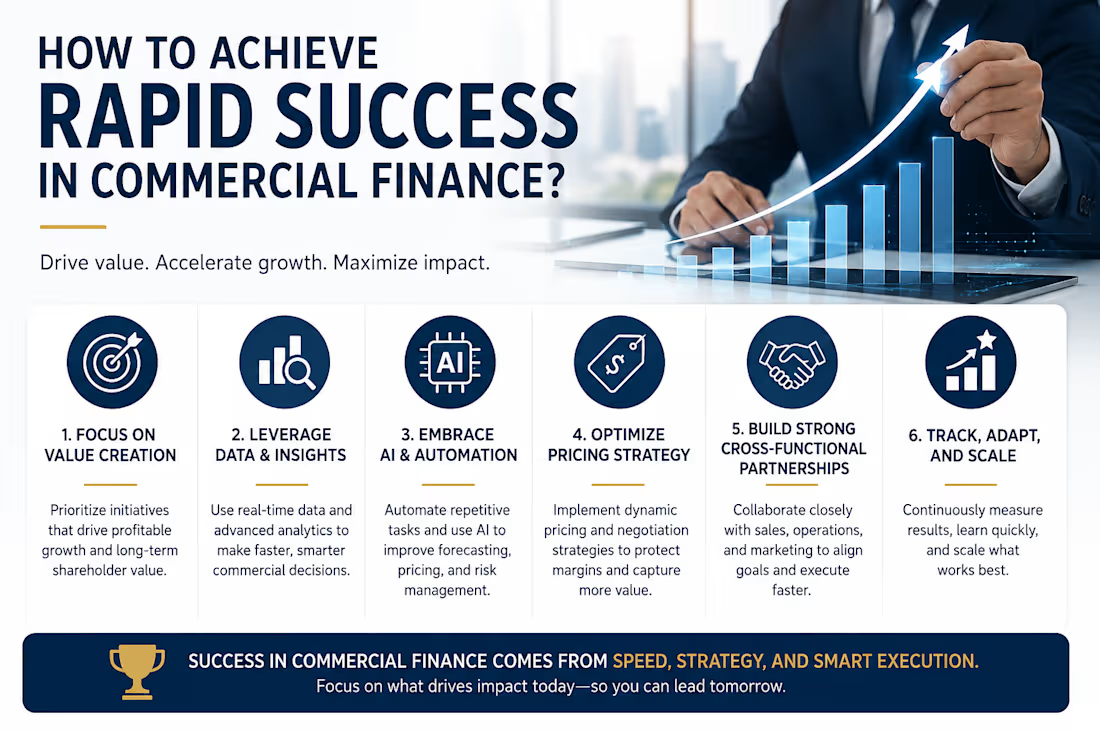
How to Achieve Rapid Success in Commercial Finance
Commercial finance is becoming one of the most important strategic functions inside modern organizations.
The role is no longer limited to budgeting, reporting, forecasting, and explaining financial results. Today, commercial finance leaders are expected to help businesses grow revenue, protect margins, improve cash flow, optimize pricing, and make better decisions faster.
But how can professionals and organizations achieve rapid success in this environment?
The answer is not simply working harder or producing more financial reports. Rapid success comes from connecting financial intelligence with commercial action.
1. Start With Profitable Growth
The first step is to stop treating revenue growth as the only measure of success.
A business can increase sales while profitability declines because of discounting, rising costs, poor customer mix, or inefficient operations.
Commercial finance should therefore focus on questions such as:
Which customers generate the strongest margins?
Which products create the most value?
Where are discounts reducing profitability?
Which markets deserve additional investment?
Which revenue opportunities generate sustainable cash flow?
The objective is simple:
Grow revenue—but make sure the growth creates economic value.
2. Turn Data Into Decisions
Modern commercial finance teams have access to enormous amounts of financial, customer, operational, and market data.
The competitive advantage comes from turning that information into decisions.
Instead of producing reports that only explain what happened last quarter, finance teams should provide insights that answer:
What is happening? Why is it happening? What happens next? What should we do about it?
This requires stronger data integration, reliable performance metrics, and clear communication with commercial leadership.
3. Make Pricing a Financial Strategy
Pricing can have a significant impact on profitability.
A small improvement in realized pricing can sometimes create more value than a large increase in sales volume—particularly when additional volume requires higher acquisition, fulfillment, or service costs.
Commercial finance should work closely with sales and revenue-management teams to evaluate pricing by:
Customer segment
Product
Geography
Channel
Volume
Discount level
Contribution margin
The goal is not simply to increase prices.
The goal is to capture the value the company creates.
4. Use AI to Increase Decision Speed
Artificial intelligence is changing how finance teams operate.
AI can support forecasting, scenario analysis, anomaly detection, management reporting, pricing analysis, and working-capital monitoring.
However, the greatest opportunity is not automation for its own sake.
The real advantage is decision speed.
A finance team that can identify a margin problem today rather than at the end of the quarter has a significant strategic advantage.
AI should therefore be viewed as a decision-support capability that strengthens financial judgment—not as a replacement for it.
5. Protect Cash Flow
Profitability and cash flow are closely connected, but they are not the same.
Rapid growth can consume cash through higher inventory requirements, longer customer payment cycles, increased staffing, and additional capital expenditure.
Successful commercial finance teams continuously monitor:
Accounts receivable.
Inventory.
Payment terms.
Working capital.
Capital expenditure.
Operating cash flow.
A strong growth strategy should answer two questions:
How much profit will this opportunity generate?
and
How much cash will we need to support it?
6. Build Strong Relationships With Commercial Teams
Finance cannot create rapid business impact while operating in isolation.
The most effective commercial-finance professionals build strong relationships with sales, marketing, operations, procurement, and executive leadership.
They understand the commercial reality behind the numbers.
Instead of simply saying:
“The margin is declining.”
they help explain:
“Margin is declining because customer discounts increased, product mix shifted, and fulfillment costs rose. Here are three actions that could reverse the trend.”
That is the difference between financial reporting and financial leadership.
7. Focus on a Small Number of High-Impact Metrics
More metrics do not necessarily create better decisions.
Commercial finance should identify the indicators that genuinely influence business performance.
Depending on the organization, these may include:
Revenue growth
Gross margin
Contribution margin
Customer profitability
Price realization
Customer acquisition cost
Working capital
Operating cash flow
Forecast accuracy
Return on invested capital
The goal is to create a clear performance system where leadership can quickly understand what is working and what requires intervention.
8. Develop Scenario-Based Thinking
Markets can change quickly.
Interest rates, customer demand, input costs, competition, regulation, and technology can all affect financial performance.
Instead of relying on a single forecast, commercial finance teams should develop multiple scenarios.
For example:
Base case: Expected business performance.
Upside case: Stronger demand, better pricing, or improved margins.
Downside case: Lower demand, higher costs, or weaker customer retention.
Scenario planning allows executives to prepare before conditions change rather than reacting after the impact appears in financial statements.
9. Communicate Finance in Business Language
One of the fastest ways to increase influence is to communicate financial information clearly.
Executives and commercial teams generally do not need more complicated spreadsheets.
They need answers.
A strong finance leader can translate financial analysis into business language:
What happened?
Why did it happen?
What is the financial impact?
What should we do next?
When finance communicates this way, it becomes easier for the organization to act on financial insights.
10. Create a Culture of Continuous Improvement
Rapid success is rarely the result of one major initiative.
It usually comes from continuous improvements across pricing, forecasting, cost management, customer profitability, working capital, and capital allocation.
The strongest commercial finance organizations constantly ask:
Can we forecast better?
Can we price smarter?
Can we reduce unnecessary costs?
Can we convert revenue into cash faster?
Can we identify profitable opportunities earlier?
This mindset transforms finance from a reporting department into a continuous source of business improvement.
The Formula for Rapid Commercial Finance Success
Rapid success in commercial finance ultimately comes from combining several capabilities:
Better data + faster analysis + commercial understanding + disciplined execution = stronger financial performance.
Technology can accelerate analysis.
AI can improve speed.
Data can improve visibility.
But leadership determines whether those capabilities translate into results.
The most successful commercial finance professionals will be those who can connect financial discipline with commercial opportunity.
They will understand that the purpose of finance is not simply to explain yesterday's numbers.
It is to help the business make better decisions today that create greater value tomorrow.
The Bottom Line
Commercial finance is entering an era where speed, profitability, data, AI, pricing, and cash flow are increasingly interconnected.
Organizations that want rapid success should stop viewing finance as a function that only measures performance.
Finance should help create performance.
The winning commercial-finance model is therefore not:
Revenue → Reporting → Review
It is:
Data → Insight → Decision → Action → Profitable Growth
That is how commercial finance can move from being a financial support function to becoming a genuine engine of sustainable business growth.
https://www.24-7pressrelease.com/press-release/533973/sergio-p-mendes-shares-a-practical-framework-for-turning-data-into-decisions
https://about.me/sergio.p.mendes
https://finance.yahoo.com/economy/policy/articles/sergio-p-mendes-highlights-data-180000112.html

This is a strong perspective on how commercial finance is evolving from a reporting function into a true business-growth partner. I especially agree that profitable growth, pricing discipline, AI-enabled decision-making, and cash-flow management need to work together. The shift...

Excellent perspective on the evolution of commercial finance. I strongly agree that the greatest impact comes from moving beyond reporting historical performance to actively shaping profitable growth through pricing, customer profitability, cash-flow optimization, and...
The network for creativity
Join 1.25M professional creatives like you
Connect with clients, get discovered, and run your business 100% commission-free
Creatives on Contra have earned over $150M and we are just getting started
Trending
retrofuturism
Share your favorite designs from the past exploring the distant future. Or your own take on the aesthetic 🚀
halftone
Dots. Texture. Grain. Let's see your designs using the halftone technique.

Midjourney
Creatives are showing off what they're making with Midjourney.
colorgrade
Video editors sound off: How do you enhance the mood of your video in color grading?





Related posts

How Commercial Finance Can Turn Revenue Growth Into Real Income
In today’s competitive business environment, increasing revenue is only part of the challenge. The bigger question is: Are we converting that revenue into sustainable profit and stronger cash flow?
As a VP of Commercial Finance and Revenue Management, I see commercial finance as the connection between financial strategy, pricing, customer value, and business growth.
A company can generate millions in additional sales and still underperform if pricing is too aggressive, customer acquisition costs are rising, discounts are uncontrolled, or low-margin revenue is consuming valuable resources.
The real opportunity is to focus on profitable growth.
That means:
• Analyzing revenue and margin by customer, product, and market
• Improving pricing and discount strategies
• Identifying the most profitable revenue channels
• Strengthening forecasting and financial planning
• Connecting sales targets with realistic profitability goals
• Turning financial data into decisions that improve cash flow and income
For businesses in competitive markets like Norwalk and the broader New York–Connecticut region, finance leaders have an increasingly important role: not simply reporting what happened, but helping management decide what should happen next.
Revenue management should ultimately answer three questions:
Where is the money coming from?
Where is profit being lost?
What decisions can create more profitable income?
The strongest commercial finance organizations do more than protect the bottom line. They help build a business model where growth, margin, and cash generation work together.
#CommercialFinance #RevenueManagement #FinancialStrategy #Profitability #RevenueGrowth #FPandA #BusinessFinance #FinanceLeadership

Revenue growth is valuable only when it creates sustainable profit and stronger cash flow. Commercial Finance helps businesses connect pricing, customer value, margins, forecasting, and strategic decision-making to achieve profitable growth. The focus should not simply be on...
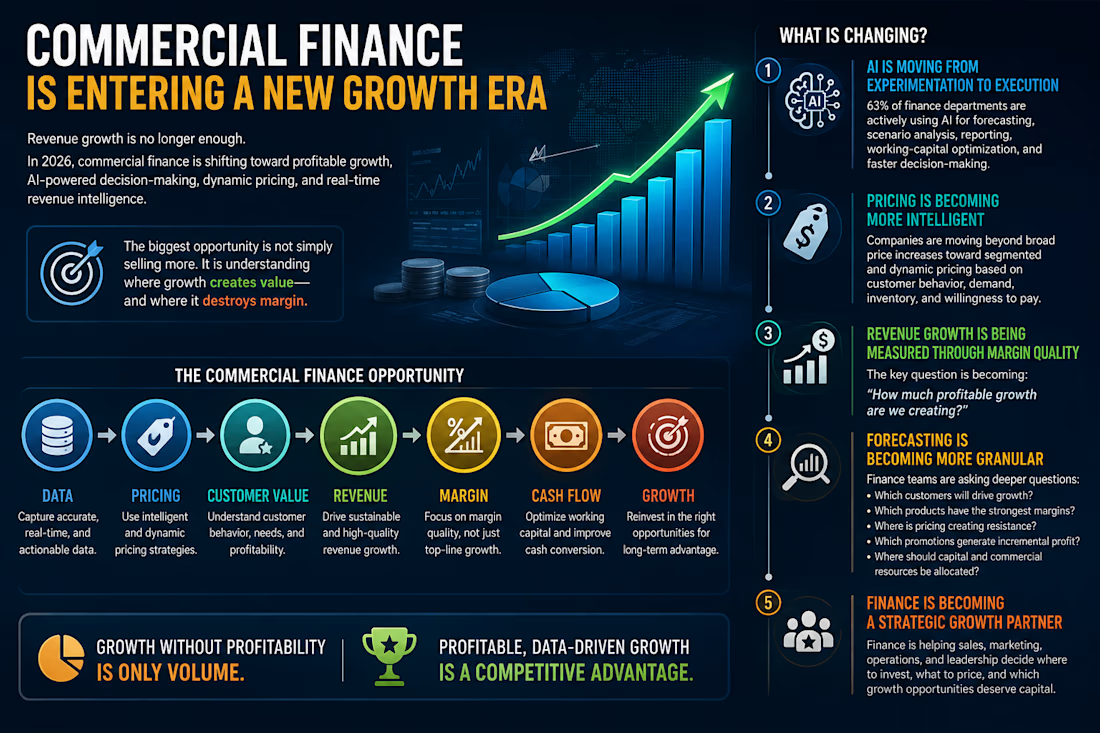
:Commercial Finance Is Entering a New Growth Era
Revenue growth is no longer enough.
In 2026, the direction of commercial finance is increasingly shifting toward profitable growth, AI-powered decision-making, dynamic pricing, and real-time revenue intelligence.
The biggest opportunity is not simply selling more. It is understanding where growth creates value—and where it destroys margin.
What is changing?
1. AI is moving from experimentation to execution
Finance teams are using AI for forecasting, scenario analysis, reporting, working-capital optimization, and faster decision-making. Deloitte reports that 63% of surveyed finance departments are actively using AI solutions.
2. Pricing is becoming more intelligent
Companies are moving beyond broad price increases toward segmented and dynamic pricing based on customer behavior, demand, inventory, and willingness to pay.
3. Revenue growth is being measured through margin quality
The key question is becoming:
“How much profitable growth are we creating?”
Commercial finance leaders increasingly need to connect revenue, pricing, customer profitability, cost-to-serve, and cash flow—not analyze them separately.
4. Forecasting is becoming more granular
Instead of asking only, “What will revenue be next quarter?”, finance teams are increasingly asking:
Which customers will drive growth?
Which products have the strongest margins?
Where is pricing creating resistance?
Which promotions generate incremental profit?
Where should capital and commercial resources be allocated?
5. Finance is becoming a strategic growth partner
The modern commercial finance function is moving beyond reporting historical performance. It is helping sales, marketing, operations, and leadership decide where to invest, what to price, and which growth opportunities deserve capital. PwC describes CFOs as increasingly acting as enterprise strategists and architects of transformation.
The commercial finance opportunity
The future belongs to organizations that can connect:
Data → Pricing → Customer Value → Revenue → Margin → Cash Flow → Growth
That is the real evolution of commercial finance.
Growth without profitability is only volume.
Profitable, data-driven growth is a competitive advantage.
#CommercialFinance #RevenueManagement #Profitability #PricingStrategy #FP&A #FinancialStrategy #AI #BusinessGrowth #RevenueGrowth #CFO
Linked pages:https://www.sergiomendesnorwalkct.com/
https://www.24-7pressrelease.com/press-release/533973/sergio-p-mendes-shares-a-practical-framework-for-turning-data-into-decisions
https://about.me/sergiomendes

Ledgr - Finance Platform Landing Page
Streamline your finances and unlock growth with Ledgr. This landing page design reimagines accounting software for modern SaaS businesses, transforming complex data into a clear, actionable, and visually engaging experience.
Key Features:
🔹 Instant Setup - Users can quickly get started, integrating their financial data in minutes without the need for experts.
🔹 Automated Insights - Real-time metrics and financial summaries for smarter decisions.
🔹 Minimalist Design - Clean, modern UI with a focus on simplicity and usability.
🔹 Interactive Elements - Easy-to-navigate flow with clear CTAs to guide users through their journey.
This design perfectly balances functionality and aesthetics, ensuring users can engage easily and find exactly what they need. Whether you're a startup in the financial tech industry or a seasoned SaaS company, this landing page will set your brand apart.




Beautiful work all around 🔥