The network for creativity
Join 1.25M professional creatives like you
Connect with clients, get discovered, and run your business 100% commission-free
Creatives on Contra have earned over $150M and we are just getting started
Back to feedPost

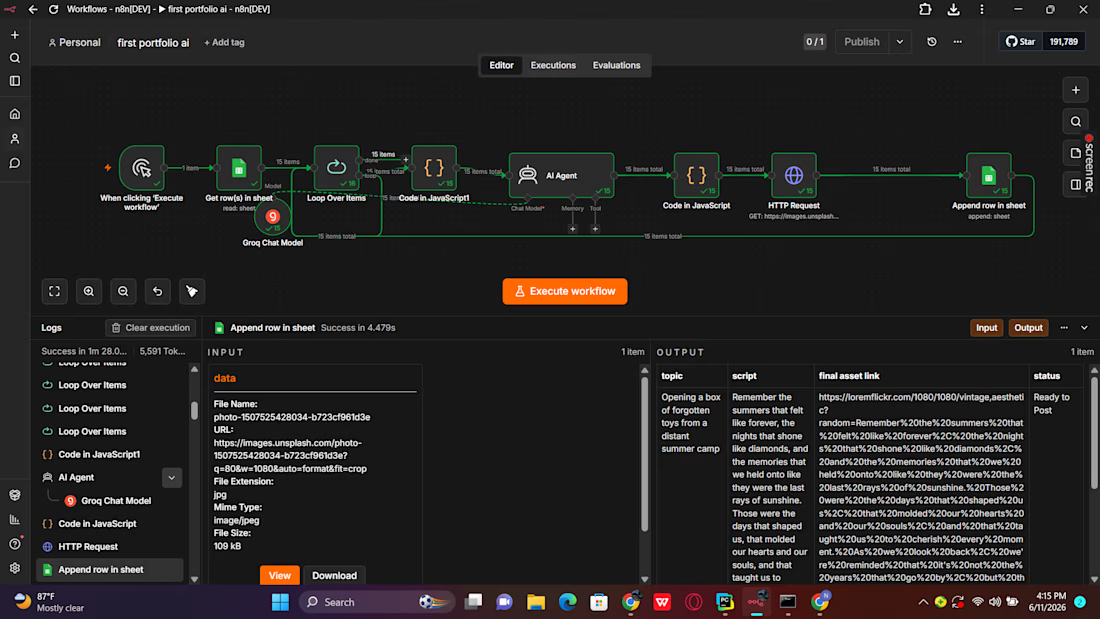
AI Content Pipeline — Automated with n8n
An end-to-end automation that pulls data from Google Sheets, generates content using AI, and writes the results back automatically — no manual steps required. Built with n8n and integrated AI generation.


The network for creativity
Join 1.25M professional creatives like you
Connect with clients, get discovered, and run your business 100% commission-free
Creatives on Contra have earned over $150M and we are just getting started











Related posts

FLEXWEAR - From Pharaohs to LA
I created a 30s cinematic brand story for FLEXWEAR that bridges ancient Egyptian heritage with modern LA streetwear culture.
The concept: An Ankh (key of life) opens a portal from a Pharaonic tomb in Egypt to the Hollywood hills of Los Angeles. The protagonist wears a FLEXWEAR hoodie with a golden Ankh, symbolizing that heritage is not history - it's wearable identity.
Built entirely in CapCut AI (Studio + AI Video Generator) - from text-to-video, temple reconstruction, portal VFX, and final color grading.
Tags: #capcutworldlachallenge #WelcomeToLA #CCW #FLEXWEAR #FromPharaohsToLA
Clean export, no watermark, 1080p, original concept for CapCut World LA Challenge.


If you’re a Creative in 2026, you should wake up every morning and Say “Thank You Ai “. 😂
Imagine a client wants a premium, animated website, but she only has 2 or 3 images.
A few years ago, you’d probably have to wait for her to organize another photoshoot, get more brand assets, or find a way to work with what you have.
But today? Give me just 2 good images and AI. 😂
I can create different product angles, lifestyle shots, campaign visuals, and all the assets needed to make that website look like the brand spent thousands on photography.
And the best part? The client doesn’t need to spend extra money on another photoshoot.
AI has genuinely changed the way we work
Of course, you still need good design skills and creative direction. AI won’t magically give you good taste.
But the possibilities we have today? Insane.
If you’re still refusing to learn AI as a creative in 2026, you’re making your own work unnecessarily difficult.
Btw this was built with Claude opus 5.5 + Higgsfield AI for the visuals

$15,000 from one browser game takes 1 to 15 million plays.
I did the math because my first web game, built with Claude Code, went live on CrazyGames today.
Bolt Pit is a Three.js arena shooter. It has earned $0 so far, because CrazyGames keeps ads off during the Basic Launch test, which runs until November 5.
Only games with good numbers get a Full Launch, and that's where the ad revenue share starts.
The formula:
Revenue = sessions × ads per session × eCPM ÷ 1,000 × your share
eCPM is what advertisers pay per 1,000 ads. CrazyGames allows at most one midgame ad every 3 minutes. The share isn't public, and reports range from 40% to 60%, so I used 50%. The rest are my assumptions, based on reported ad rates:
Low: 1 ad per session, $2 eCPM = $1 per 1,000 plays. You need 15 million plays.
Mid: 2 ads, $5 eCPM = $5 per 1,000 plays. You need 3 million plays.
High: 3 ads, $10 eCPM = $15 per 1,000 plays. You need 1 million plays.
One developer reported about €1.20 per 1,000 CrazyGames plays across eight older games. That's the low case, so I plan around the middle at best.
Is 3 million plays realistic?
CrazyGames reported 320 million play sessions a month this October. Poki says it has 100 million players a month. The players exist. Retention and session length decide which line you land on.
That's the bigger reason I'm here. I have Unity games in progress that were meant for the App Store. On the App Store, I'd only find out if people come back after paying for players.
So the new plan is web first, App Store later:
Launch on CrazyGames and Poki, where test players are free.
Tune retention and session length on real data.
If a game becomes a hit on the web, take it to the app stores.
Both portals' exclusivity rules cover only the web, so the app stores stay open.
I'm also skipping CrazyGames' exclusivity bonus. It pays 50% more for two months if your game stays off other web portals, and I want to test on Poki too.
Getting a Claude Code build accepted took six fixes, including a static build, relative paths, no Google Fonts and cutting the size from 20.5 MB to 12.4 MB. One known bug is still live: on landscape phones the start button sits below the fold.
I'll post the real numbers as they come in. Play it here:
https://crazygames.com/game/bolt-pit
