The network for creativity
Join 1.25M professional creatives like you
Connect with clients, get discovered, and run your business 100% commission-free
Creatives on Contra have earned over $150M and we are just getting started
Back to feedPost

The Life of Eirene — A Musical in Seven Acts
What if Peace could remember everything humanity had done in her name?
My first reaction to The Met's marble statue of Eirene was the irony of it.
Here was a woman created to personify Peace—now headless, fragmented, and broken.
That contradiction was what initially drew me to her.
After watching Sasha's challenge walkthrough and seeing how they developed the inspiration behind their own piece, I started thinking beyond simply reimagining what Eirene might look like. I began thinking about the different ways humans have defined peace—and, more importantly, how we teach those definitions to the generations that come after us.
We do that through stories.
And throughout history, one of the ways we've told those stories is through music. Music carries traces of the people who created it: their beliefs, cultures, religions, conflicts, celebrations, fears, and ordinary lives.
So I thought: Why not turn Eirene's story into a musical?
That became The Life of Eirene, a fictional musical in seven acts:
Prosperity → Victory → Faith → Order → Freedom → Community → Peace Is ______
Each generation believes it understands what peace requires. Each changes Eirene according to that belief—and the generation that follows inherits what was left behind.
Building Eirene's world
I developed the project inside FLORA as an accumulating world rather than a single reimagined image.
I experimented with different generations of Eirene and explored additional Open Access works and musical instruments from The Met's collection as inspiration for the world surrounding her.
From there, the idea grew into an entire fictional production: I developed The Kora Fire as the musical's band, explored its instruments and musical language, designed the stage, created promotional material, and eventually wrote the seven-act script itself.
One of the most important creative rules became:
Nothing completely resets.
The stage remembers.
A banquet table can become a barricade and eventually a workbench. Decorations meant to comfort Eirene can cover old wounds. A repair intended to protect her can become a restraint. When that restraint is removed, its marks remain.
The music remembers too.
Eirene carries a recurring musical motif through the production, but each generation transforms it according to its own idea of peace—sometimes a lullaby, sometimes a march, a hymn, something rigid, something liberated, and eventually something shared.
And Eirene remembers most of all.
Every crack, repair, decoration, restraint and restoration becomes part of the version inherited by the next generation.
From fixing Peace to caring for her
As I worked through the different generations, the question behind the project began to change.
At first, I was asking:
How would each generation define—and therefore rebuild—Peace?
But by the time I reached Community, I became more interested in another possibility:
What if Peace doesn't need each generation to completely redefine or perfect her? What if our responsibility is to care for what we've inherited, learn from the marks already there, and consider what we're leaving for the people who come next?
That became the emotional center of the musical.
The final performance
For the final piece, I wanted to take the world-building one step further.
Instead of making a polished image of the fictional musical, I wanted it to feel as though The Life of Eirene had actually been performed.
So I created its climax from the perspective of someone sitting in the audience who happened to pull out their phone at exactly the right moment.
Every generation converges around Eirene.
She isn't restored to perfection. She carries them all—the cracks, repairs, restraints, decorations, and remnants of everything humanity has asked Peace to represent.
And then the generations disappear.
Eirene remains, carrying Ploutos once again.
The musical ends without completing its final sentence:
PEACE IS ______
Because there isn't a single definition we can leave behind.
Perhaps every generation inherits someone else's attempt at peace, adds something of its own, and eventually passes the unfinished question forward.
Built with FLORA
The network for creativity
Join 1.25M professional creatives like you
Connect with clients, get discovered, and run your business 100% commission-free
Creatives on Contra have earned over $150M and we are just getting started


Related posts

A website hero and motion identity concept for Cycle.
The experience takes the viewer through seven historical eras in one continuous forward journey, while the logo, camera path and core composition remain consistent.
The concept explores how a static identity can become a living digital experience through motion, environment and interaction.
Workflow included Spline, Claude via MCP, Midjourney and SeaDance.
Available for brand identity, motion and digital design projects.


I fall in love, It is like Encarta, but 1000% better

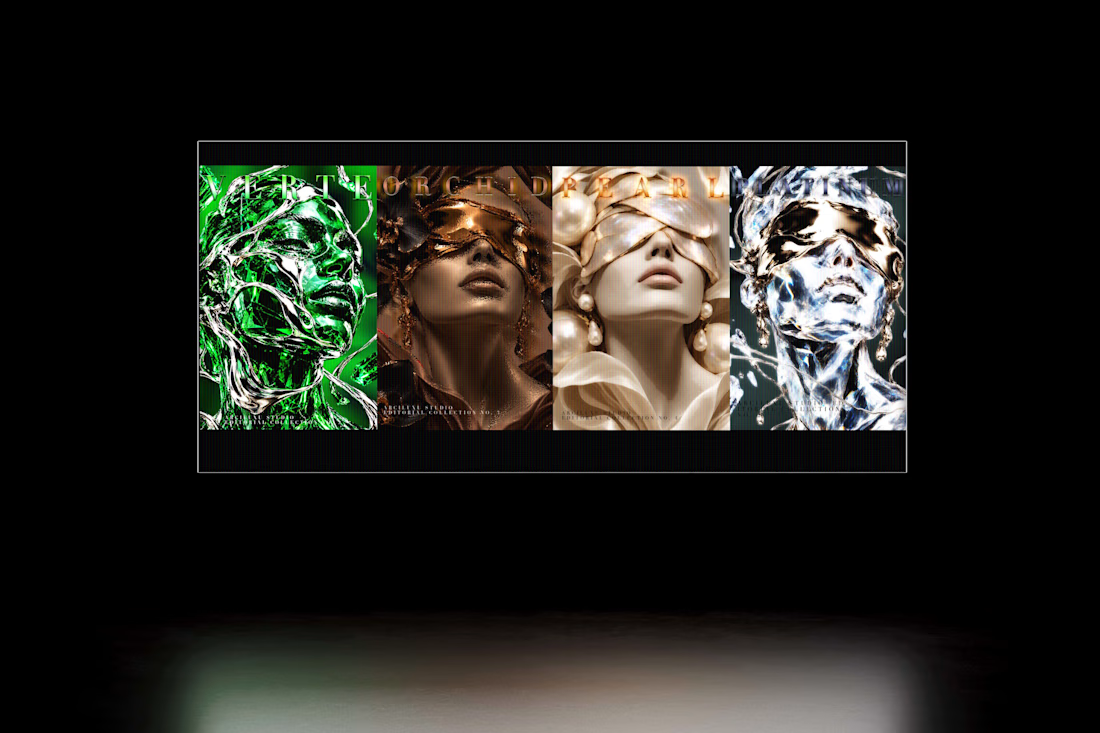
An experimental digital art collection exploring the intersection of futuristic aesthetics, sculptural forms, and luxurious material design. The project combines liquid chrome, emerald glass, metallic textures, and refined pearlescent surfaces to create a series of striking visual compositions. Each artwork explores the interplay of light, reflections, depth, and contrasting materials, bringing together cyberpunk influences, avant-garde fashion, and high-end editorial aesthetics. The result is a cohesive collection of sophisticated digital visuals that merges artistic experimentation with contemporary luxury design. Created as a personal creative project using AI-assisted visual generation and digital art direction.


Very nice

I wanted to bring some of that energy into a motion piece for POLIDO. A butterfly moving through different visual styles, with the music setting the pace.
Made in Blender. Had a lot of fun with this one.
What game has had the biggest influence on your taste in art?

Nice colors in butterfly 🦋