The network for creativity
Join 1.25M professional creatives like you
Connect with clients, get discovered, and run your business 100% commission-free
Creatives on Contra have earned over $150M and we are just getting started
Back to feedPost

We help when backend pieces are unclear, fragile or already in production.
E.g. payments, order flows, ERP/API connections and updates that need to be handled carefully.
Recent examples include:
* a first-time Woo to Shopify payment gateway, now stable in production
* an ERP XML to MS SQL Server bridge built from undocumented specs and handed over as maintainable system
Typical entry points are small and contained:
fixing or extending an existing integration,
handling a plugin/update issue or taking ownership
of a backend task during a busy sprint.
Available now.
The network for creativity
Join 1.25M professional creatives like you
Connect with clients, get discovered, and run your business 100% commission-free
Creatives on Contra have earned over $150M and we are just getting started





Related posts

NetworkAI — AI-Powered Campus Network Monitoring System
A real-time network monitoring dashboard designed to help campus IT teams observe network health, monitor interfaces, and identify potential issues from a single interface.
What I built
Real-time network monitoring with live interface and system status
Network interface analytics showing traffic and connection activity
Historical monitoring data for analyzing network behavior over time
Live WebSocket communication for continuously updated monitoring data
Network controls to start and stop monitoring directly from the dashboard
Interactive charts and visualizations for easier interpretation of
network metrics
Responsive dashboard UI designed for clear monitoring rather than unnecessary complexity
FastAPI backend providing REST APIs and WebSocket communication
React frontend with a modern monitoring-focused interface
Why I built it
The goal was to create a practical campus network monitoring system that demonstrates how real-time networking data can be collected, processed, and presented through a modern web interface.


cool project bro. live data + history in one place is useful. how do you handle reconnecting when the websocket drops?

PlayNest — Handcrafted Wooden Toys & Play Equipment.
PlayNest is a modern, high-performance, full-stack E-Commerce platform built for selling handcrafted indoor wooden jungle gyms, Swedish walls, and Montessori educational toys.
Live Url: https://playnest-store.vercel.app/



For wall-mounted play equipment, dimensions and mounting requirements would be the first things I’d check. Are those part of the product pages, or handled when the customer contacts you?

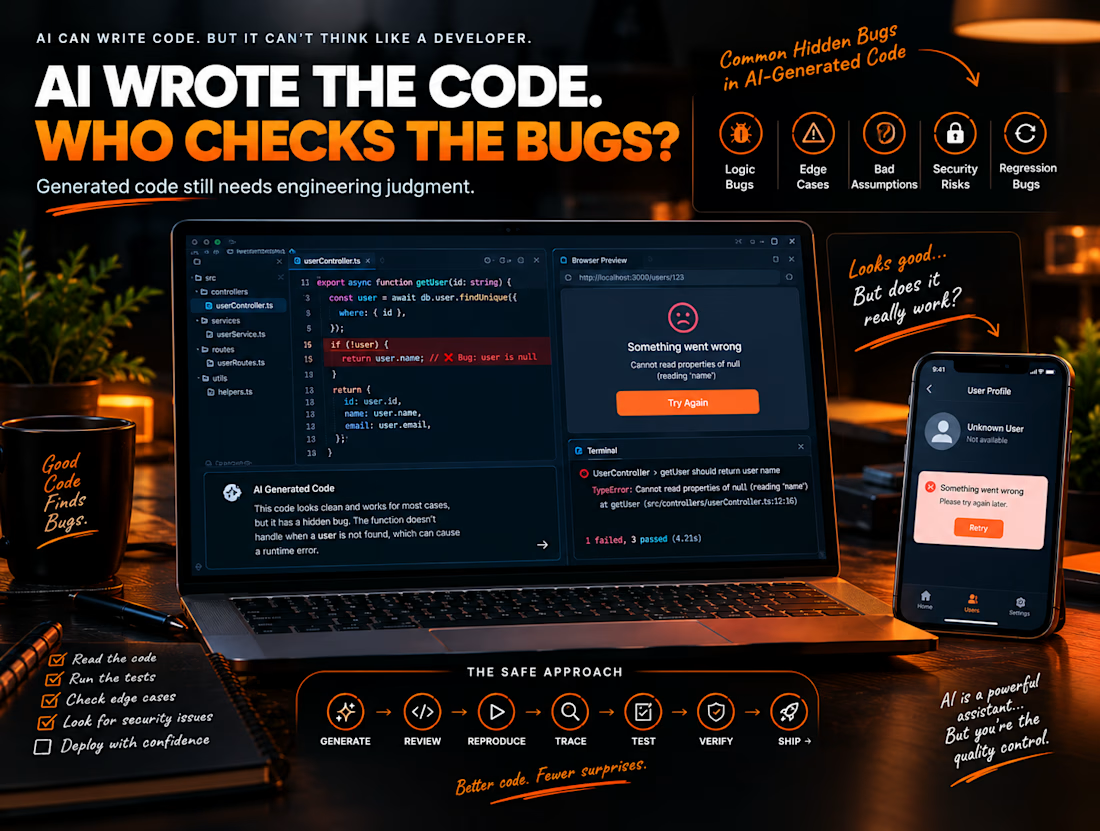
AI WROTE THE CODE. WHO CHECKS THE BUGS?
AI can generate a working-looking feature in seconds but “it runs” doesn't automatically mean “it's correct.”
One of the biggest lessons I’m learning with AI-assisted development is that the hardest bugs aren't always obvious. They can hide in:
🐛 Edge cases the original prompt never mentioned
🧠 Incorrect assumptions about how the application should behave
🔐 Security issues that don't appear during normal testing
🔄 Regression bugs that break something that previously worked
⚠️ Poor error handling when real users do unexpected things
🗄️ Data/API problems that only appear under different conditions
That’s why I don't treat AI-generated code as the final answer.
My workflow is:
GENERATE → REVIEW → REPRODUCE → TRACE → TEST → VERIFY → SHIP
First, I understand what the code is actually doing.
Then I test the happy path and the paths the AI may not have considered.
I check the stack trace, inspect the data flow, test edge cases, review dependencies and security-sensitive areas, and verify that the fix doesn't introduce another problem.
This is becoming even more important as coding agents take on larger development tasks. GitHub's current tooling, for example, combines code review, testing, dependency checks, secret scanning, and security analysis around agent-generated changes.
The lesson isn't “don't use AI to code.



“It runs” vs “it’s correct” is the gap — AI-generated features need the same edge-case passes you’d do on junior dev output, just faster to produce.