The network for creativity
Join 1.25M professional creatives like you
Connect with clients, get discovered, and run your business 100% commission-free
Creatives on Contra have earned over $150M and we are just getting started
Back to feedPost

The Canvas That Dreams Backward
Melius Project:
Melius Project Link
LinkedIn Post:
LinkedIn
X Post:
X
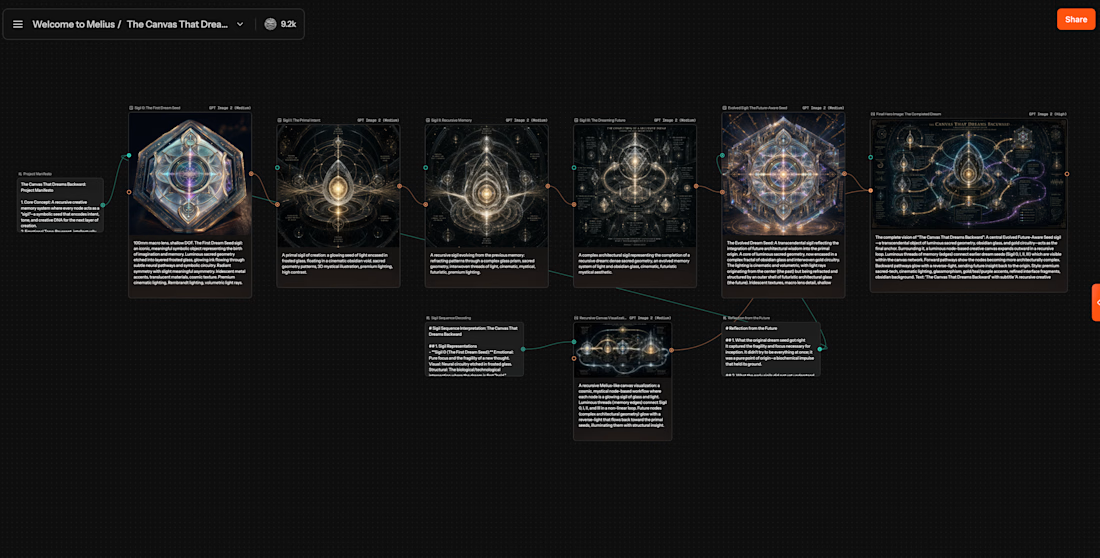
For the Melius Challenge, I built “The Canvas That Dreams Backward,” a recursive creative workflow where each node becomes a sigil for the next.
The core idea is simple:
What if creative workflows didn’t just generate more — what if they remembered why they began?
Instead of treating each node as only a prompt or output, I treated every node as a symbolic memory object. Each sigil compresses the emotional tone, visual meaning, creative DNA, and intent of that stage. The next node then inherits that symbolic memory and evolves it further.
As the workflow grows, future nodes reflect backward and send insight to earlier nodes, allowing the original dream seed to evolve without losing its soul.
This project is not just a collection of generated images. It is a prototype for a future creative memory system.
The workflow includes:
Project Manifesto
The starting point that defined the creative thesis, emotional tone, symbolic motifs, and continuity rules.
Sigil 0: The First Dream Seed
The origin image — a symbolic anchor for the first spark of the idea.
Sigil I: The Primal Intent
The first expansion of the dream seed into focused creative direction.
Sigil II: Recursive Memory
A more complex sigil representing the project beginning to remember itself.
Sigil III: The Dreaming Future
The evolved future state of the sigil system.
Sigil Sequence Decoding
An agent interpretation node that decoded the symbolic evolution across the sigils.
Recursive Canvas Visualization
A system-level image showing how sigil-based creative nodes could function as a future Melius-style workflow.
Reflection from the Future
A future-facing agent node that looked backward and identified what earlier nodes should learn from the completed system.
Evolved Sigil: The Future-Aware Seed
A matured version of the original dream seed after receiving insight from the future.
Final Hero Image: The Completed Dream
The final visual artifact showing the entire recursive system.
The canvas layout itself is also part of the concept. I arranged the workflow with a subtle echo-flow inspired by whale song, sound, vibration, memory, and recursive calling through depth. From a distance, the canvas suggests a living symbolic organism. Up close, it functions as a readable node-based creative memory system.
A key practical idea that emerged from this build is the canvas as memory core.
In this model, the canvas is more than a production board. It becomes a persistent visual framework where nodes, sigils, images, prompts, reflections, and outputs become linked continuity anchors.
I started calling this an “imagechain.”
An imagechain is not a blockchain. It is a chain of symbolic visual states where each image, sigil, or output becomes a memory-linked checkpoint for the next stage of creation.
This could support practical creative workflows such as:
Brand continuity systems
Film and storyboarding workflows
Video editing memory frameworks
UX and product design systems
Creative operations across multiple agents and collaborators
Campaign generation and localization
Software planning and design architecture
Personal knowledge and reflection systems
In a software context, this does not replace frameworks like MVC. Instead, it suggests a parallel visual continuity layer: a way to preserve symbolic intent, design DNA, emotional tone, and narrative coherence across outputs, interfaces, code, media, and future iterations.
What Melius made possible here was the ability to treat the canvas itself as the artifact.
The agents were not only used to generate outputs. They helped define the manifesto, decode the symbolic sequence, reflect backward from the future state, refine the baseline, and package the final submission. There were moments where the agent had to reassess and reorient the workflow, and that became part of the proof-of-concept: reference sigils helped stabilize the system so it could continue forward with stronger continuity.
That is the larger idea behind this submission:
I used Melius to demonstrate a new creative pattern — the canvas as memory core, where every node becomes a sigil, every sigil becomes a continuity anchor, and every future output can send insight backward to preserve the original dream.
Melius already gives creators the primitives: agents, nodes, edges, references, images, and iteration. This project explores what happens when those primitives are used not only for generation, but for recursive intent preservation.
I didn’t build a single asset.
I built a creative memory model.
#MeliusChallenge #Melius #GenerativeAI #AIAgents #CreativeAI #DesignSystems #CreativeWorkflows



The network for creativity
Join 1.25M professional creatives like you
Connect with clients, get discovered, and run your business 100% commission-free
Creatives on Contra have earned over $150M and we are just getting started
Related posts


Wow, this is cool

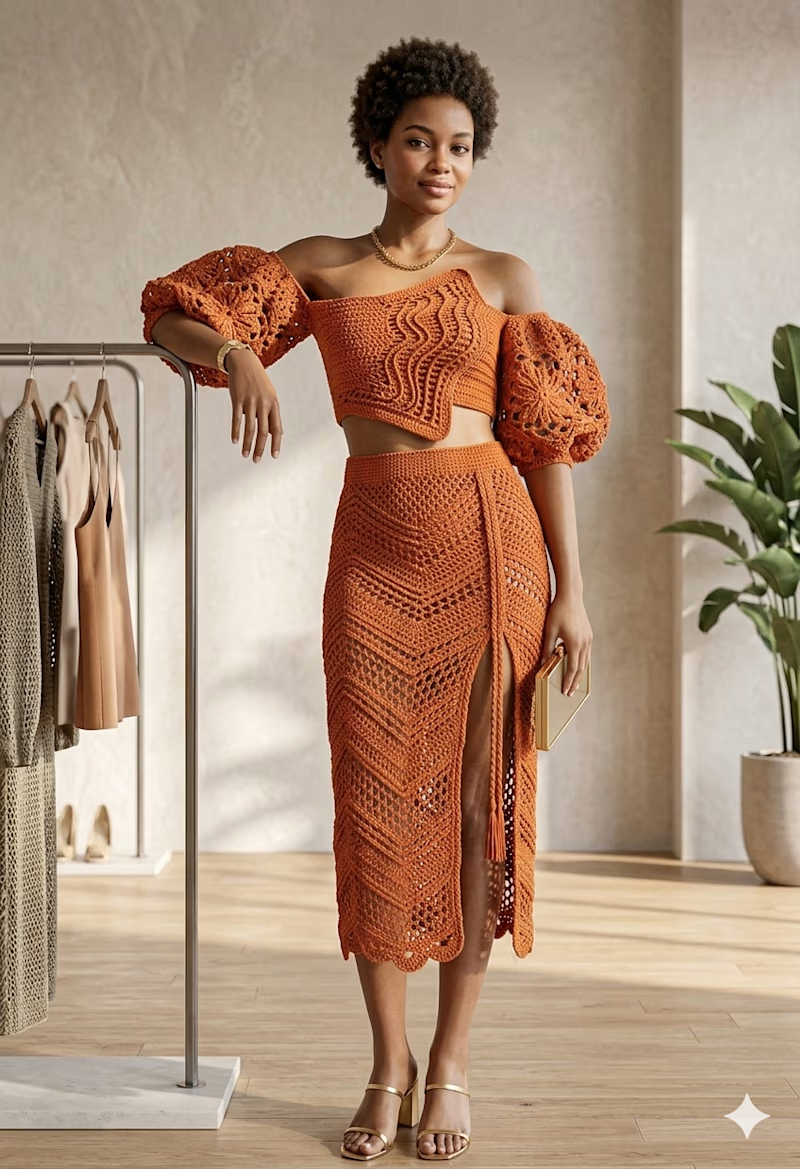
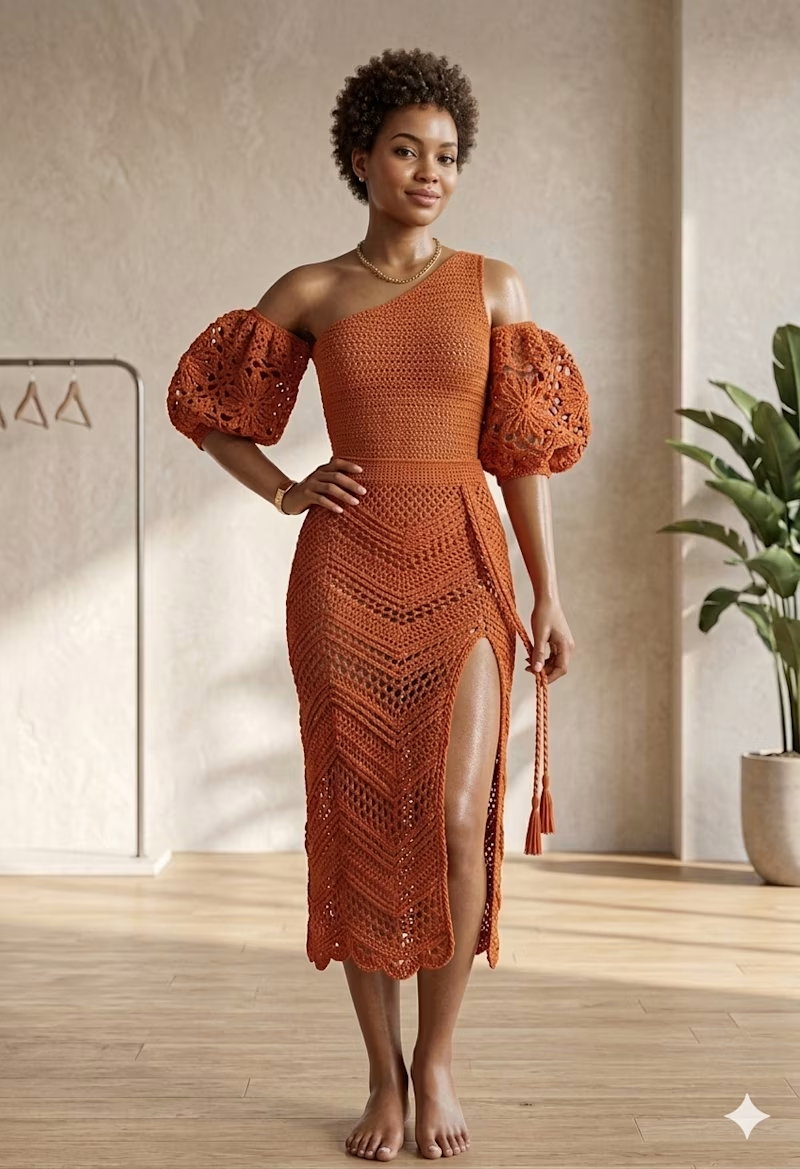
A clothing brand that focuses on designing and making crochet Kintted clothes.
The brand made two different syle of the same colour but was finding it difficult which of them is the best to display for her customers.
My Job was to use AI generated image to display the two outfit and know which of them the audiance will like/prefer more....
5 voted
42%
7 voted
58%
12 votes
Closed
Going for outfit 2.... bcos the lasy pose brought out the beauty of the cloth

Traditional museums preserve what changed the world.
What about the objects that changed you?
The train ticket you never threw away.
The toy you carried everywhere.
The watch your grandfather wore every day.
The sketch that started your career.
The random object sitting in a drawer that somehow means everything.
I'm building People's Museum, a digital museum where anyone can preserve one meaningful object and the story behind it.
No likes. No followers. No algorithms.
Just people, objects, and the reasons they matter.
If you could preserve one object forever, what would it be?


The concept is strong, but the execution makes it even better. Great work!
Challenges
View all



Trending

Claude
Claude has entered the design space. How are you using Claude Design?

Contra University
Learn from expert creatives how to earn more using next-gen AI tools.

MagicPath
The canvas is infinite, and exploration is becoming the workflow. How are you using MagicPath?
creativeaiflow
Creative AI workflows are evolving. What tools do you use, and what are their strengths and weaknesses?
freelancerlife
Freelancer life is wins, pivots, and everything in between. What’s yours right now?