The network for creativity
Join 1.25M professional creatives like you
Connect with clients, get discovered, and run your business 100% commission-free
Creatives on Contra have earned over $150M and we are just getting started
Back to feedPost

HOMESMART
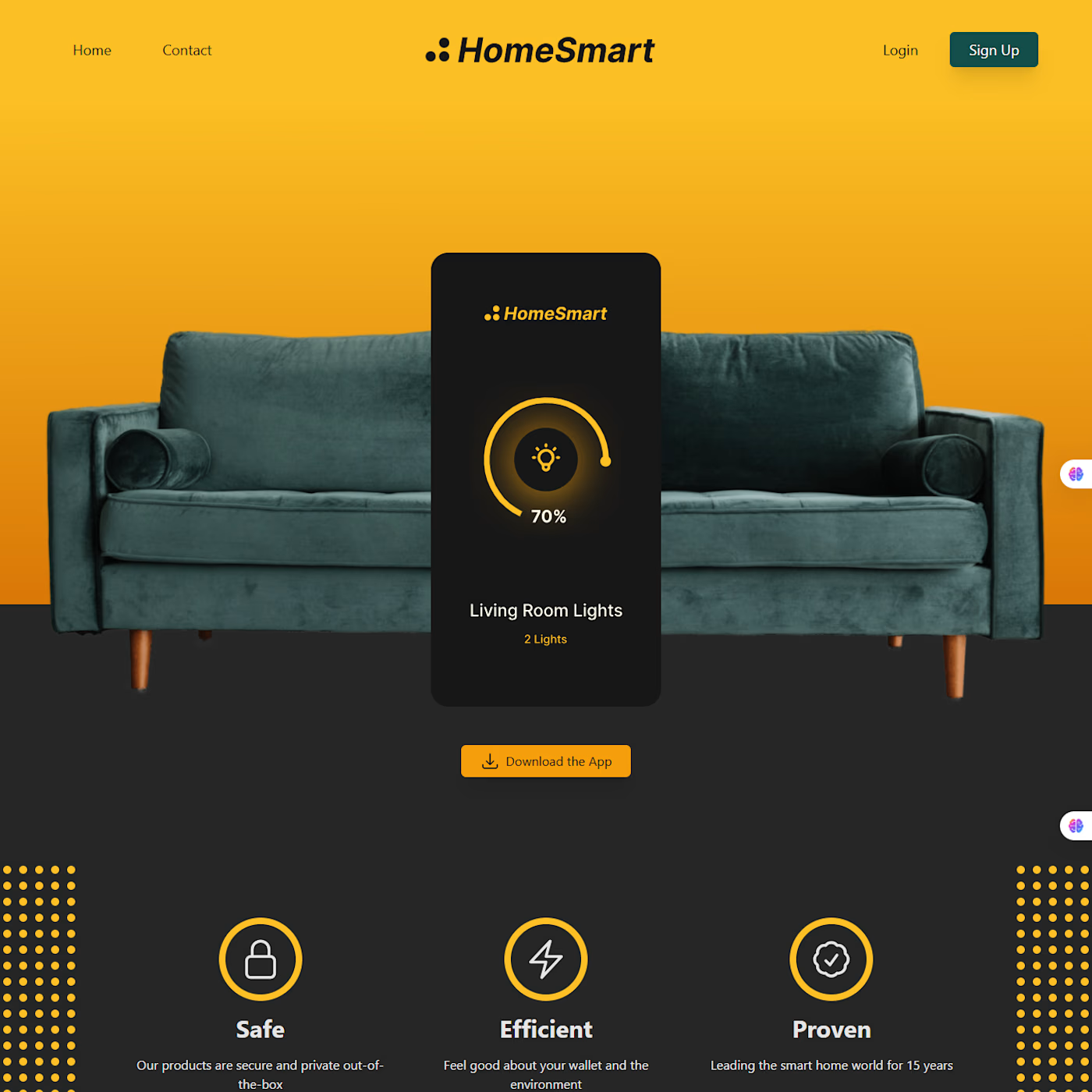
HomeSmart is a modern landing page designed for a smart home automation mobile application. The goal of the project was to create a visually engaging and conversion-focused website that introduces users to the app’s ability to control and manage home devices efficiently.
The design highlights simplicity, security, and efficiency while showcasing the mobile app interface at the center of the experience. A strong dark-themed layout combined with vibrant accent colors creates a premium tech feel that aligns with the smart home industry.


The network for creativity
Join 1.25M professional creatives like you
Connect with clients, get discovered, and run your business 100% commission-free
Creatives on Contra have earned over $150M and we are just getting started

Challenges
View all


Related posts


So excited to see Creative Intelligence 2026 by @Contra Labs out in the world!
At @Heed Collective , we had the pleasure of designing both the website and the report. We’re incredibly grateful for this collaboration!
Our creative exploration started with a question:
What does Creative Intelligence mean today?
We believe it lives at the intersection of creativity and analysis, imagination and insight.
We translated this into a visual story that begins in space — vast, dreamy, full of possibility — and gradually moves closer to Earth, grounding imagination in something tangible and human.
Huge congrats to the whole team, @Erin Horner, @Ben Huffman, @Mark Vassilevskiy, @Alex Karpodinis, @Stacy · Heed Collective, @Heed Collective , and the entire @Contra Labs team 👏


Incredible work, congrats!

One of my favorite projects this year: a full migration of ecopiatech.com from a legacy PHP CMS to Webflow.
Ecopia builds AI-generated 3D maps, and their site had a lot going on. Smooth scroll, parallax, character reveals, a fullscreen menu with an animated tile grid, timeline carousels, before/after sliders. The brief was simple: rebuild it 1:1.
So instead of eyeballing it, I went into the live site's CSS and measured everything. Easing curves, delays, durations, even the "random" text reveal turned out to be a 6-step delay cycle per word. Then I rebuilt it in Webflow so it feels exactly like the original, but now the team can update everything on their own.
On the content side:
220+ blog posts, news and case studies moved into Webflow CMS
Before/after sliders, videos and map embeds inside rich text, handled with simple shortcodes the editors can use
250 redirects mapped and verified so no old URL breaks
HubSpot forms restyled to match the brand, plus tracking set up for launch
The fun part of projects like this is the details nobody notices when they're done right.
Take a look: https://www.ecopiatech.com/


"High-Performance Creative Web Exploration"
A civic bureau seals your letter to 2126 under molten wax, witnessed. A civic bureau that seals letters for exactly one hundred years. Write a message to 2126, watch it set in wax, and receive your engraved certificate of deposit.
I built this project to test A civic bureau seals your letter to 2126 under molten wax, witnessed. A civic bureau that seals letters for exactly one hundred years. Write a message to 2126, watch it set in wax, and receive your engraved certificate of deposit. The core engineering challenge was sustaining uncompromised 60 FPS rendering using Canvas2D while handling continuous user interaction without framework overhead.
WHAT I WAS TESTING:
I focused on two core engineering benchmarks:
Precision implementation of wax-seal SVG under continuous interactive user input
Sustained 60 FPS render performance and zero-dependency browser execution
THE TECHNICAL SIDE:
Engineered directly in the browser with Canvas2D, Wax-seal SVG. The application runs without third-party frameworks or build-step dependencies, using hardware-accelerated rendering and custom event loops to achieve zero-latency response.
Everything executes in the browser using Canvas2D, Wax-seal SVG. No third-party frameworks, no heavy runtime bundles, and zero external tracking.
WHAT I LEARNED:
Balancing the mathematical rigors of wax-seal SVG with tactile browser interaction required tuning event throttling and memory allocation to eliminate all garbage collection stutters.
Finding the sweet spot between mathematical precision and frame budget took careful profiling, but the result runs at a steady 60 FPS even on modest hardware.
TRY IT YOURSELF:
The live build is deployed on Netlify. Open it in your browser, test the controls, and observe the render response times.
If you are building high-performance 3D, physics, or creative web systems and want to collaborate, reach out here on Contra.


Dynamic or static?


