The network for creativity
Join 1.25M professional creatives like you
Connect with clients, get discovered, and run your business 100% commission-free
Creatives on Contra have earned over $150M and we are just getting started
Back to feedPost

Case Study: Simple Tagger - Shopify Store Automation App
1. Executive Summary
Simple Tagger – Automate Tag is a Shopify automation application designed to help merchants automatically organize and classify their store data using configurable tagging rules.
Instead of manually tagging customers, products, and orders, merchants can define conditions that trigger automated tagging actions. This transforms repetitive administrative work into an automated workflow.
The product follows a straightforward automation model:
Event/Data → Conditions → Rule Evaluation → Automatic Tag → Activity Tracking
The app is positioned as an affordable Shopify micro-SaaS product, with subscription plans beginning at approximately $4/month.
2. Business Problem
Shopify merchants frequently need to categorize their customers, orders, and products.
For example, a merchant may want to identify:
High-value customers
Large orders
Customers from specific countries
Specific product categories
Repeat customers
Special customer segments
Orders requiring manual attention
Without automation, merchants have to repeatedly inspect Shopify data and manually assign tags.
This creates several problems:
Time consumption
Manual tagging becomes increasingly difficult as order volume grows.
Human error
Merchants may forget to tag an order or apply the wrong tag.
Inconsistent store organization
Different staff members may use different tagging conventions.
Poor scalability
Manual workflows become impractical for high-volume Shopify stores.
Limited operational visibility
Merchants need to know whether automation rules are actually executing successfully.
Simple Tagger addresses these problems by turning tagging into an automated rules-based process.
3. Product Solution
The central concept of Simple Tagger is a configurable automation engine.
A merchant creates a rule containing:
Trigger / Data Condition → Logical Conditions → Tagging Action
For example:
Example 1: High-Value Order
Condition:
Order value > $1,000
Action:
Add tag:
VIP-ORDER
Example 2: Geographic Customer Segmentation
Condition:
Customer location = Canada
Action:
Add tag:
CANADA
Example 3: Product-Based Classification
Condition:
Product type = Shoes
Action:
Add tag:
SHOES
Example 4: Multiple Conditions
Conditions:
Product type = Shoes
AND
Order value > $200
Action:
Add tag:
HIGH-VALUE-SHOE-ORDER
This allows merchants to create more sophisticated store-management workflows without writing code.
4. Core Product Features
4.1 Automated Tagging
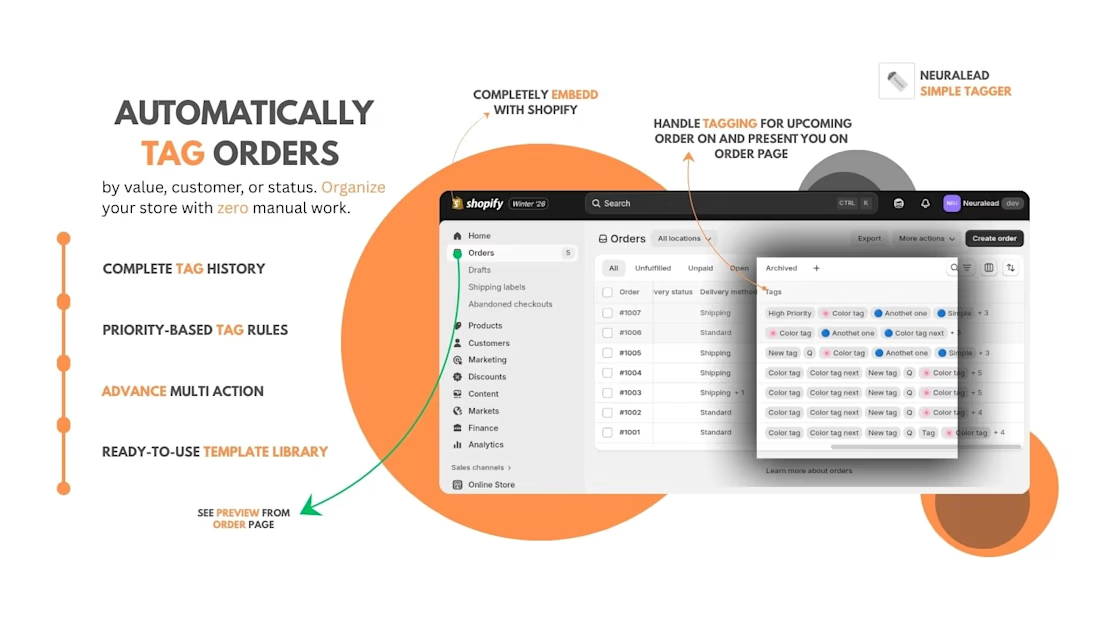
The primary feature automatically applies tags to Shopify objects according to predefined rules.
Supported objects include:
Orders
Customers
Products
This eliminates repetitive manual classification.
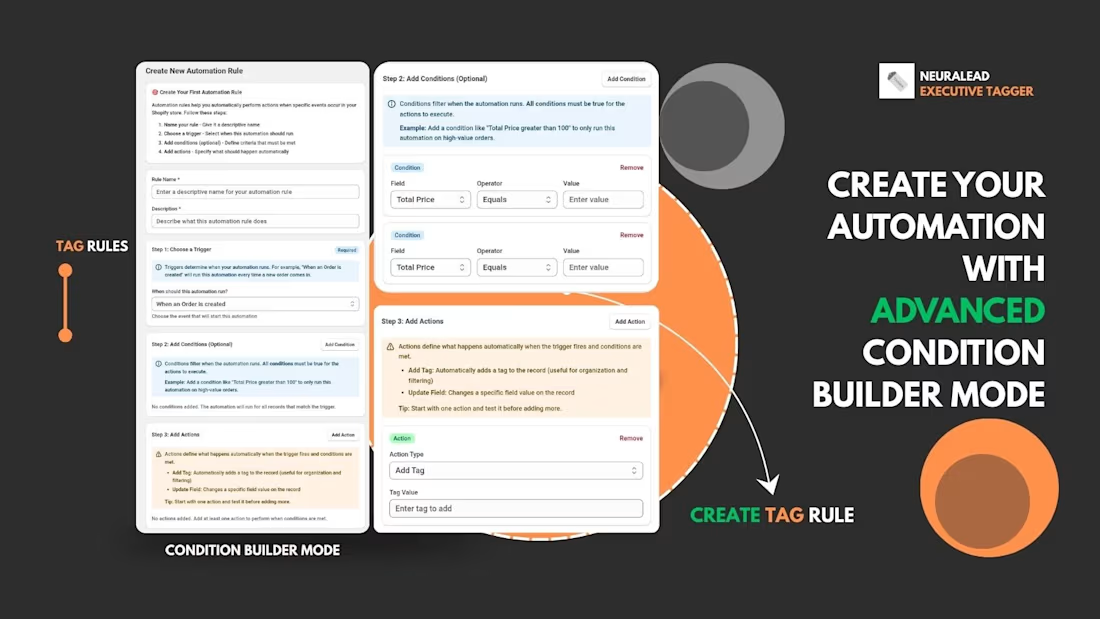
4.2 Multi-Condition Rules
The application supports rules involving multiple conditions.
Instead of creating a separate automation for every possible scenario, merchants can combine conditions to create more precise workflows.
For example:
Customer location = United States
AND
Order value > $500
→ Apply:
US-HIGH-VALUE
This increases the flexibility of the automation engine.
4.3 Real-Time Processing
The application is designed around real-time automation.
When relevant Shopify events occur, the system evaluates the applicable rules and executes the corresponding tagging action.
This means merchants do not necessarily need to manually initiate a synchronization process.
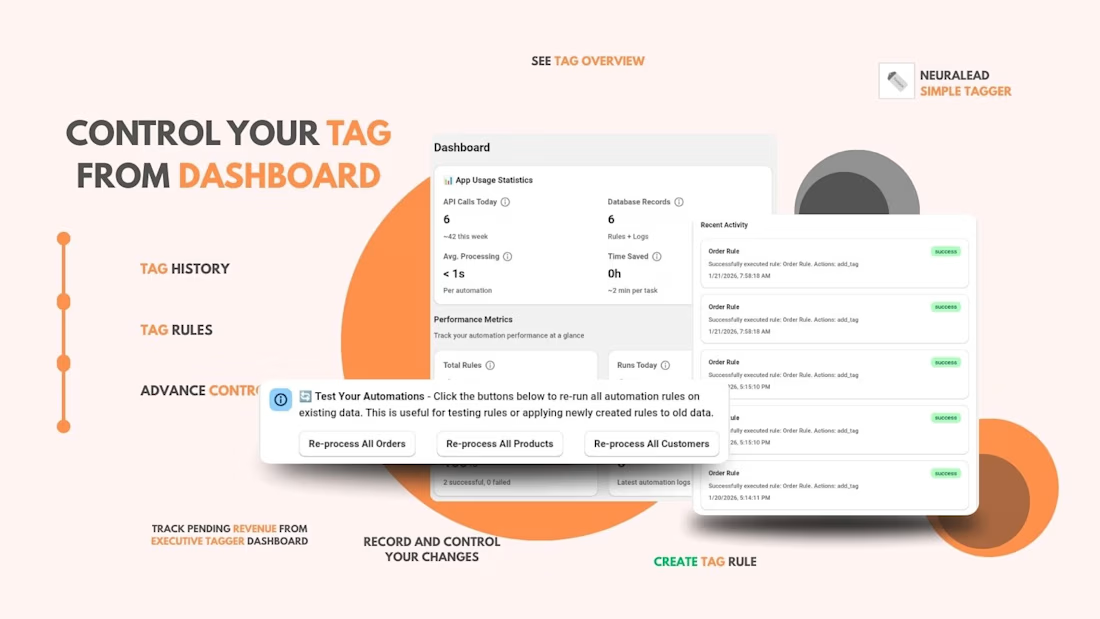
4.4 Activity Monitoring
Automation systems require visibility.
Simple Tagger includes activity/logging functionality that allows merchants to monitor automation activity and understand whether rules are executing successfully.
This provides operational transparency and helps identify problems with automation rules.
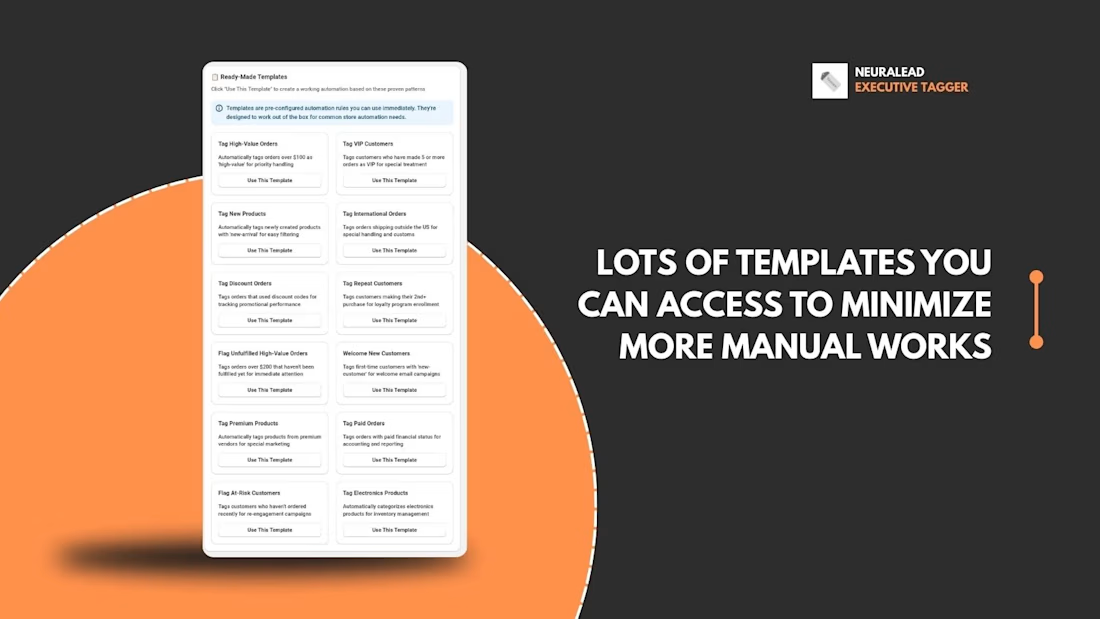
4.5 Rule Templates
The application includes predefined templates intended to help merchants create common automation workflows more quickly.
This reduces the learning curve for users who may not understand automation logic immediately.
4.6 Bulk Reprocessing
Higher-tier functionality provides bulk reprocessing capabilities.
This is particularly useful when a merchant creates a new rule and wants it applied to existing Shopify data rather than only future events.
For example:
A merchant creates:
Order > $500 → VIP
They may then need the rule applied to historical orders.
Bulk processing makes that possible at scale.
4.7 Workflow Builder
The higher-tier product offering includes a workflow-building capability.
This indicates a progression from simple single-condition tagging toward more sophisticated automation workflows.
The product therefore has the potential to evolve from a tagging utility into a broader Shopify workflow automation platform.
5. User Workflow
A typical merchant workflow can be represented as follows:
This workflow keeps the merchant interaction simple while moving the complexity into the automation engine.
6. Target Customers
The product is primarily relevant to Shopify merchants who have enough operational volume to benefit from automation.
Primary Customers
Growing Shopify stores
High-order-volume merchants
Multi-product stores
Stores with customer segmentation requirements
Stores with complex order-management workflows
Shopify agencies managing multiple stores
Secondary Customers
Shopify consultants
E-commerce operations teams
Marketing teams
Customer-support teams
Merchants performing CRM segmentation
7. Pricing Strategy
The product uses a tiered SaaS subscription model.
Plan Approx. Monthly Price Intended Customer Basic $4/month Small stores Growth $20/month Growing stores Pro $59/month Advanced merchants Business $199/month High-volume businesses
Annual billing is also offered at discounted rates.
The pricing strategy follows a common SaaS progression:
Low entry price → Increased usage limits → Advanced functionality → Enterprise-scale usage
This allows merchants to start with a low financial commitment and upgrade as their automation requirements grow.
8. Monetization Model
The product uses recurring subscription revenue rather than a one-time purchase.
The primary monetization variables are:
Number of automation rules
Number of automation executions/runs
Advanced workflow functionality
Bulk processing
Higher operational limits
This is a strong model for a Shopify application because the merchant's usage tends to increase together with store growth.
A simplified revenue model is:
MRR = Paying Stores × Average Revenue Per Store
For example:
If an application reaches:
1,000 paying stores
with an average revenue of:
$20/month
then:
MRR = $20,000
and:
ARR = $240,000
This demonstrates why relatively small Shopify utilities can become attractive SaaS businesses when distribution is strong.
9. Technical Product Architecture
A likely high-level architecture for this type of application would be:
A scalable implementation would typically separate:
Shopify Integration Layer
Responsible for:
OAuth
API communication
Webhooks
Store authentication
Shopify data synchronization
Rule Engine
Responsible for:
Condition evaluation
AND/OR logic
Rule prioritization
Rule activation/deactivation
Execution Engine
Responsible for:
Applying actions
Handling retries
Preventing duplicate execution
Recording execution results
Data Layer
Stores:
Merchant/store information
Rules
Conditions
Actions
Execution history
Usage statistics
Application configuration
Monitoring Layer
Tracks:
Successful executions
Failed executions
Processing time
API errors
Rule activity
Usage limits
10. Security and Permissions
Because the application interacts with Shopify customer, product, and order data, permission management is an important part of the product architecture.
The application requires access to relevant Shopify resources to perform its automation functionality.
Potential security considerations include:
OAuth-based store authentication
Shopify access-token protection
Least-privilege API scopes
Secure webhook validation
Encryption of sensitive credentials
Tenant isolation
Audit logging
Rate-limit handling
Secure API communication
Data-retention policies
For a production Shopify SaaS, multi-tenant isolation is particularly important because one application's backend may serve many independent Shopify stores.
11. UX Strategy
The product benefits from having a relatively simple user experience despite the complexity of the underlying automation system.
The ideal UX can be structured around five steps:
Step 1 — Select Object
Choose:
Order
Customer
Product
Step 2 — Define Condition
Example:
Order Value > $500
Step 3 — Select Action
Example:
Add Tag → VIP
Step 4 — Activate
Turn the automation on.
Step 5 — Monitor
Review execution history and success/failure information.
This reduces the cognitive load compared with traditional workflow automation systems.
12. Competitive Positioning
Simple Tagger operates in a useful niche between:
Manual Shopify administration
and
Large-scale workflow automation platforms
Its competitive advantage can be summarized as:
Simple automation focused specifically on Shopify tagging and store organization.
Rather than attempting to solve every possible e-commerce automation problem, the product focuses on a narrow operational problem.
This can be advantageous because a narrowly defined product can communicate its value more clearly.
13. Strengths
1. Clear Problem Definition
The application solves a specific operational problem rather than attempting to be an overly broad platform.
2. Low Entry Price
A low starting price reduces adoption friction for small Shopify merchants.
3. Recurring Revenue
The subscription model creates predictable recurring revenue potential.
4. Automation Value
The product saves merchants repetitive operational work.
5. Expandable Architecture
Tag automation can potentially evolve into broader Shopify workflow automation.
6. Scalable Customer Model
The SaaS model allows the same software infrastructure to serve many Shopify stores.
14. Potential Weaknesses
The product also faces several challenges.
Limited Initial Scope
Tagging alone may not provide enough value for some merchants to justify higher subscription prices.
Strong Competition
Shopify already has a large ecosystem of automation and workflow applications.
Platform Dependency
The application depends heavily on Shopify APIs, policies, rate limits, and platform changes.
Retention Challenge
Once merchants configure their rules, the product can become a "set-and-forget" utility. This can reduce engagement unless the application continuously demonstrates operational value.
Discoverability
A Shopify App Store application needs strong:
SEO
Reviews
Screenshots
App Store conversion
Merchant trust
Onboarding
to compete successfully.
15. Growth Opportunities
The product could expand beyond simple tagging.
Potential future capabilities include:
Customer Automation
Customer segmentation
VIP identification
Customer lifecycle tags
Repeat-purchase detection
Order Automation
Fraud-risk classification
High-value order detection
Fulfillment categorization
Geographic routing
Product Automation
Inventory-based tags
Product lifecycle tags
Collection automation
Supplier-based classification
Marketing Automation
Integration with:
Email platforms
SMS platforms
CRM systems
Advertising platforms
This could turn the application into a broader:
Shopify Store Automation Platform
rather than simply a tagging application.
16. Strategic Analysis
The most interesting aspect of Simple Tagger is not the tagging feature itself.
The strategic opportunity is the automation engine underneath it.
Tagging is simply the initial use case.
Once the application has:
Shopify event processing
Condition evaluation
Rule management
Action execution
Execution monitoring
Merchant configuration
Usage metering
the same infrastructure can support many other actions.
For example:
At that point, the product moves from a tagging application toward a general-purpose Shopify automation platform.
17. Business Model Opportunity
A broader version of the product could use a usage-based SaaS model.
Possible pricing dimensions:
Rules
Number of active workflows.
Executions
Number of automation runs.
Stores
For agencies managing multiple Shopify stores.
Advanced Actions
Premium integrations and workflow actions.
Historical Processing
Premium access to bulk/historical processing.
This provides multiple opportunities for expansion revenue.
18. Key Lessons
The product demonstrates several important SaaS principles.
Lesson 1: Solve a Small Problem First
A narrowly defined operational problem can be easier to market than a large, complicated platform.
Lesson 2: Automation Creates Recurring Value
If the product continuously saves merchant time, subscription pricing becomes easier to justify.
Lesson 3: Usage-Based Limits Create Natural Upgrade Paths
Small merchants can start cheaply while larger merchants pay more because they consume more resources.
Lesson 4: Infrastructure Can Become the Real Product
The initial tagging functionality can serve as an entry point into a much larger automation ecosystem.
Lesson 5: Shopify Provides a Large Distribution Platform
Building on Shopify gives developers access to a large ecosystem of merchants, but competition and platform dependency must be considered.
19. Conclusion
Simple Tagger – Automate Tag represents a focused Shopify SaaS product built around a straightforward business problem: automating repetitive store classification and tagging tasks.
Its product strategy combines:
Simple automation
Rule-based conditions
Real-time processing
Activity monitoring
Tiered subscriptions
Usage-based limitations
Advanced functionality for larger merchants
The strongest long-term opportunity is not merely selling automated tags. The underlying rule engine can become the foundation for a much broader Shopify automation platform.
From a business perspective, the product illustrates how a relatively narrow operational problem can be converted into a recurring-revenue SaaS product when the solution is easy to understand, inexpensive to adopt, and capable of scaling with merchant usage.


The network for creativity
Join 1.25M professional creatives like you
Connect with clients, get discovered, and run your business 100% commission-free
Creatives on Contra have earned over $150M and we are just getting started

Challenges
View all


Related posts

Ledger — AI CFO Platform
Ledger is an AI platform that acts as an always-on Chief Financial Officer for founders — connecting to accounts, learning cash rhythm, and surfacing risks before they become real problems. I designed the full landing page.
My role: UI/UX Design
Scope: Landing page
Financial tools for founders usually feel either cold (dashboards) or intimidating (accounting software).
For Ledger, we borrowed from old-world institutional finance instead — serif type, oil-painting textures, classical architecture — so an AI CFO feels like real authority, not another app.


This color pallet works so well with data and makes everything look premium. love it!

Built this over a weekend as an experiment with AI-assisted design and development.
Duo Case is an absurd concept for turning two iPhones into a very unofficial foldable iPhone. The goal was to see how far AI could accelerate the process while keeping creative direction, design decisions and final execution in human hands.


A weekend build that looks this polished is wild. Where did AI actually save you the most time here, the concepting or the production grind?

Stop rebuilding the same Shopify mobile app from scratch. 📱⚡
I just released a 100% FREE + OPEN SOURCE React Native + Expo Shopify template for building native ecommerce apps on iOS and Android.
It already includes:
• Product + collection browsing
• Variants
• Cart state
• Shopify Storefront API integration
• Native Shopify checkout
• Expo Router
• MobX
• TypeScript
• Demo data so you can run it before connecting a store
Built for developers, agencies, indie hackers, and Shopify brands that want a real native starting point instead of another throwaway demo.
Clone it. Fork it. Customize it. Ship it.
No paywall. No license fee. MIT licensed.
Check it out on Contra 👇
https://contra.com/products/CsuvbKXC-react-native-expo-shopify-template
If it saves you time, give the repo a ⭐ and share it with someone building in React Native.
#ReactNative #Expo #Shopify #OpenSource #TypeScript #MobileDevelopment #Ecommerce #IndieHackers
