The network for creativity
Join 1.25M professional creatives like you
Connect with clients, get discovered, and run your business 100% commission-free
Creatives on Contra have earned over $150M and we are just getting started
Back to feedPost
Last year, a stressed client reached out in a panic. He wanted to add a couple of images, but it turned into a responsive nightmare, breaking the UI across multiple pages of his Bubble app.
He needed it fixed within 2–3 hours. I was about to have dinner, but the food had to wait.
Handling a crisis requires a calm, systematic approach. We jumped on a quick call to assess the damage. I dove straight into the editor, isolated the broken groups, and restored the layouts.
Two hours later, the app was 100% back to normal.
Moments like this remind me that being an independent developer isn’t just about building apps, it’s about stepping in with a cool head and delivering reliable solutions when things go wrong.
Sharing his review below means a lot. 🙏


This was one of those moments where solving the problem quickly made a huge difference for the client.
The network for creativity
Join 1.25M professional creatives like you
Connect with clients, get discovered, and run your business 100% commission-free
Creatives on Contra have earned over $150M and we are just getting started











Related posts

A few weeks ago my girlfriend’s phone died without warning, and everything she needed was on it. Finding a repair shop took hours. Half the websites barely worked, the rest wanted a form and a callback, and nobody could tell us the price or whether they had time. Booking took almost another hour of calls and messages.
The repair itself took 30 minutes. The repair wasn’t the problem; everything around it was. The shop owner was stuck too, answering the same questions instead of fixing devices.
So for the #Base44Challenge I built Reborn: a repair booking platform for customers, with an operations dashboard for the shop.
🔗 Live site: https://reborn-repairs.base44.app/
🔐 Shop admin: https://reborn-repairs.base44.app/login
For customers:
Pick your city and device. If you don’t know the exact model, that’s fine.
Diagnose on an interactive 3D model. Instead of filling in a form, you spin the phone or laptop, tap the part that’s broken, or pick from common problems.
Describe the issue your way. Type what happened, record a voice note, or add photos.
Get an instant quote. A preliminary quote updates as you choose, using the workshop’s own rate card. Nobody has to call you back.
Book a real slot. Choose a workshop visit or doorstep pickup, and pick from time slots that are actually available.
Track the repair. You get a booking reference to follow every stage.
For the shop (Workshop OS):
One dashboard for every booking, filterable by city, status and technician.
Assign a technician. Only technicians in that city show up.
Quote approval. The shop sends a quote, and the customer approves it before any work begins.
Notes. Internal notes, or notes the customer can see.
Settings in one place. Pricing, opening hours, slot capacity, cities, delivery fees and legal pages are all managed here, so customers always see quotes and slots that match how the shop really runs.
Automation:
Every status change emails the customer automatically: device received, technician assigned, ready for return, and so on.
An email history log shows each message as sent, failed or skipped.
Updates that used to mean phone calls now happen on their own, and the shop gets back to fixing things.
How I built it:
I built all of this with Base44. I described what I needed in plain language, and it helped me create the database, the booking flow, the email automation and the dashboard. That let me spend my time on the experience, not the plumbing.
Why it matters:
With component prices climbing, repairing what you already own matters more than ever. It’s better for your wallet and better for the planet.
Your tech. Back in motion.
📣 Social posts
#Base44Challenge @Base44


Brilliant in every way.

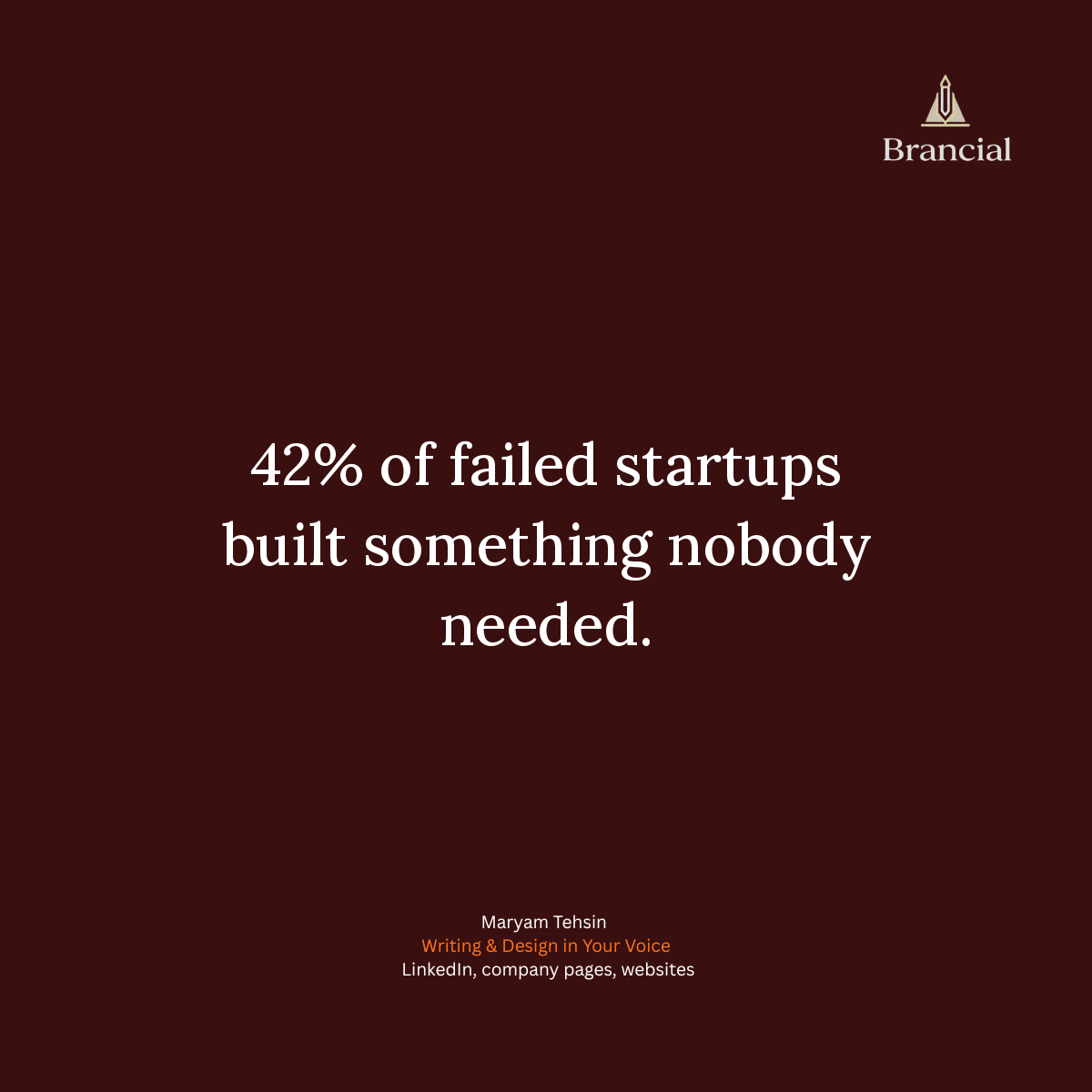
42% of failed startups built something nobody needed.
That is from one CB Insights analysis of 101 founder post-mortems.
Not bad code. Not bad luck. Nobody needed it.
If you are building an AI product...this is the cheapest fix you will ever make...
Ask these 5 questions BEFORE you build...
1. Who exactly has this problem?
Everyone is not an answer. Name a job title.
2. How are they solving it today?
If they are not solving it at all, it may not hurt enough.
3. What does it cost them?
Hours, money or missed deals. Get a number.
4. Would they pay for a fix this month?
Ask for a pre-order or a pilot, not a compliment.
5. Who have you talked to this week?
Aim for 5 real conversations before writing a line of code.
Copy-paste prompt to prepare your interviews:
I am building [product] for [job title]. Write 10 customer interview questions that uncover how they solve [problem] today, what it costs them, and what they have already paid for. No leading questions.
Compliments do not validate a product.
Payments and pilots do.
Save this before your next build sprint.
Follow me to meet again
Daily learn with me (Maryam Tehsin)


Such an important reminder! 👏 It's easy to focus on building a product, but understanding the customer's real problem should always come first. Real feedback is worth more than compliments!

Snap — Interactive 3D Patch Studio
The problem
Customizing clothes online creates a gap between what the customer imagines and what ends up on the sewing table. People want creative freedom; production needs exact instructions. The result is endless back-and-forth and “where do I put this patch?” messages.
The build
I’m a designer, so everything started in Figma — every screen, hover and sticker. Then I rebuilt it in Base44, one prompt at a time: layout first, then motion, then the 3D studio.
In the studio, you drop patches anywhere on a real 3D shirt, then rotate, resize, duplicate or undo. On mobile, it’s built for one thumb: separate modes for viewing, placing and editing, and quick zones like Chest or Sleeve. Small details carry the brand: hover a patch in the catalog to see it sewn on a shirt, or hover the headline letters to watch them turn into 3D type.
Three things fought back:
Patches on a real 3D shirt — solved with surface decals that follow the fabric.
Saving exactly what people design — solved with automatic front/back snapshots.
One-thumb mobile editing — solved by splitting the studio into clear modes instead of shrinking the desktop layout.
Automation
Snapshot → production (saves time, removes errors). The moment you add to bag, snap captures your design front and back. The snapshots go to production with the order, and the admin can download a ready-to-print production sheet as a PDF. What you see is exactly what we sew.
Status emails (customer experience). Change an order’s status in the admin, and the customer is notified automatically: in production, shipped with tracking, delivered.
Owner alerts (operations). New orders and contact messages land in my inbox right away, with a link to the order.
Waitlist (leads). Unreleased items like the hoodie collect sign-ups instead of being a dead end. The moment I switch it live, everyone waiting gets an email.
Vibe code. Vibe design. Real thread.
Life project:
https://figma-snap-416e61aa.base44.app
Figma file (for personal use)
Full screencasts are in the comments: the customer flow (from the catalog to checkout, on desktop and mobile) and the admin flow (the order with its snapshots → the production PDF → a status change → the automatic email).

Ohhhh wowww this is nice