The network for creativity
Join 1.25M professional creatives like you
Connect with clients, get discovered, and run your business 100% commission-free
Creatives on Contra have earned over $150M and we are just getting started
Back to feedPost

What Building My First Startup Taught Me About Growth
When I started my first startup, I thought growth was mostly about doing more.
●More channels.
●More marketing.
●More activity.
I assumed momentum came from constant expansion.
Over time, I learned something less obvious.
Growth often comes less from doing more and more from doing essential things better.
That realization changed how I thought about building.
I Thought Growth Was About Speed
Early on, I equated speed with progress.
Launch faster.
Test more.
Add features.
Push harder.
Some of that mattered.
But I began noticing a pattern.
Teams were often accelerating broken systems.
●Scaling confusion.
●Scaling weak positioning.
●Scaling inefficient processes.
And scale does not usually fix those problems.
It tends to magnify them.
That was a difficult lesson.
But an important one.
Positioning Matters More Than People Admit
One of the first things I underestimated was positioning.
I used to think strong products naturally found traction.
Reality felt more complicated.
People do not just buy products.
●They buy clarity.
●They buy confidence.
●They buy solutions they can understand quickly.
When messaging is vague, growth often suffers long before product quality becomes the issue.
That realization made me pay much more attention to how value is communicated.
Not just what is built.
Customer Understanding Is a Growth Lever
Another lesson came from talking to customers.
●Not surveying.
●Actually listening.
Some of our biggest assumptions about what mattered were wrong.
Features we thought would drive adoption mattered less than problems customers urgently wanted solved.
That changed product decisions.
It also changed marketing.
Growth improved when messaging reflected customer language instead of internal assumptions.
That seems obvious now.
It did not at the time.
Execution Usually Beats Complexity
I used to admire complicated growth systems.
●Multi-channel strategies.
●Elaborate funnels.
●Sophisticated playbooks.
Then I saw simpler operators outperform with stronger execution.
●Clear offer.
●Consistent follow-up.
●Better sales conversations.
Nothing glamorous.
Just disciplined fundamentals.
That shaped how I think about leverage.
Complexity often looks impressive.
Execution usually wins.
Scale Amplifies What Already Exists
This may be the biggest lesson.
Scale is not neutral.
It amplifies.
If positioning is weak, scale amplifies inefficiency.
If conversion is poor, scale amplifies waste.
If systems are strong, scale amplifies growth.
That changed how I approached expansion.
I became less interested in growth hacks.
More interested in strengthening fundamentals before scaling.
That mindset made better decisions possible.
Growth Is Often About Removing Friction
I used to think growth meant adding things.
●New channels.
●New tactics.
●New experiments.
Sometimes growth comes from removing things instead.
●Removing confusion.
●Removing friction.
●Removing steps between interest and action.
That was a subtle but powerful shift.
Growth can come from subtraction.
Not just addition.
The Leverage Question Changed How I Operate
A question I began asking more often was simple:
What creates disproportionate impact?
That question changed priorities.
Instead of chasing activity, I looked for leverage.
Sometimes that meant improving onboarding.
Sometimes improving sales qualification.
Sometimes rewriting positioning.
Smaller changes with compounding effects.
That often mattered more than chasing entirely new channels.
What I Would Tell Earlier-Stage Founders
If I were starting again, I would pay attention sooner to:
Positioning clarity
Customer conversations
Execution discipline
Conversion fundamentals
Leverage over activity
Not because these ideas sound strategic.
Because they often drive outcomes.
And outcomes matter.
Final Thought
When I first started, I thought growth belonged to the teams doing the most.
Now I think it often belongs to the teams understanding fundamentals most deeply.
Growth is rarely just motion.
●Often it is clarity.
●Execution.
●And leverage.
That lesson shaped almost every business decision after.


The network for creativity
Join 1.25M professional creatives like you
Connect with clients, get discovered, and run your business 100% commission-free
Creatives on Contra have earned over $150M and we are just getting started
Trending
retrofuturism
Share your favorite designs from the past exploring the distant future. Or your own take on the aesthetic 🚀
halftone
Dots. Texture. Grain. Let's see your designs using the halftone technique.

Midjourney
Creatives are showing off what they're making with Midjourney.
colorgrade
Video editors sound off: How do you enhance the mood of your video in color grading?





Related posts


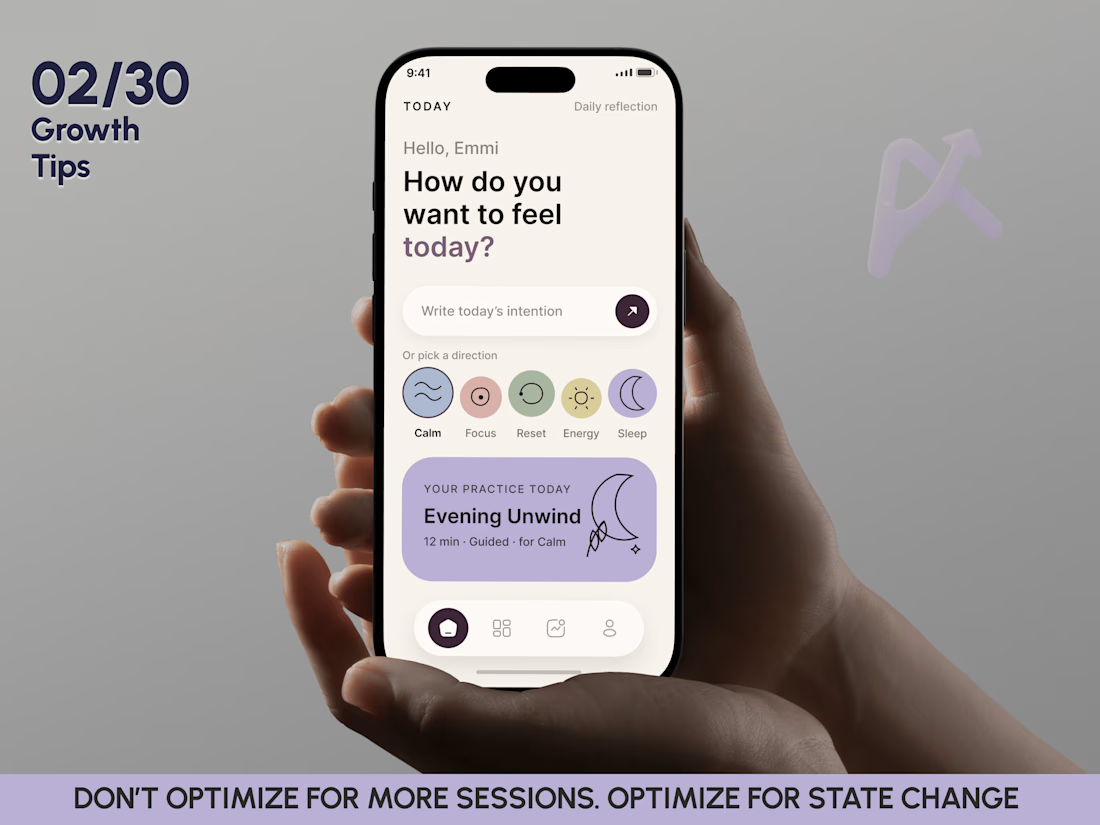
🧠 GROWTH TIP 02/30: OPTIMIZE FOR STATE CHANGE, NOT SESSION COMPLETION
A meditation session can be completed and still create zero product value. For this wellness product, we changed the growth logic from content consumption to state change.
The framework:
Signal → Selection → Shift → Proof → Adaptation
SIGNAL
We identified what the user actually needed in the moment.Calm. Focus. Reset. Energy. Sleep.
SELECTION
Instead of pushing users into a library of sessions, we reduced choice friction and surfaced one relevant next action.
SHIFT
We measured whether the recommended practice actually moved the user toward the desired state.
The key metric became: State Shift Rate Successful desired state changes divided by completed recommended sessions.
PROOF
I showed users what was actually working for them.
Stress ↓18% after Evening Unwind
Best time: 8:30 PM
Insights stopped being passive analytics and became part of the retention loop.
ADAPTATION
Every completed outcome improved the next recommendation.
The loop became:
Intent → Recommendation → State Change → Proof → Better Recommendation → Repeat Use
📈 RESULTS
35% faster Time to Confident Choice
25% higher recommendation acceptance
20% higher repeat practice rate
15% lift in 30 day retention
25%+ improvement in successful state shifts as personalization learned
💡 GROWTH INSIGHT 02
The biggest shift was not getting users to complete more sessions It was increasing the percentage of sessions that actually delivered the outcome users came for.
More sessions did not create the growth. Better outcomes did.
That is when a wellness app stops behaving like a content library and starts becoming a product that learns what actually works for each user.
#MobileAppGrowth #ProductGrowth #WellnessApp #MeditationApp #Retention #Personalization #BehavioralDesign #MobileUX #ProductStrategy #AsolDesign


Nice App

currently working on a new project, and it reminded me why the strategy phase is probably my favorite part of the whole process.
whether it’s for a website or a full brand identity, i love going beyond the brief and trying to understand the business as deeply as possible.
the client call, the brief, the old website… those are just the starting point.
then comes the fun part: researching, asking questions, digging deeper, understanding how the business works, who they sell to, what they stand for, how they communicate, and why people should choose them.
sometimes, you even discover things the client knows internally but hasn’t fully articulated yet, or things they’re simply not communicating clearly enough.
that’s what i love about strategy: taking all that information, finding the patterns, and bringing clarity and structure to everything.
honestly, this might be my favorite part of the whole process.


Awesome!
🚨 MORE RECOMMENDATIONS CAN MAKE A TRAVEL APP WORSE.
01/30 MOBILE APP GROWTH TIPS
I’m starting a new series: 30 mobile products → 30 growth decisions.
Not about UI tricks. About product decisions that can actually change retention, activation, and user behavior.
The first case is travel. 🌍
Most travel apps optimize supply. The real bottleneck is confidence.
Users already have no shortage of places to discover. Google Maps, TikTok, Instagram, blogs, saved lists. There are already more options than they can realistically use.
So adding more recommendations often does not create more value. It creates decision entropy.
In Veya, I shifted the core loop.
Not: discover → browse → save
But: context → decision → successful experience → trust → delegation
Weather, time, location, energy level, taste, previous saves and skips are not just personalization data. They are a mechanism for reducing uncertainty.
If the product repeatedly answers “What is actually worth doing today for me?” well enough, it stops being a catalog. It becomes a decision layer.
And that creates a stronger retention loop: more usage → more context → better decisions → more trust → more delegation → more usage
💡 GROWTH TIP #01
DON’T MAXIMIZE RECOMMENDATIONS. MAXIMIZE HOW MUCH OF THE DECISION USERS ARE WILLING TO DELEGATE TO YOUR PRODUCT.
That is when personalization becomes a real growth mechanism, not just another feature.
Day 1/30 Veya Mobie App Redesign
29 more product decisions are coming around gamification, personalization, retention, monetization, and AI driven growth. 🚀
If this is your kind of topic, see you in #02.
#MobileAppGrowth #ProductStrategy #Gamification #Personalization #MobileUX #Asol_design #ProductDesign