The network for creativity
Join 1.25M professional creatives like you
Connect with clients, get discovered, and run your business 100% commission-free
Creatives on Contra have earned over $150M and we are just getting started
Back to feedPost

Amazon S3 Files gives multi-agent AI pipelines a POSIX shared memory layer, so marketing and sales agents hand off work through files, not bloated prompts.
New breakdown: AWS's Amazon S3 Files gives multi-agent AI pipelines a POSIX shared file layer, so marketing and sales agents hand off work through directories instead of token-bloated prompts — lower cost, lower latency, cleaner audits. What changed, and how to adopt it safely.

vanaxity.com
Multi-Agent Orchestration on a Shared S3 File Layer
Amazon S3 Files gives multi-agent AI pipelines a POSIX shared memory layer, so marketing and sales agents hand off work through files, not bloated prompts.
The network for creativity
Join 1.25M professional creatives like you
Connect with clients, get discovered, and run your business 100% commission-free
Creatives on Contra have earned over $150M and we are just getting started
Related posts

Most PDF extraction pipelines would have missed the Brazilian court-filing injection.
Two law firms hid white-on-white text in a labor court petition. It told the court's AI reviewer to answer superficially and not challenge the documents. The court's tool, Galileu, flagged it and blocked it, and the court fined the firms 10% of an R$842,000 claim.
Most of the Hacker News thread blames the court for running AI on filings. But the trick works on any pipeline that reads PDFs. White text is invisible on the page and still sits in the text layer, which is what gets extracted.
My extraction pipelines check each field against the page it came from. That catches a wrong value, but not an instruction that changes how the model reads the rest of the file. That needs a check before the model sees anything: text a person can't see on the page shouldn't reach the model.
In the PDFs you extract from, how often does the text layer hold something the page doesn't show?

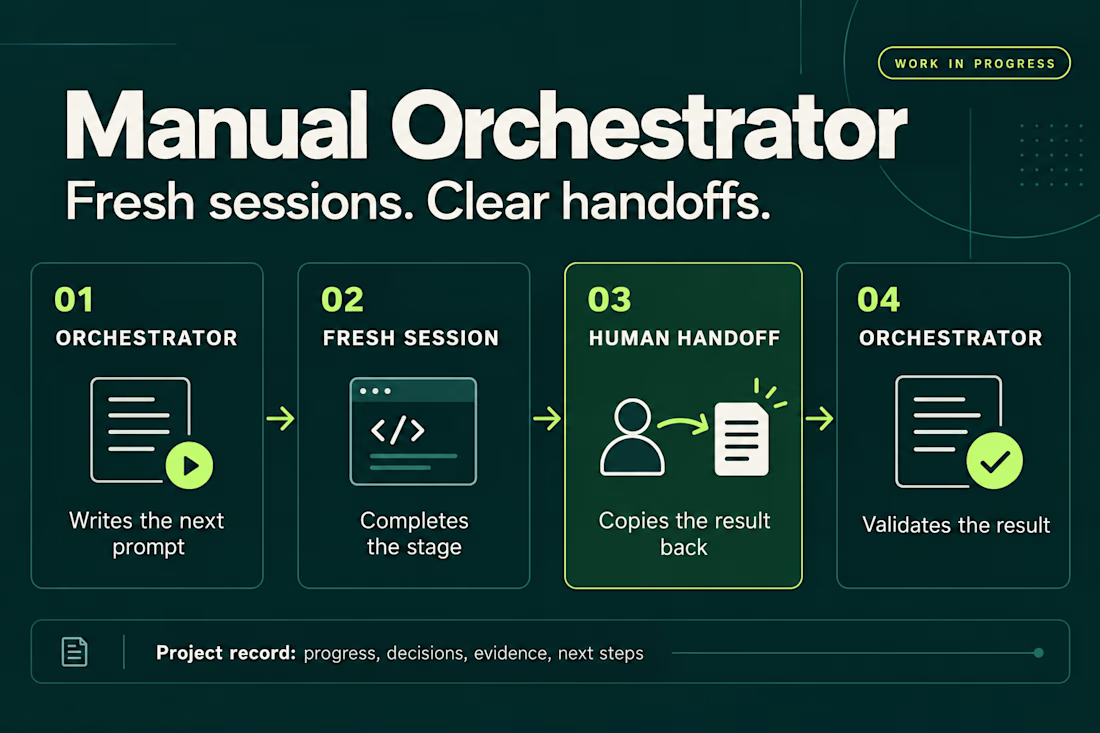
I’ve been working on a small skill called Manual Orchestrator to make longer projects with AI agents easier to manage.
The problem started with a familiar situation: one chat would accumulate plans, implementation details, corrections, and test results. By the time I was ready for the next phase, I wanted a fresh conversation without losing the decisions we’d already made.
Manual Orchestrator gives that process some structure. One chat acts as the orchestrator: it breaks the work into stages and writes a prompt for the next one. I run that prompt in a new session, then bring the result back. The orchestrator reviews it against the stage’s criteria before preparing the next prompt. If something needs fixing, I go back to the same worker session.
The skill also keeps a record in the project with the current stage, decisions, evidence, and next steps. That makes it easier to pause, resume, or hand the work to another session.
The handoff is manual. I choose when to open a session and carry the result back. The orchestrator and worker sessions can also use different agent CLIs, with the prompt adapted to the capabilities available.
It’s open source and still a work in progress. I’m using it to learn what helps in practice and where the workflow needs to improve. Installation has been checked for Codex, Claude Code, and Gemini CLI, but the full workflow hasn’t been tested across every CLI or version.
If you try it, I’d be interested in hearing what works and where it gets in your way.


Did a motion for the Cockpit concept ⁕ 🔈 ON
Design & Creative Direction: Me
Motion & Sound: Claude Code
Cockpit is an AI agent management platform concept that helps teams:
- Set boundaries
- Monitor activity
- Manage approvals
- Track knowledge sources
- Measure performance and costs
It brings together five key AI UX challenges:
👉 Autonomy
👉 Observability
👉 Human Approvals
👉 Context
👉 Analytics
The idea is simple:
As AI agents become more capable, the experiences we design around them need to make their actions more transparent, predictable, and manageable.
Thanks!


Human approvals is the part most agent UIs skip. Good call making it one of the five challenges.