The network for creativity
Join 1.25M professional creatives like you
Connect with clients, get discovered, and run your business 100% commission-free
Creatives on Contra have earned over $150M and we are just getting started
Back to feedPost

Send me your Python error/code. I'll identify the problem and fix a small bug for $5.
The network for creativity
Join 1.25M professional creatives like you
Connect with clients, get discovered, and run your business 100% commission-free
Creatives on Contra have earned over $150M and we are just getting started


Related posts

A full-stack RAG application that answers questions from a team's own documents, with every answer cited to the source document and page. I designed, built, tested and deployed it end to end:
document ingestion with content-based file validation;
semantic search with PostgreSQL + pgvector;
streaming answers over Server-Sent Events, with server-side citation verification;
multi-tenant workspaces with role-based access;
usage metering with quotas and a cost dashboard;
a crash-safe PostgreSQL job queue.
Deployed as a public demo on free tiers (Vercel, Render, Supabase) with hard caps on AI spend.
Citations verified against the retrieved passages; unsupported answers return "not found"
Tenant isolation in every query; Supabase Data API locked down (verified on production)
Durable ingestion queue (SKIP LOCKED, leases, retries): kill -9 under load lost nothing
Costs reserved before every AI call; per-user, per-workspace and deployment-wide caps
Data-driven model migration (5 configurations evaluated; about 74% cheaper per answer)
1,099 backend + 393 frontend tests; load-tested; encrypted, restore-verified backups
https://knowledgepilot-ai-olive.vercel.app/


The reservation before the AI call is the detail most teams miss: you can add cost metering later, but you cannot un-spend the money after a runaway loop. On the crash-safe queue, with SKIP LOCKED plus leases, what happens to a lease held by a worker that is alive but stuck, do...

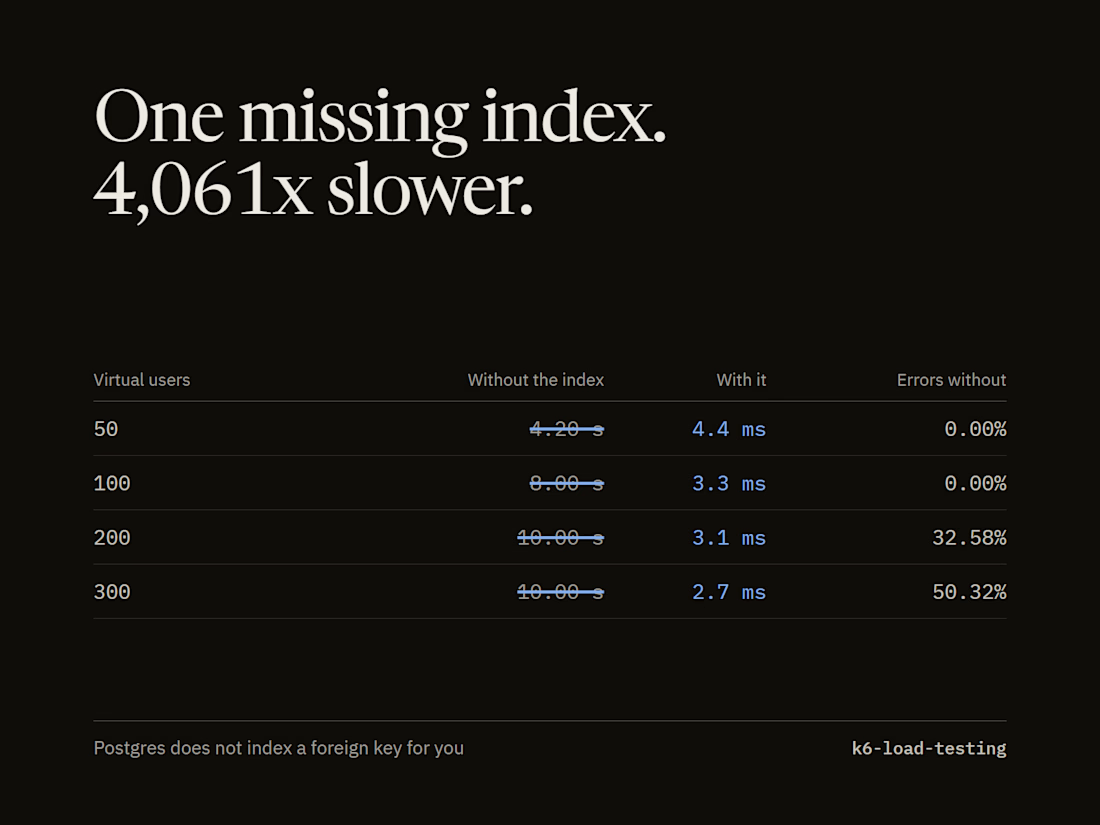
I load-tested a small parcel tracking API with k6: 200,000 parcels, about 3 million tracking events in Postgres.
Under stress, p95 hit the 10-second timeout and half the requests failed at 300 virtual users. The cause was one missing index on a foreign key. Postgres doesn't create those for you.
Same scenarios after the fix: p95 around 3 ms, zero errors. The hot endpoint got 4,061x faster. Every number in the README is generated from the k6 output files, not typed.
https://github.com/murillovskfilho/k6-load-testing

What's this Optimizely hack everyone's talking about? BBC was serving malicious code? 💀
I know this is not a dev heavy community, so I wrote a plain-English rundown of what happened and how this can happen to any marketing site.
6 min read. You'll probably skim it in 2 anyway.
https://www.geekygrowth.com/resources/optimizely-hack-explained

geekygrowth.com
The Optimizely Hack Explained Like You’re Five, for Founders
Malware hit Zoom, CNN and 176 other sites through Optimizely. Here’s what happened in plain English, and how to protect your Webflow marketing site.

Good call writing this for non developers, Nicolas. Most marketing teams have no idea how many third party scripts their site loads until something like this happens. A quick audit of every tag plus a content security policy that only allows known domains closes a lot of that...