The network for creativity
Join 1.25M professional creatives like you
Connect with clients, get discovered, and run your business 100% commission-free
Creatives on Contra have earned over $150M and we are just getting started
Back to feedPost

A client pays two weeks late. Can you still cover payroll?
That’s the kind of question I built this 13-week Excel cash flow forecast to answer. Put expected payments and bills in the weeks they’re due, then move a payment back and see how your projected cash balance changes.
I’m kicking off a week of free Excel tools from Digi Source Finance Lab. Comment CASH FLOW and I’ll send you a copy.
The network for creativity
Join 1.25M professional creatives like you
Connect with clients, get discovered, and run your business 100% commission-free
Creatives on Contra have earned over $150M and we are just getting started



Related posts

I had two days to build a gift app on PayPal.
First place is $12,000.
Winners are announced right before Christmas.
Two test payments. NT$3,000 and ¥3,000.
My fee estimate matched PayPal's receipt exactly.
Every design call came after that.
Start by testing the payment.
The full story is in today's newsletter:
https://summerchang.substack.com/p/paypal-ai-hackathon-a-consumer-app
What would you send to someone across the distance?


During BFCM weekend, the thing that quietly costs brands money isn't usually a big crash — it's small data mismatches that pile up while everyone is busy shipping.
Before I build any automation for a Shopify store, I have them run the same 10-minute morning check I run myself. Three numbers, every morning:
Orders in Shopify vs. charges in your payment gateway. They should match one-to-one. A gap usually means a duplicate charge or an order that never confirmed.
Fulfilled orders vs. actual shipments. The view you want is "paid but not fulfilled" — that is the list that turns into a Monday-morning support ticket.
Refunds and cancellations tracked separately. The moment they get mixed into your normal sales report, your daily revenue numbers stop being trustworthy.
Ten minutes a morning beats spending half the following week reconciling after the fact. No new tools required — just three saved views or a simple spreadsheet.
If anyone is drowning in post-BFCM reconciliation right now, I am happy to help you set up the check. What is the one number that always breaks for you this weekend?


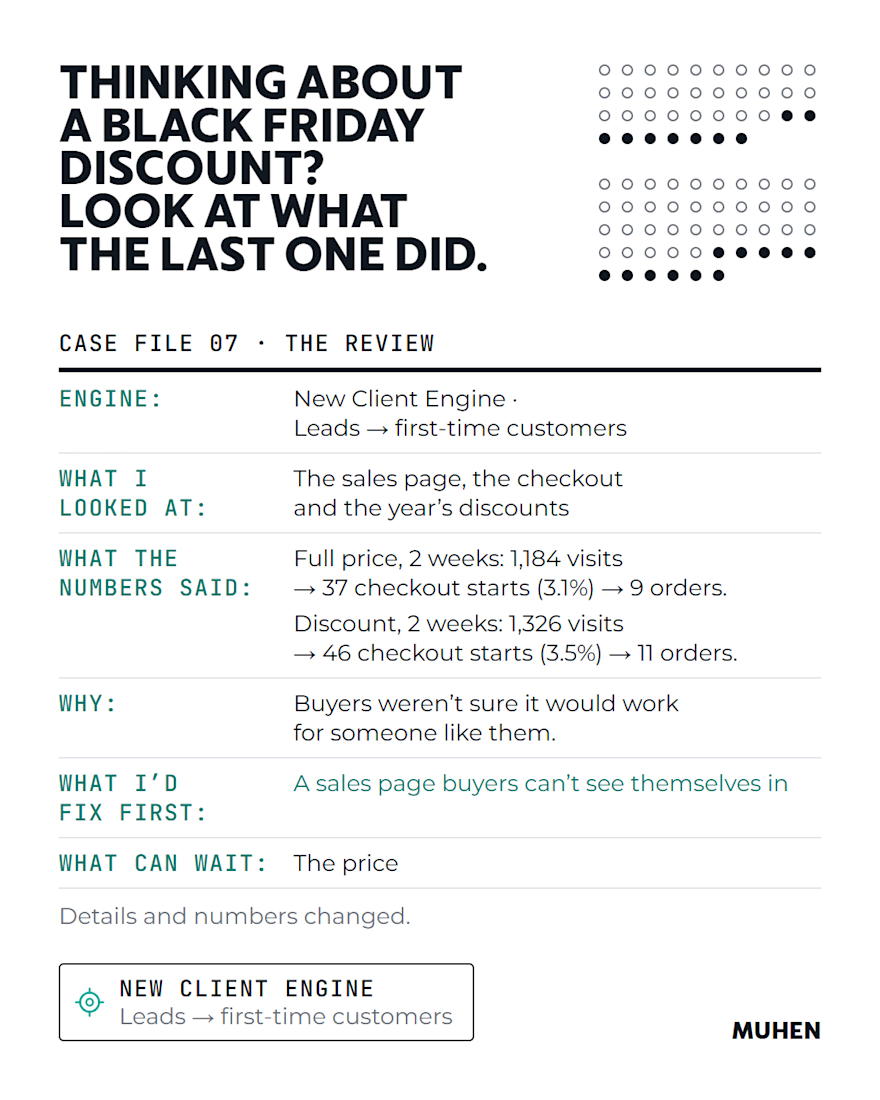
It's Black Friday, so here's one from my case files on discounts.
An online coach has a slow month, so a discount goes out. It's the third one that year. This sits in what I call the New Client Engine, the stretch where leads become first-time customers. I looked at the sales page, the checkout and the year's discounts.
Here's what the numbers said. Two weeks at full price brought 1,184 sales page visits, 37 checkout starts (3.1%) and 9 orders. Two weeks on the discount brought 1,326 visits, 46 checkout starts (3.5%) and 11 orders. Visits went up. Almost the same share of them led to a checkout start.
Why? Buyers weren't sure the program would work for someone like them. Nothing on the page spoke to their situation, and every story they'd seen came from a different kind of person at a different stage. A cheaper version of something you doubt is still something you doubt.
Based on these numbers, I wouldn't run another discount. I'd fix the sales page first, so buyers can see themselves in it. At full price, 1,147 of 1,184 visits ended without a checkout start, and the discount barely changed that.
The price can wait. It can stay right where it is.
Case File 07. Details and numbers changed.