The network for creativity
Join 1.25M professional creatives like you
Connect with clients, get discovered, and run your business 100% commission-free
Creatives on Contra have earned over $150M and we are just getting started
Back to feedPost

WordPress vs. Custom-Coded Websites: Choosing the Right Development Approach
In an increasingly digital-first world, a website is no longer simply an online representation of a business. It is a critical component of a company’s brand identity, customer experience, marketing strategy, and long-term growth.
However, before developing a website, one fundamental question must be addressed:
Should the website be built with WordPress, or should it be developed entirely from scratch using custom code?
Both approaches have their own strengths and limitations. The right choice depends not on which technology is considered “better,” but on the specific objectives, technical requirements, budget, and future direction of the project.
Understanding the distinction between these two approaches can help businesses make more informed and strategic decisions.
Understanding WordPress
WordPress is an open-source Content Management System (CMS) that provides a flexible foundation for developing and managing websites.
Its extensive ecosystem of themes, plugins, page builders, and development tools allows developers to create a wide variety of digital experiences without having to develop every component from the ground up.
WordPress is commonly used for:
Corporate and business websites
Personal portfolios
Blogs and publishing platforms
E-commerce stores
Service-based businesses
Personal brands
Membership websites
Educational platforms
Its combination of flexibility, accessibility, and extensive functionality has made it a practical solution for organizations of many different sizes.
Understanding Custom-Coded Websites
A custom-coded website is developed specifically for a particular project using programming languages, frameworks, and technologies selected according to its requirements.
Depending on the nature of the application, developers may work with technologies such as HTML, CSS, JavaScript, PHP, Python, React, Next.js, Node.js, or Laravel.
Rather than relying primarily on pre-built themes and plugins, developers create the architecture, functionality, and user experience specifically for the project.
This approach is particularly valuable when a business requires highly specialized functionality, complex workflows, advanced integrations, or complete control over its technical architecture.
1. Development Speed
Development time is often one of the first considerations when selecting a technology.
WordPress
WordPress can considerably accelerate the development process because developers can leverage existing themes, plugins, components, and development tools.
For a standard business website, this can make it possible to move from concept to launch relatively quickly.
Custom Development
Custom-coded applications generally require more development time because core components and functionality may need to be designed and implemented specifically for the project.
Although this increases the initial development effort, it can be justified when the project has complex or highly specific requirements.
In terms of development speed, WordPress generally has the advantage.
2. Cost and Investment
Budget is another major consideration in website development.
WordPress
WordPress can be a cost-effective option, particularly for small and medium-sized businesses.
Developers can utilize existing solutions instead of building every feature from scratch. However, expenses may increase depending on premium themes, plugins, hosting, security, maintenance, and custom development requirements.
Custom Development
Custom development typically requires a greater initial investment because more development work must be performed specifically for the project.
However, for complex applications, this investment can provide long-term value by creating a system that is precisely aligned with the organization's operational requirements.
Therefore, the lowest initial cost is not always the same as the lowest long-term cost.
3. Customization and Control
Customization is one of the most significant differences between the two approaches.
WordPress provides substantial flexibility through themes, plugins, page builders, and custom development.
For the majority of business websites, this level of customization is more than sufficient.
Custom development, however, provides a deeper level of control. Developers can determine how the application is structured, how its features operate, how data is processed, and how different systems interact.
For projects with highly specific requirements, this level of control can be extremely valuable.
Custom development generally has the advantage when complete technical control is required.
4. Performance and Optimization
Website performance is influenced by far more than the technology used to build a website.
Hosting quality, code efficiency, image optimization, database structure, caching, third-party services, and overall architecture all have an impact.
A WordPress website can perform exceptionally well when it is professionally developed and properly optimized. However, excessive plugins, poorly developed themes, unoptimized media, and inadequate hosting can negatively affect performance.
Custom development allows developers to build an application around specific performance requirements and minimize unnecessary dependencies.
Therefore, while custom development can provide greater control over performance, a well-engineered WordPress website can also deliver excellent speed and reliability.
5. Security
Security is an essential consideration for every website, regardless of the development approach.
WordPress requires regular updates to its core software, themes, and plugins. Using outdated software or unreliable third-party plugins can introduce unnecessary security risks.
Custom-coded applications provide greater control over the underlying architecture, but they are not automatically secure.
Secure authentication, authorization, database protection, input validation, server configuration, dependency management, and regular security updates remain essential.
Ultimately, security is determined largely by development quality, configuration, and ongoing maintenance—not simply by whether a website uses WordPress or custom code.
6. Content Management
This is an area where WordPress provides a particularly strong advantage.
WordPress offers an intuitive administration interface that enables non-technical users to manage website content without requiring programming knowledge.
Businesses can easily update:
Pages
Articles
Images
Products
Categories
Services
Menus
Other website content
With custom development, a dedicated administration system can certainly be created. However, developing such a system requires additional time and resources.
For organizations that frequently manage their own content, WordPress can therefore be a highly practical solution.
7. Scalability and Future Growth
A website should not only satisfy current requirements; it should also have the ability to evolve as the business grows.
WordPress can support a wide range of expansions, including:
Website → Blog → E-commerce → Memberships → Booking Systems → Advanced Filtering → Custom Integrations
With appropriate architecture, hosting, optimization, and maintenance, WordPress can support substantial growth.
Custom development can also be highly scalable and may be particularly suitable for large applications where complex business logic, high traffic, or specialized infrastructure is required.
The important consideration is not simply scalability itself, but how the system is architected from the beginning.
8. Maintenance and Long-Term Management
No professional website is truly “finished” after launch.
Both WordPress and custom-coded applications require ongoing maintenance.
For WordPress, maintenance may include:
Core updates
Plugin and theme updates
Security monitoring
Backups
Performance optimization
Database maintenance
Custom applications may require:
Security patches
Bug fixes
Dependency updates
Server maintenance
Performance optimization
Feature enhancements
Therefore, long-term maintenance should always be considered when evaluating the total cost and practicality of a development approach.
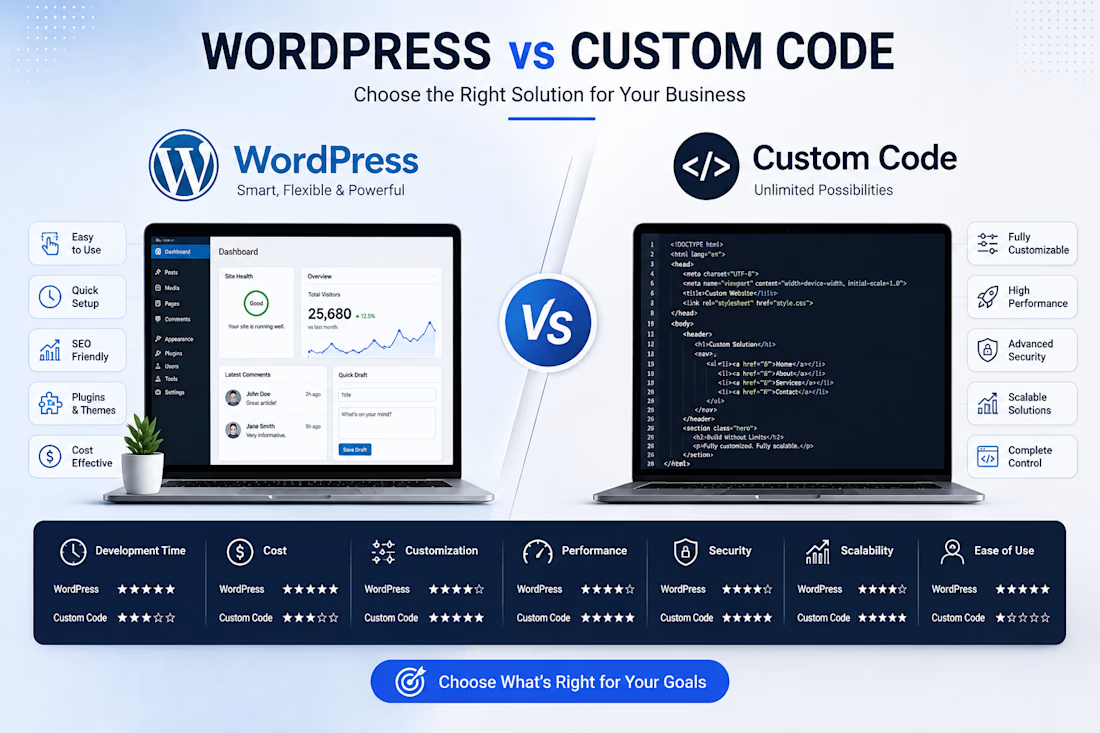
WordPress vs. Custom Development: At a Glance
FactorWordPressCustom DevelopmentDevelopment SpeedGenerally fasterUsually slowerInitial InvestmentOften lowerUsually higherCustomizationHighVery highContent ManagementExcellentRequires custom CMS/adminE-commerceStrong with WooCommerceFully customizablePerformance ControlHigh with optimizationVery highTechnical ControlHighVery highScalabilityHighVery highMaintenanceStructured and regularFully project-dependentIdeal Use CaseBusiness websites, blogs, storesComplex applications and specialized systems
When Should You Choose WordPress?
WordPress is often an excellent choice when the project requires:
A professional website within a reasonable timeframe
A user-friendly content management system
A business or corporate website
A content-driven platform
An online store
A flexible and expandable solution
A moderate development budget
For many businesses, WordPress provides an excellent balance between cost, functionality, flexibility, and development efficiency.
When Should You Consider Custom Development?
Custom development may be more appropriate when a project requires:
Highly specialized functionality
Complex business logic
Advanced integrations
A unique application architecture
Complete control over the technology stack
Highly specific performance requirements
A large-scale application environment
In these situations, building a solution specifically around the project's requirements can provide significant long-term benefits.
The Technology Should Serve the Business
One of the biggest misconceptions in web development is that custom coding is always superior to WordPress simply because it involves more programming.
That is not necessarily true.
Likewise, choosing WordPress simply because it is faster or more affordable is not always the correct decision.
The real question should be:
What technology can deliver the most effective solution for the project's requirements?
Technology is a tool.
The objective of web development is not to use the most complicated technology available. The objective is to create a reliable, secure, scalable, and user-focused digital solution that delivers measurable value.
Final Thoughts
WordPress and custom-coded websites are not competing technologies where one must always replace the other. They are different approaches designed to address different types of problems.
WordPress excels in accessibility, development efficiency, content management, flexibility, and cost-effectiveness.
Custom development excels in specialized functionality, architectural control, and highly tailored digital solutions.
The best choice depends on the project's objectives, complexity, budget, performance requirements, maintenance strategy, and long-term vision.
Ultimately, successful web development is not measured by how much code has been written or which platform has been selected.
It is measured by how effectively the final product solves a problem, serves its users, supports the business, and creates value.
The right technology is not the one that looks the most impressive—it is the one that best serves the purpose.
Contact me 🔥
Fiverr : https://www.fiverr.com/pubudubhagya?public_mode=true
Linkdin : https://www.linkedin.com/in/pubudu-bhagya-9b886042a/
Behance : https://www.behance.net/pubudubhagya7729
Facebook : https://web.facebook.com/APEXDEV7729
Instargram : https://www.instagram.com/apexdev7729/
Tiktok : https://www.tiktok.com/@apexdev7729


The network for creativity
Join 1.25M professional creatives like you
Connect with clients, get discovered, and run your business 100% commission-free
Creatives on Contra have earned over $150M and we are just getting started
Trending
retrofuturism
Share your favorite designs from the past exploring the distant future. Or your own take on the aesthetic 🚀
halftone
Dots. Texture. Grain. Let's see your designs using the halftone technique.

Midjourney
Creatives are showing off what they're making with Midjourney.
colorgrade
Video editors sound off: How do you enhance the mood of your video in color grading?
Related posts

Custom component for the Forja website
The cards animate on horizontal scroll with a flashlight effect and revealing text
What do you think?


Looks good!

Recent design project. Created an animated background for the section using Midjourney + Codex.


Nice work

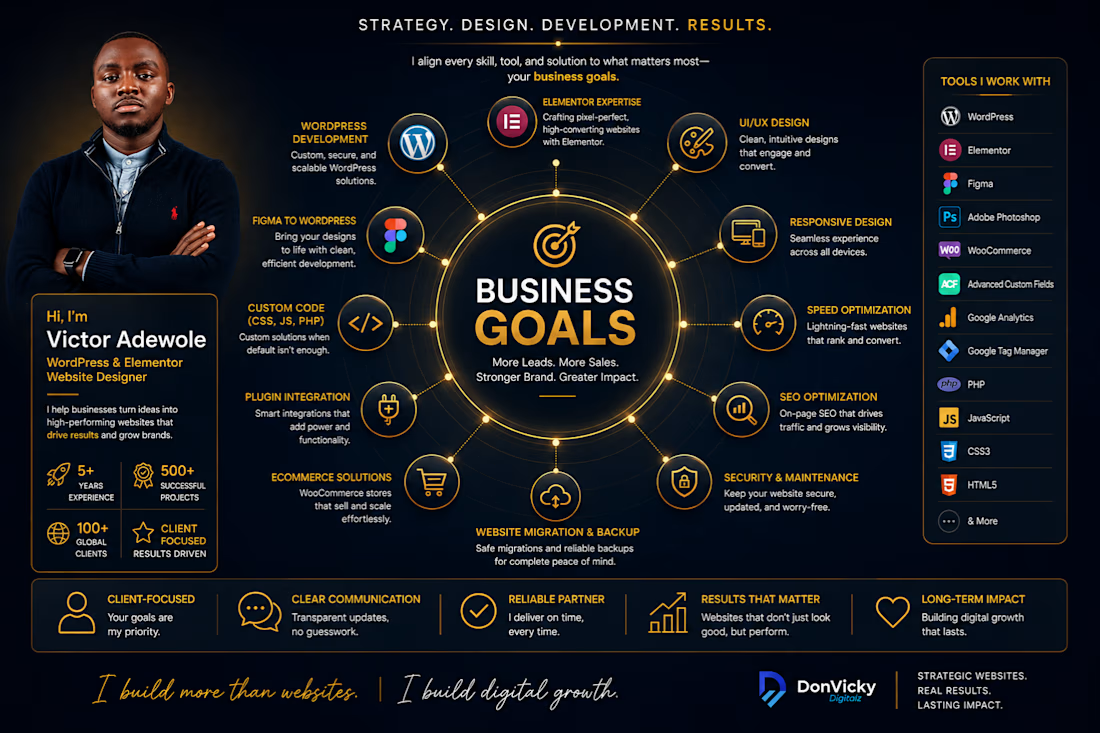
𝗜 𝗗𝗼𝗻'𝘁 𝗥𝗲𝗮𝗹𝗹𝘆 𝗕𝘂𝗶𝗹𝗱 “𝗪𝗲𝗯𝘀𝗶𝘁𝗲𝘀.” 𝗜 𝗕𝘂𝗶𝗹𝗱 𝗦𝘆𝘀𝘁𝗲𝗺𝘀 𝗔𝗿𝗼𝘂𝗻𝗱 𝗕𝘂𝘀𝗶𝗻𝗲𝘀𝘀𝗲𝘀
A website might be where the project starts.
But it rarely ends there.
A business website can involve:
WordPress
→ Content management
Elementor
→ Visual experience
WooCommerce
→ E-commerce
Forms & automation
→ Lead capture
Analytics
→ Measurement
SEO
→ Discovery
Performance optimization
→ User experience
Third-party integrations
→ Business operations
Custom code
→ Functionality the standard tools can't handle
Once you understand how these pieces connect, you stop looking at a website as a collection of pages.
You start seeing it as part of the business infrastructure.
That's the direction I've been taking my work:
Not just building pages.
Building digital systems that actually support the business behind them.