The network for creativity
Join 1.25M professional creatives like you
Connect with clients, get discovered, and run your business 100% commission-free
Creatives on Contra have earned over $150M and we are just getting started
Back to feedPost

LOOP — A softer way to organize a life that refuses to stay in one category.
As a student, bouquet seller, occasional part-time worker, and someone who joins competitions and different projects, I kept running into the same problem:
My life didn't fit neatly into one calendar.
School had its own deadlines.
My small business had its own tasks.
Competitions had their own schedules.
And then there was everything personal—sleep, routines, errands, and the things I kept forgetting to keep track of.
I wanted one place where all of these could coexist without turning everything into one overwhelming list.
So I built Loop.
Try Loop → loop--rffsky.replit.app
The idea
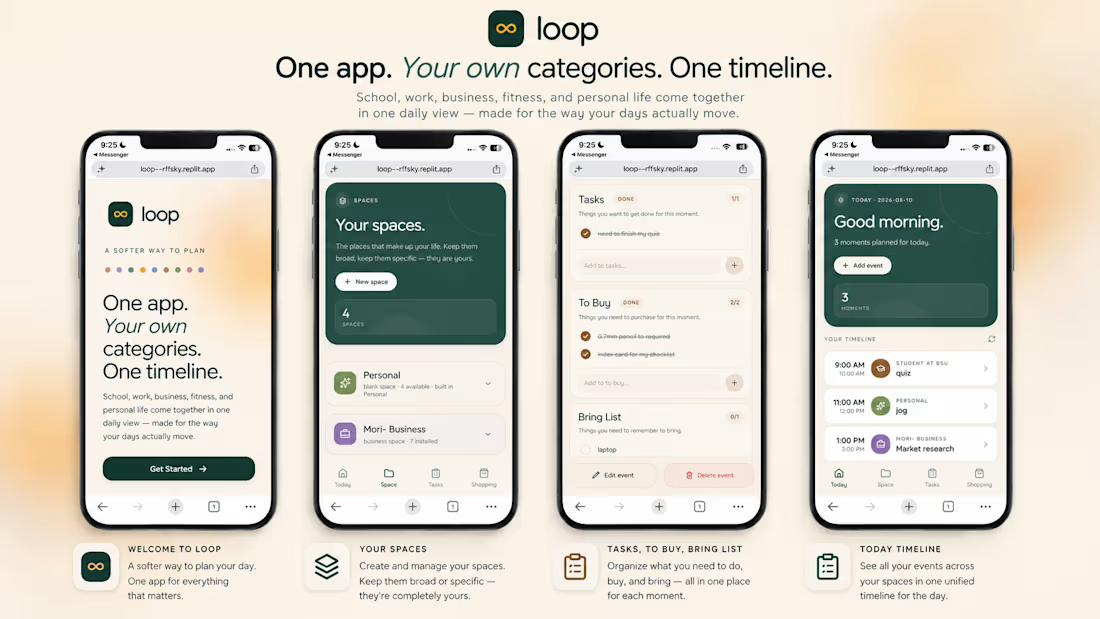
Loop organizes life into Spaces.
A Space can represent anything: Personal, School, Business, Fitness, a project, a client, an organization—or something completely different.
Each Space has its own identity, color, events, and installable tools.
There are 14 general tools available to build a Space around your needs:
Calendar · Tasks · To Buy · Bring List · Habits · Notes · Journal · Files · Contacts · Inventory · Price List · Goals · Expenses · Links
And Personal has its own built-in tools:
Sleep · Water Tracker · Mood
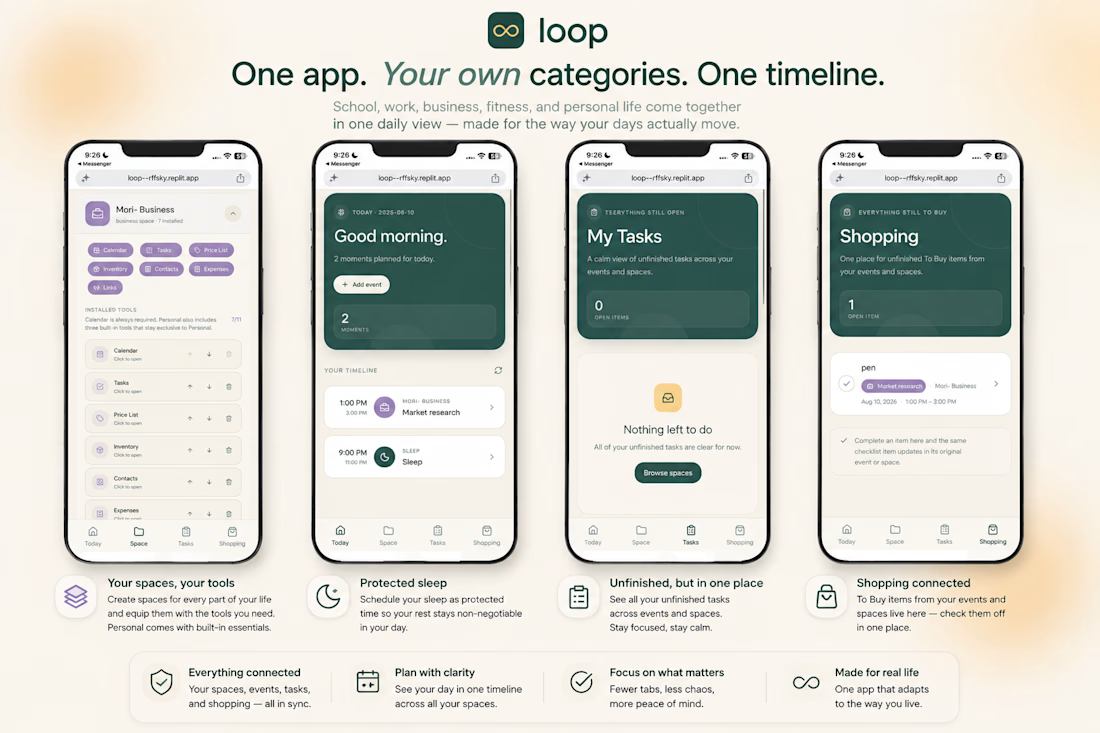
Sleep is particularly important because it isn't treated as another task—it can become protected time in your schedule.
Everything is connected
Loop isn't just a collection of separate screens.
Create an event → add Tasks, To Buy, or Bring List items → those unfinished items can surface in My Tasks and Shopping → and your events ultimately come together in Today, giving you one timeline across all your Spaces.
The system also accounts for schedule conflicts and protected time, so organizing your life isn't only about recording what happens—it's about understanding how everything fits together.
Built as a template, not just an app
Although I designed Loop around my own life, the underlying idea is intentionally broader.
A student could remix it into a school planner.
A freelancer could turn Spaces into clients and projects.
A small business could use them for operations, inventory, expenses, and contacts.
A team could adapt it into a project-management workspace.
A creator could turn it into a content-production system.
An event organizer could build a planning dashboard.
Or someone could simply keep it as what it is now:
one place for a complicated life.
That's what I wanted Loop to be—a polished, functional starting point that someone else can open, understand, and reshape into something completely their own.
Built in Replit, with a reusable visual system, connected workflows, responsive interfaces, and real sample data.
The showcase
I’ve included the project presentation in this post:
01 — UI mockups
A visual overview of the Loop experience and its design language.
02 — Mobile walkthrough
A complete look at the mobile experience and how the core workflows connect.
03 — Desktop walkthrough
The same system presented as a larger workspace, showing how the experience scales beyond mobile.
Try the live project:
loop--rffsky.replit.app
Loop — different parts of life. One connected space.
#Replit #ReplitBuildathon #Contra #Buildathon #ReplitTemplates #WebApp #ProductDesign #UIUX #DesignSystems #Productivity #LifeOrganizer #NoCode #IndieMaker #BuildInPublic


Nice
The network for creativity
Join 1.25M professional creatives like you
Connect with clients, get discovered, and run your business 100% commission-free
Creatives on Contra have earned over $150M and we are just getting started





Related posts

I already submitted my Lovable challenge but I decided to update the landing page and make it look a little bit better by introducing more images to make the page a little bit more interactive especially on the services section, which one do you like: the old one or the new one?
You can test it here: https://carmobifix.lovable.app/
submitted project: https://contra.com/community/KUoCqygQ-i-built-mobi-fix-nairobi-a
43 voted
74%
15 voted
26%
58 votes
Closed

you had credit left ? mine finished...like 4, 5 credits left..😂

FadeFlow: From “Can I book Saturday?” to “You’re booked.”
I built FadeFlow for Fade District, a fictional solo barbershop in Yaba, Lagos, run by Malik Adeyemi.
The problem is simple: a lot of bookings start with a message like:
“Can I get a haircut Saturday afternoon?”
From there, Malik has to ask for the service, check availability, reply with time options, create the booking, confirm it, collect the deposit, send reminders, and handle changes.
FadeFlow removes that back-and-forth.
Customers can choose a service, see available times, pay a ₦5,000 deposit, and confirm their appointment themselves.
And when they still message instead, FadeFlow turns the inquiry into a structured booking request. Malik can see what they want, send available times, and create the booking in one action.
Once it's booked, FadeFlow keeps everything connected:
✓ Calendar updated
✓ Customer updated
✓ Confirmation sent
✓ Reminder scheduled
Rescheduling works the same way. The old slot is released, the new one is reserved, and the related reminders are updated automatically.
I built it around one idea:
Let the customer handle the predictable parts. Let Malik handle the moments that actually need him.
Lovable project links:
Landing page (Customers view):
https://screenshot-perfect-6501.lovable.app
Webapp (Malik's view):
https://id-preview--329aba93-5208-4e22-947a-05f325da1d5c.lovable.app/app
Built with Lovable.
#lovablechallenge @Lovable
looking shap

We can't wait to kick off the Invideo Editor Challenge!
Check out the guidelines here to get started on your submission ⭐️