The network for creativity
Join 1.25M professional creatives like you
Connect with clients, get discovered, and run your business 100% commission-free
Creatives on Contra have earned over $150M and we are just getting started
Back to feedPost

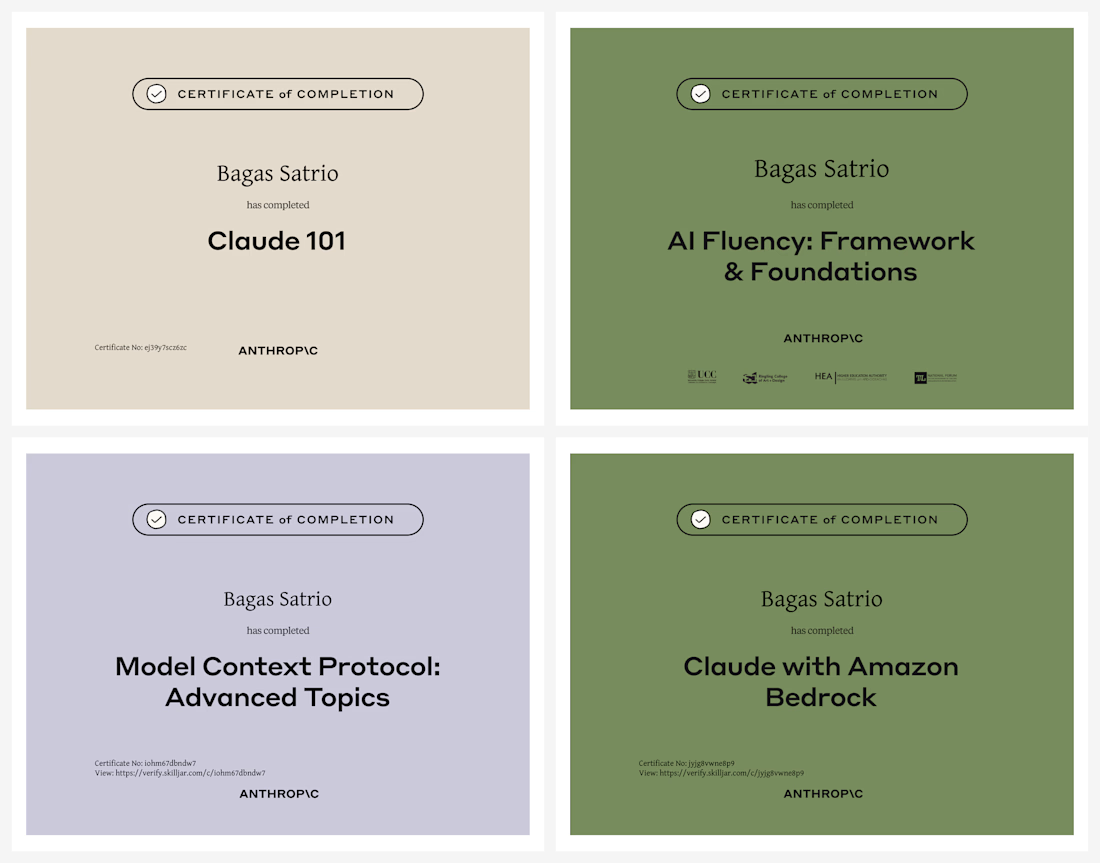
Last month, I wrapped up a deep dive into Anthropic Academy — 19 certifications covering everything from AI fluency fundamentals to Claude API, Claude Code, Model Context Protocol, and deploying Claude on AWS Bedrock & Google Vertex AI.
Nothing fancy, just consistent learning over a few weeks. I wanted to properly understand the tools I've been building with, not just use them on the surface.
Now bringing that deeper understanding into client work — building SaaS products, automations, and AI-integrated tools that are actually grounded in how these systems work under the hood.
Always learning, always building. 🚀
#claude #freelancerlife #buildingwithAI


The network for creativity
Join 1.25M professional creatives like you
Connect with clients, get discovered, and run your business 100% commission-free
Creatives on Contra have earned over $150M and we are just getting started











Related posts

Shipped my first feature on Delphi last week!
We touched on profiles to add more entry points to a conversation, based off the users life experiences.
Already working on v1.2, stay tuned!


Solid work here can't wait for v1.2

The team is cooking
Motion design for the logo we are making for Nation e-commerce

Wou

Building a Modern Restaurant Management Dashboard with Lovable (Light ☀️ vs. Dark 🌙)
I’ve been working on the dashboard interface for ReserveTable (Eat Pro Japan), focusing on giving restaurant managers and users a clean, modern, and intuitive interface to manage bookings, tables, and analytics.
Using Lovable, I was able to rapidly prototype and construct a modern UI system complete with smooth component transitions and native theme switching.
✨ Key Design & Tech Highlights:
⚡ Built with Lovable: Leveraged AI-powered design-to-code workflows to assemble clean component hierarchies, responsive search/filter bars, and sleek cards rapidly.
🌗 Seamless Light & Dark Mode: Designed a flexible color system using modern CSS variables / Tailwind tokens so the entire interface gracefully shifts between an elegant light aesthetic and a moody, dark dining ambience.
🎯 Contextual UI Elements: Styled input controls, select menus, and primary CTA buttons to maintain legibility and contrast across both light and dark themes.


For reservation and table states, the same semantic color tokens need to stay clear in light and dark mode. Did you define status tokens once and map both themes to them, or tune those colors per component?