The network for creativity
Join 1.25M professional creatives like you
Connect with clients, get discovered, and run your business 100% commission-free
Creatives on Contra have earned over $150M and we are just getting started
Back to feedPost

A lot of good content does not perform.
Not because it lacks effort or quality.
But because it lacks clarity.
If the audience cannot quickly understand
why something matters to them,
they move on.
Good content holds attention.
Clear content earns it.

The network for creativity
Join 1.25M professional creatives like you
Connect with clients, get discovered, and run your business 100% commission-free
Creatives on Contra have earned over $150M and we are just getting started





Related posts

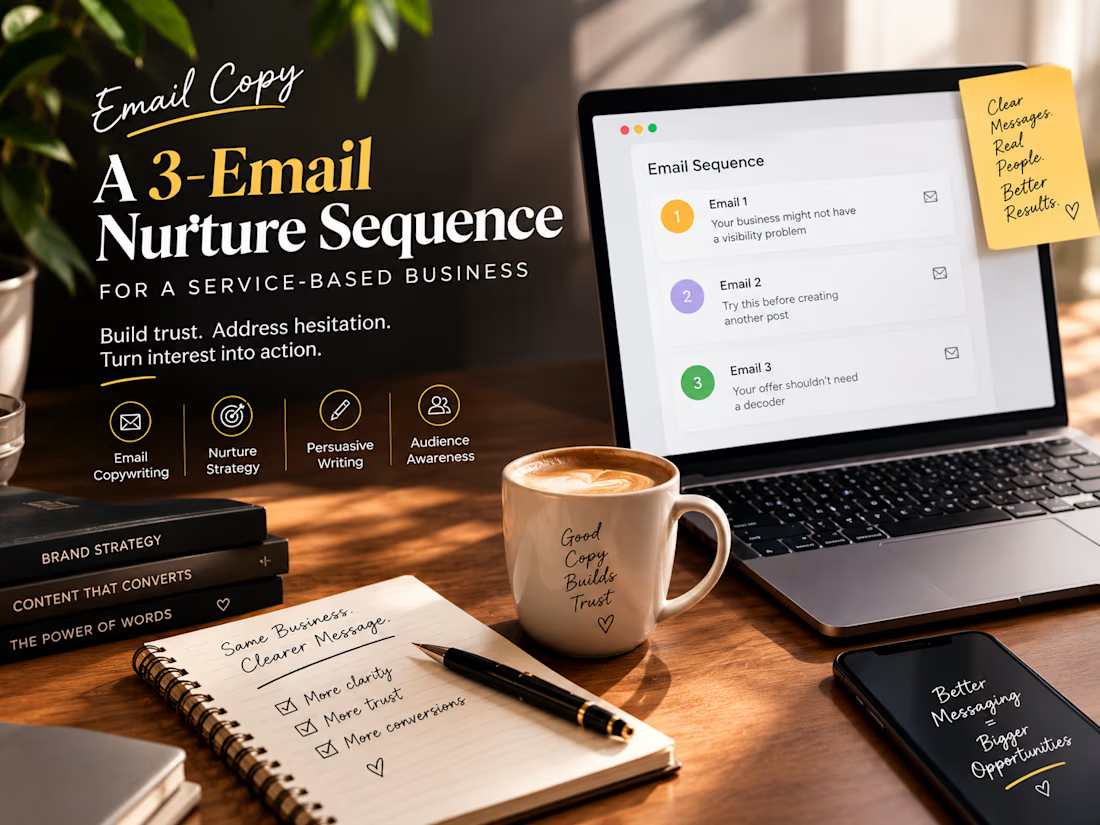
EMAIL 1 — The problem
Subject: Your business might not have a visibility problem
You’re posting.
You’re showing up.
You’re talking about what you do.
But somehow, people still don’t seem to understand why they should choose you.
That can feel like a visibility problem.
Sometimes, it isn’t.
Sometimes, the real problem is that your message isn’t making the value of your business clear enough.
When someone lands on your website or sees your content, they should be able to quickly understand:
What do you help with?
Who is it for?
And why should they care?
If those answers aren’t clear, posting more won’t necessarily fix the problem.
The message comes first.
Tomorrow, I’ll show you one simple way to check whether your current messaging is doing its job.
[Brand Strategist]
EMAIL 2 — The insight
Subject: Try this before creating another post
Open your website.
Now imagine you’ve never heard of your business before.
Give yourself 10 seconds.
Can you answer these three questions?
What does this business help me do?
Is this actually for someone like me?
Why should I trust them?
If you have to search for the answers, your potential customer probably has to as well.
And when people have to work too hard to understand an offer, they often leave.
Your copy doesn’t need to say everything.
It needs to make the right things clear.
That’s where strong positioning and messaging can change the way people experience your business.
If your message feels harder to explain than your service should be, that’s worth looking at.
[Brand Strategist]
EMAIL 3 — The next step
Subject: Your offer shouldn’t need a decoder
You already know how good your service is.
The challenge is making a stranger understand that quickly.
If your website, content, or offer currently feels like it’s saying a lot without making the main value obvious, it may be time to simplify.
Not by making your business smaller.
By making the message clearer.
If you’d like help figuring out where your messaging is losing clarity, book a consultation here — [CTA]
No complicated pitch.
Just a conversation about what’s working, what’s unclear, and what could be stronger.
[Brand Strategist]
Project description
Brief:
Create a 3 email nurture sequence for a fictional brand strategist whose prospects have shown interest but haven’t taken the next step.
Approach:
The sequence moves from identifying a messaging problem, to providing a useful insight, to presenting a low pressure next step. The copy focuses on clarity and relevance rather than aggressive selling.
Skills demonstrated:
Email copywriting, persuasive writing, audience awareness, nurture strategy, CTA writing.
Project note:
This is a speculative practice project created to demonstrate my email copywriting and strategic thinking. No client performance results are being claimed.


Great nurture sequence. Each email builds trust naturally and makes the next step feel easy.

200 reactions look great, but what do they tell us?
As a content and social media manager, I look beyond the engagement count: are we reaching the people we want to reach and getting the response we’re aiming for?
If the goal is to generate product interest, I’d rather see 20 people asking about the product than 200 simply liking the video.
Both can be valuable, but the goal determines which matters more.
Which audience would you rather build?
3 voted
27%
8 voted
73%
11 votes
Closed

This creative is 🔥 — and your stratagy is really awsome that show how you make the intrests of your's clint and engage them for long term work.

on Saturday i got to speak on social media & content strategy at my first IRL event 🥹
i'm still processing all the emotions but it was amazing to speak at The Retreat by FWDHer.
in my session i talked to the women founders about building a content strategy you can actually sustain.
we went through an exercise to help them ideate content ideas by starting with a "thesis" that helps ground their useful content & then commit to a repeatable practice rhythm
then we moved on to how to execute that useful content using different production levels in mind:
🌱high effort: think an edited video or designed carousel)
🌱medium effort: think a one-take video, repurposed video, picture carousel/photo dump or text or graphic photo + caption)
🌱low effort: think photo with caption, short text post or simple story)
your content shouldn't be built on high-effort posts alone. a mix of effort levels and repurposing is what keeps it sustainable.
the takeaway i left them with: you don't need to post every day. you need one idea, three ways to use it (teach, prove, invite), and a rhythm you can return to when the week gets busy.
this was my first time speaking/teaching like this IRL, and it reinforced what i believe about content: it works best as a practice, not a pressure. 🌻
if you're planning a retreat, workshop, or event and want a speaker on social media & content strategy, i'd love to talk.
and if you're a founder or brand that needs a strategist to build a content practice you can actually sustain, you can book time with me here: https://contra.com/s/m6ZFFBev-the-consult-a-single-strategy-session