The network for creativity
Join 1.25M professional creatives like you
Connect with clients, get discovered, and run your business 100% commission-free
Creatives on Contra have earned over $150M and we are just getting started

The network for creativity
Join 1.25M professional creatives like you
Connect with clients, get discovered, and run your business 100% commission-free
Creatives on Contra have earned over $150M and we are just getting started



Related posts

Lots of talk about AI Bubble vs AI Domination.
Let's see who wins in November 2026

Such cool concept 😄

I rebuilt my AI trading system's brain in 48 hours. It no longer matches keywords. It reasons.
Two days ago, OIL-NEWS-SYSTEM was a deterministic sentiment engine. It scanned oil headlines against a hard-coded vocabulary of bullish and bearish phrases—"production cut," "pipeline attack," "inventories draw"—and fired a trade when the signal was strong enough.
It worked. But it was blind in a specific way: it could not tell the difference between a headline about oil and a headline that mentioned oil. It could not weigh how severe a supply shock was. It could not answer the question every trader actually asks: how much does this matter?
So I ripped out the brain and built a new one.
Enter groq_brain.py.
The system now runs every headline through a reasoning model (openai/gpt-oss-20b via Groq) before a single dollar moves. It returns structured output:
Is this actually about oil? (Binary gate. Filters noise.)
Impact: BULLISH / BEARISH / NEUTRAL
Strength: 1–5, where 5 is "war, embargo, major supply shock"
Confidence: 0.0–1.0
A trade only fires above a confidence threshold. A circuit breaker catches API failures and falls back to the original deterministic engine—so the system never goes dark, it just gets dumber for a cycle instead of dying.
The architecture, stripped of marketing:
📡 twitter_monitor.py — polls target accounts every 20 seconds, primes on first poll, never trades stale news.
🧠 groq_brain.py — the new reasoning layer. Structured JSON out. Confidence-gated.
⚙️ sentiment.py — the original keyword engine, now the fallback, not the primary.
⚡ main.py — Binance Futures execution on BZUSDT. Leverage, position sizing, stop-loss, take-profit, rate-limit handling, reconnection logic.
🐳 Dockerized. Python 3.11. One docker run and it's live.
Cost to run: $0. No paid APIs in the critical path. No managed cloud. No subscriptions.
I also generated a 30-second film for it—entirely AI, no real footage. Fire, an empty room, a machine reasoning through a headline, and a trade executing without a human in the chair. It is the closest thing to seeing the system think.
🎥 Watch it. Then read the code.
If you're building autonomous systems and need an execution layer that actually ships—or you want to see what a real reasoning pipeline looks like before you hire someone to build yours—my inbox is open.
#AITrading #Python #Automation #LLM #BuildInPublic #QuantDev #FinTech #AI #king_AI


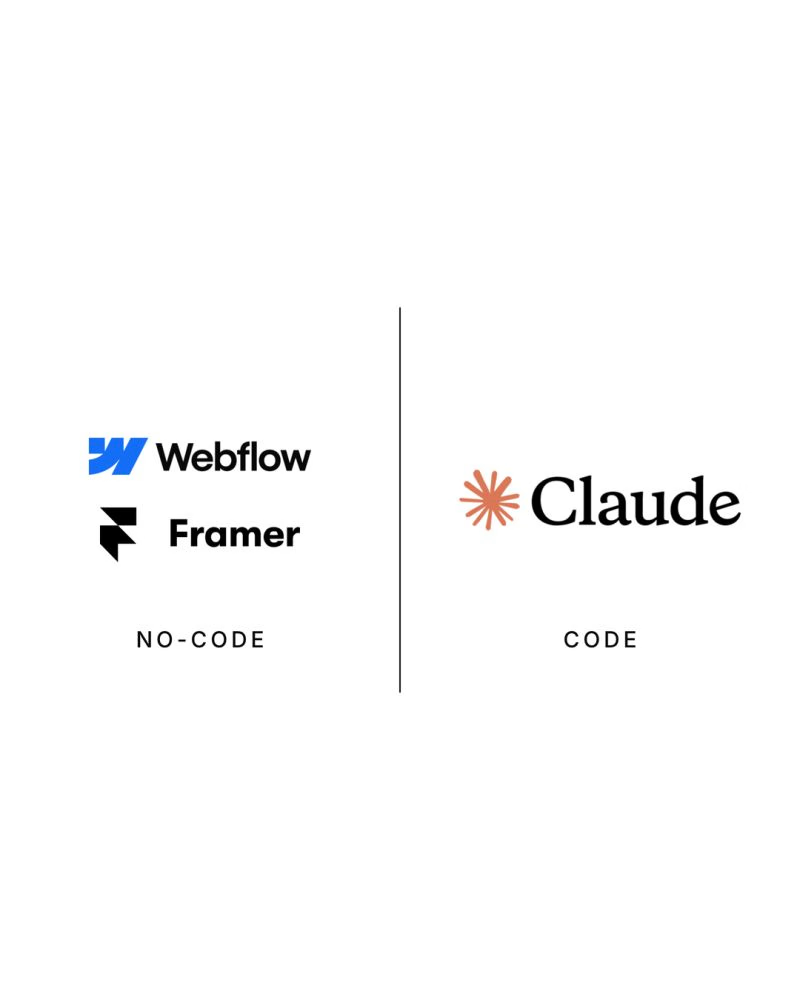
Moving from no-code to code with AI is becoming a trend.
The way people talk about it creates FOMO.
That’s the wrong reason to switch.
We’re moving our website to code too.
That doesn’t mean you should.
Stay on Webflow or Framer if:
· your marketing team edits the site every week
· nobody on the team reads code
· you’d rather pay a subscription than someone’s time
Move to code if:
· you have a design system and a style guide
· someone owns the repo, every single week
· your AI knows that system as well as you do
If nobody owns the system, stay where you are.
Which side is your team on?