The network for creativity
Join 1.25M professional creatives like you
Connect with clients, get discovered, and run your business 100% commission-free
Creatives on Contra have earned over $150M and we are just getting started
Back to feedPost

A slow MERGE in Snowflake usually comes down to one of three things:
1. Scanning everything. If the source is the whole staging table, every run reprocesses history. Filter on a high-water mark (updated_at > last load) so you only merge new rows.
2. Duplicate keys in the source. When several source rows match one target row, the MERGE either errors or does extra work. Deduplicate first with QUALIFY ROW_NUMBER() = 1.
3. No pruning on the target. Snowflake can only skip micro-partitions when the ON or filter conditions touch a column that the target is clustered or naturally ordered by, such as a date. Adding a date-range condition can cut the scan dramatically, as long as late updates can't fall outside that window.
Fix these three and you'll often see a MERGE that took minutes finish in seconds.
#Snowflake #SQL #DataEngineering


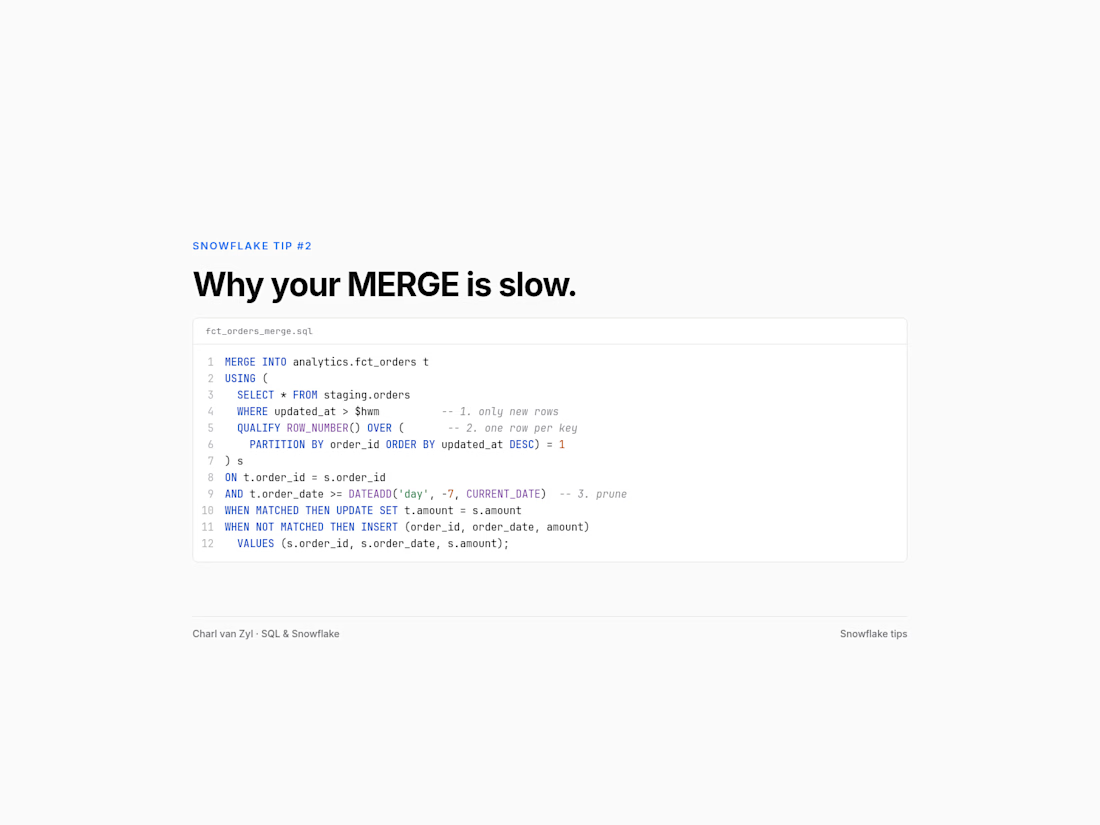


qualify row_number in one line is the dedupe trick people forget. pinning the date range tip too
The network for creativity
Join 1.25M professional creatives like you
Connect with clients, get discovered, and run your business 100% commission-free
Creatives on Contra have earned over $150M and we are just getting started











Related posts

Built an AI system that reads supplier invoices and posts them straight into a dealer management system. No one retypes anything anymore.
The problem: a group of car dealerships was getting hundreds of supplier invoices by email and WhatsApp photos, and staff were keying every line into their DMS by hand.
What I built:
• Email and WhatsApp intake, auto-matched to the right dealership
• AI and vision extraction of vendor, tax details, and line items grouped by vehicle
• Verification and duplicate detection before anything gets posted
• A review dashboard for the few cases that need a human
• Browser automation that posts approved invoices into the DMS
• WhatsApp auto-replies that chase suppliers for missing details
Result: 280+ invoices processed so far, with zero exceptions.
Stack: Python, LLM and vision models, React, Selenium
If your team is still copying data from documents into another system, that's usually very automatable. Happy to take a look at yours.
#AI #Automation #AIAgents
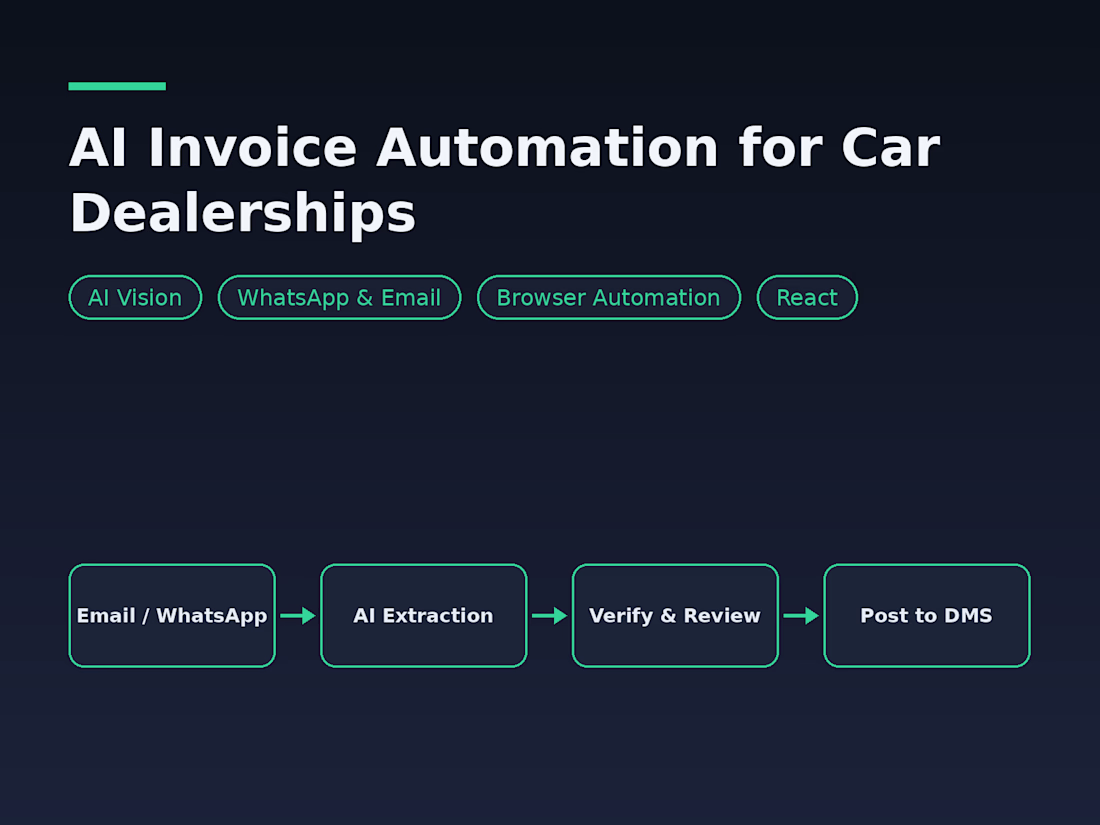

The WhatsApp auto-replies that chase suppliers for missing details are the piece I like most, since that closes the loop instead of just flagging a gap. How do you decide when a missing field gets an automatic chase versus going to the review dashboard for a person?

Built SpeedPulse AI — an automated website performance teardown and local client acquisition engine.
Most local businesses lose over 35% of their mobile conversions due to slow load times and missing Google SEO schema. Auditing each client manually took hours, so I automated the entire process on Base44:
⚡ Real-time Core Web Vitals, Local SEO & UX friction score dials
🔄 Dynamic Before/After sprint projections (gliding scores from 45 to 91+)
📄 Automated Executive PDF brief generation
🤖 Built-in Agency CRM that captures incoming leads, tracks stages, and auto-drafts client proposals with one-click copy
Live App: https://speedpulse-flow.base44.app


AI made exploration much cheaper for me
i'm not sure it made the work more enjoyable.
i enjoyed manually exploring different directions
even when it took a lot of effort
once i had a solid foundation,
new screens came together pretty easily
now i can generate a dozen directions and get something functional quickly
but it's often almost unusable.
most of my work comes afterward:
rearranging things,
discarding bad ideas,
removing generated slop...
feeling like this limping little guy
protecting you from the slop

That limping little guy protecting us from the slop is painfully relatable, Anton. I feel the same: generating a dozen directions is cheap now, but the rearranging, discarding and de-slopping afterward is where the real craft lives.