The network for creativity
Join 1.25M professional creatives like you
Connect with clients, get discovered, and run your business 100% commission-free
Creatives on Contra have earned over $150M and we are just getting started
Back to feedPost

Case Study: Online Pharmacy & Prescription Medicine Platform
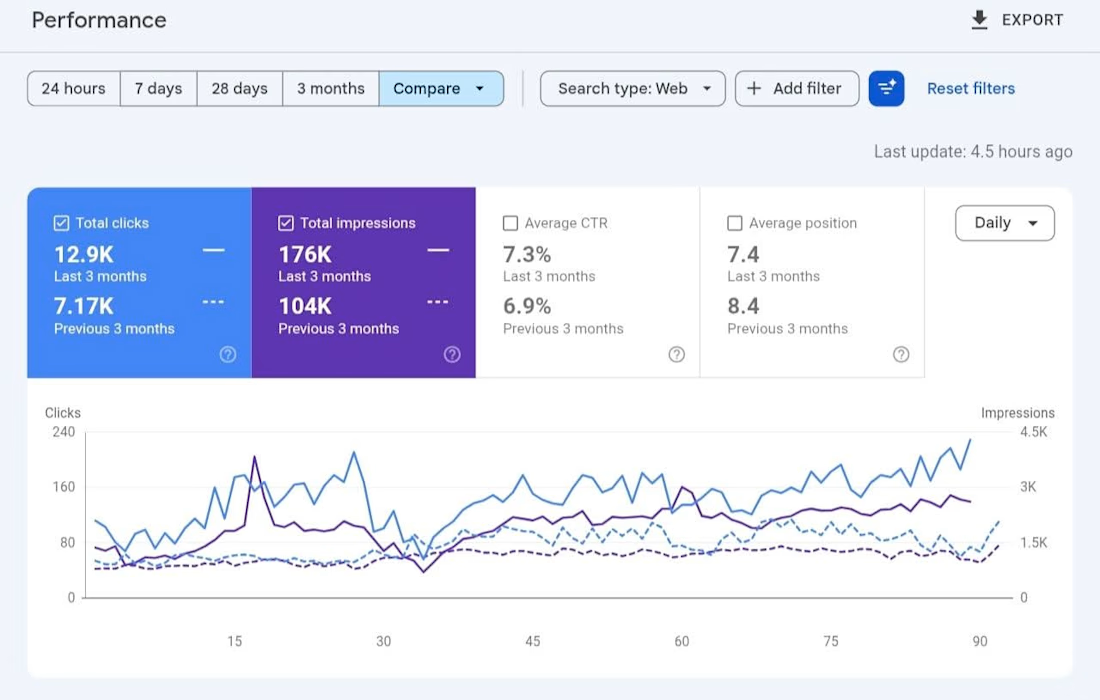
One ranking position. From 8.4 to 7.4. That single position was worth 5,730 additional clicks in one quarter."
THE DATA & WHAT IT ACTUALLY SHOWS
3-month compare view. Clicks: 7,170 to 12,900 — up 80%. Impressions: 104,000 to 176,000 — up 69%. CTR: 6.9% to 7.3% — improved. Position: 8.4 to 7.4 — improved by 1 full position.
The graph is the clearest visual in this portfolio. The light blue click line trends steadily upward from day 1 to day 90, from around 80 clicks per day to approaching the 240-click ceiling of the Y-axis. The dashed previous-period lines run well below throughout. CTR also improved alongside the click and impression growth — which means the new impressions being earned are quality ones, not volume for its own sake. This is what a clean, compounding optimisation looks like when the work is done correctly.
The key number here is that 1-position improvement. In Google's click curve, position 8 to position 7 is worth roughly 50% more traffic. That is the mathematics of the first page.
THE REAL TECHNICAL ISSUES I FOUND
First: the site had pages sitting between positions 8 and 9 for dozens of high-volume queries — a position range where you receive roughly 3-4% of available clicks. Moving those pages to positions 6-7 roughly doubles that click share. I identified 34 pages within 0.5 of a position improvement and concentrated the work there.
Second: product pages used generic titles leading with brand name and category — "BrandName | Paracetamol Tablets" — without any condition-based or symptom-based language. A patient searching by symptom ("fever tablets for adults" or "painkiller for back pain") does not immediately recognise a title that just shows a chemical name and a brand. The relevance match was weak.
Third: no MedicalWebPage or Drug Schema on product pages. Schema is structured code that tells Google exactly what a page is about — in this case, what the medication treats, its active ingredient, dosage information. Without it, these pages were ineligible for rich results and carried lower trust signals for health queries.
THE WORK I DID
I ran a position-gap audit in Search Console: every page with an average position between 8.0 and 9.5 was flagged as a priority target. I built internal links from the site's highest-authority pages pointing into each of those 34 flagged URLs. Internal links pass authority — adding three or four strong internal links to a borderline-page is often enough to push it over the position threshold.
I rewrote product page titles and H1 headings to lead with the condition or use case, followed by the product name. "Ibuprofen 400mg Tablets — Pain & Inflammation Relief" rather than "BrandName Ibuprofen".
I implemented MedicalWebPage Schema with active ingredient, condition treated, dosage form, and a reviewed-by field referencing a registered pharmacist. Every Schema field was validated in Google's Rich Results Test before going live.
THE DIRECT RESULTS
12,900 clicks and 176,000 impressions over the most recent 3-month window. Up from 7,170 clicks and 104,000 impressions the prior period. Position 7.4. CTR at 7.3%. The graph shows a growth curve that has not plateaued at day 90 — momentum is still building. The internal link authority transfers and Schema implementations both continue to compound as Google re-crawls and re-evaluates affected pages.


The network for creativity
Join 1.25M professional creatives like you
Connect with clients, get discovered, and run your business 100% commission-free
Creatives on Contra have earned over $150M and we are just getting started
Related posts

Footer section for my personal portfolio site.
Transition from website plans section to footer.
Next up: Time to launch 🚀


Looks Amazing 🔥

Taking a bold route for my website because you got to take risks in this market!
Which one nailed it?

5 voted
28%

13 voted
72%

18 votes
Closed

Traditional all the way

Your website has 3 seconds to keep a visitor.
After that - they're on your competitor's site.
Most business owners think they have a traffic problem.
They don't. They have a speed problem.
A slow website doesn't just frustrate users -
it actively sends your marketing spend straight to competitors.
=> Pages that load slowly lose up to 7% of conversions per second
=> 53% of mobile users abandon a site that takes over 3 seconds
=> Google penalises slow sites - your SEO ranking drops too
At YES IT Labs, we've helped businesses across e-commerce, hospitality and legal tech transform sluggish platforms into fast, conversion-ready experiences.
Speed isn't just a technical metric - it's a revenue metric.
Want to know exactly how your website is performing?
📩 DM us "SPEED" and we'll run a FREE performance diagnostic for your site.

Challenges
View all



Trending

Claude
Claude has entered the design space. How are you using Claude Design?

Contra University
Learn from expert creatives how to earn more using next-gen AI tools.

MagicPath
The canvas is infinite, and exploration is becoming the workflow. How are you using MagicPath?
creativeaiflow
Creative AI workflows are evolving. What tools do you use, and what are their strengths and weaknesses?
freelancerlife
Freelancer life is wins, pivots, and everything in between. What’s yours right now?