The network for creativity
Join 1.25M professional creatives like you
Connect with clients, get discovered, and run your business 100% commission-free
Creatives on Contra have earned over $150M and we are just getting started
Back to feedPost

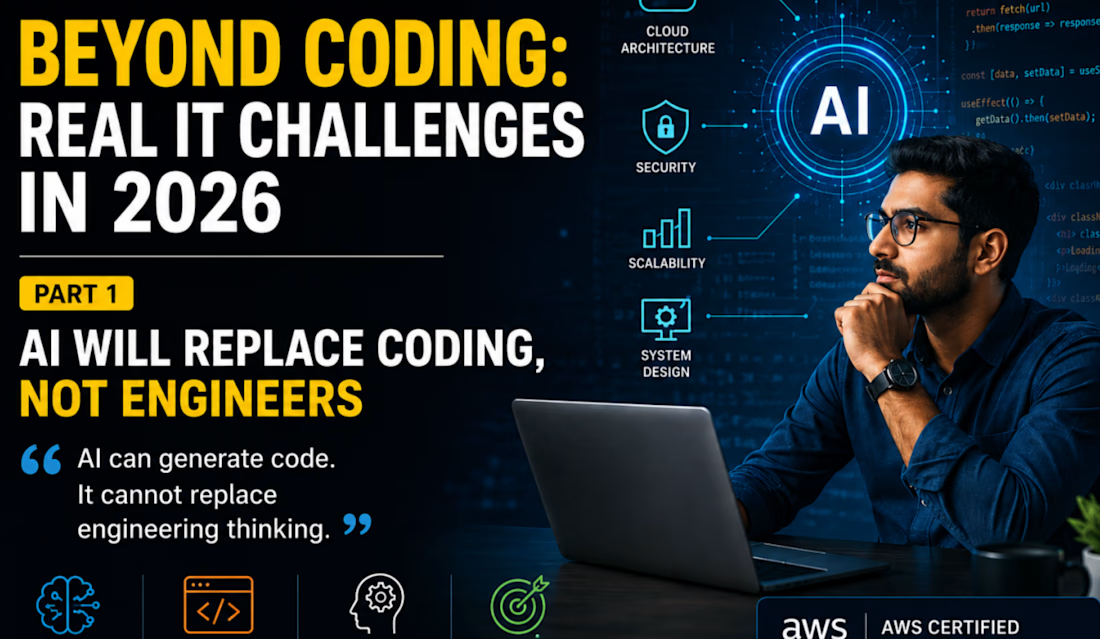
AI can already generate APIs, UI components, SQL queries, tests, even infra scripts… and this is probably only the start.
But writing code is only one part of engineering.
Most real production problems don’t happen because someone forgot a semicolon. They usually come from poor architecture decisions, scalability bottlenecks, weak security, tight coupling, or simply bad long-term planning.
AI can help us ship faster, but it still doesn’t truly understand business context, production behavior, customer expectations, or architectural tradeoffs the way experienced engineers do.
I think developers who only focus on coding may have a hard time in the next few years.
The engineers who will become more valuable are the ones who understand:
•system design
•scalability
•cloud infrastructure
•observability
•performance
•security
•product thinking
For me, AI is an accelerator, not a replacement for engineering fundamentals.
The future probably won’t belong to people fighting against AI. It’ll belong to people who know how to work with AI while still making smart technical decisions.
Curious what others think:
Will AI fully replace software engineers, or just change the role?
The network for creativity
Join 1.25M professional creatives like you
Connect with clients, get discovered, and run your business 100% commission-free
Creatives on Contra have earned over $150M and we are just getting started





Related posts

Cool AI work


For me, it’s cultural context. AI can generate references, but it can’t fully replicate lived experience. As a South African creative, so much of my work relies on instinct, memory, language and the nuances of how we actually experience our culture.
When I’m reimagining iconic...

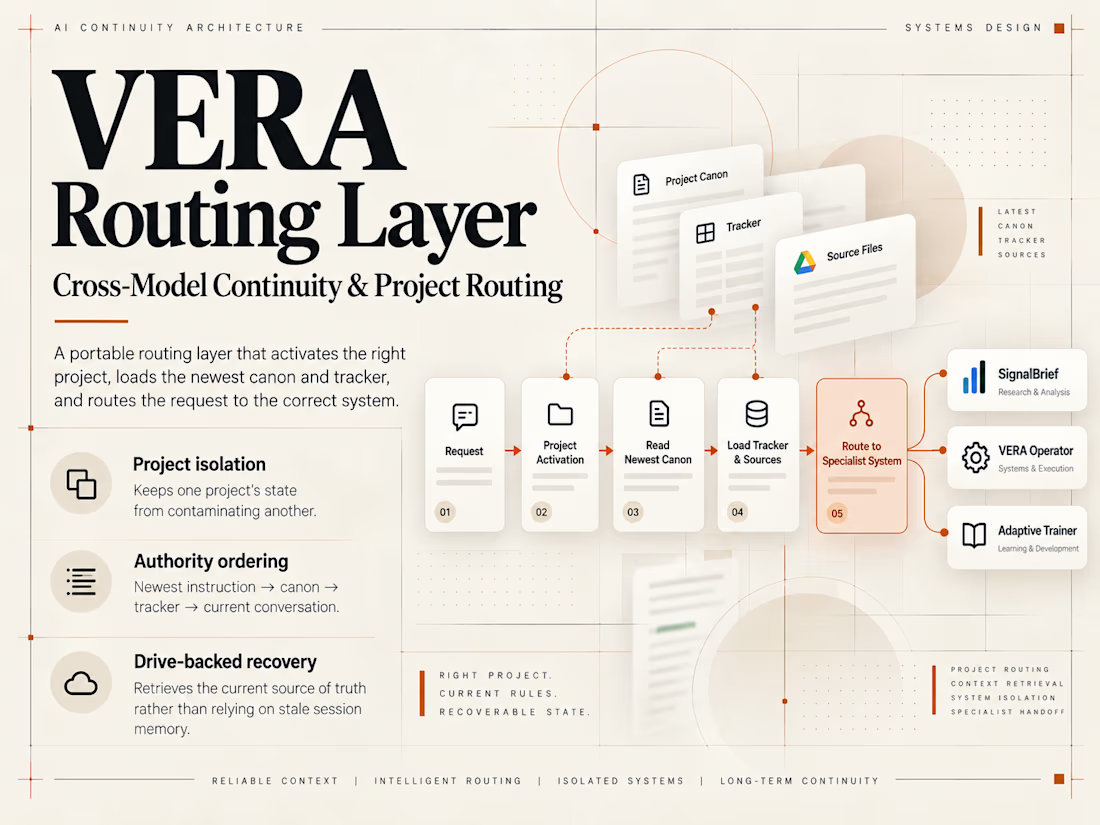
A strong specialist skill is useless if the wrong system gets invoked. Long-running AI work breaks in boring, expensive ways.
That is not a prompting problem. It is a routing and authority problem.
How I can help you:
I build project routers for teams using multiple AI workflows, agents, or specialist assistants so that they work with each other as a team.
I design source-of-truth resolutions so your agents retrieve the current rules instead of improvising or relying on assumptions or stale chat data.
I create reusable skill registries and specialist handoff logic hardened by determined and dedicated flow states reducing the need for model reliance on its own internal and displaced memory context.
I separate project states with individualized canonical states bound by rules living under essential model instructions and routed properly so unrelated workflows do not contaminate one another, but exist with awareness of the role each project plays, enabling a persistently growing ecosystem to develop organically.
I add governance wrappers, escalation hooks, and recovery mirrors around existing AI stacks so that trust is designed at the root, and variance is eliminated with rule based source archiving and implementation.
Trust means closing your eyes at night and sleeping soundly because your agents got your back. And I can put it all together for you, precision results sourced and undisputed because I got tired of doing things the hard way.

Phillip, agree that routing is where it breaks. In our builds the worst bugs came from an agent pulling an old rule from chat history instead of the current source. Pinning one source of truth per project fixed more than any prompt change did.

Then: 1 month, 1 template.
Now: 1 week, 15 templates.
Same designer, different workflow.
I wrote up how I built no-code.supply: fifteen website templates, each with its own brand, in HTML and React, and some in Framer too. Claude Code did most of the typing. I did the directing.

no-code.supply
How I built 15 website templates with an AI coding agent in a week
How I built 15 AI-ready website templates with Claude Code in a week: the workflow, the quality bar, and why a template is only the starting point.

Going from one template a month to fifteen a week is wild. How much of the design direction did you still do by hand?