The network for creativity
Join 1.25M professional creatives like you
Connect with clients, get discovered, and run your business 100% commission-free
Creatives on Contra have earned over $150M and we are just getting started
Back to feedPost

What Happens When You Audit a 100% AI-Built App
40+ issues. 12 critical. One app built entirely with Claude Code.
The Project
A solo founder came to me with a web and mobile app they had built almost entirely using Claude Code — an AI-powered coding tool. The development speed was impressive. The app was functional, the UI was clean at first glance, and they were close to launch.
Before going live, they wanted an independent QA audit. No ongoing engagement, no test management overhead — just an expert set of eyes on the product before real users touched it.
That's where QAura came in.
What I Found
Over the course of the audit, I logged 40+ issues across functional, UI/UX, and consistency categories. Of those, 12 were classified as critical — meaning they either broke core user flows, exposed incorrect data handling, or would directly impact user trust on launch day.
Here's where the issues clustered:
1. Edge Cases the AI Never Considered
The majority of the critical issues fell into one category: edge cases.
AI coding tools are excellent at building what you describe. If you tell Claude Code "create a form that submits user data," it will build exactly that — and it will likely build it well. But it won't ask: what happens if the user submits with an empty field? What if the network drops mid-submit? What if the input contains special characters?
These weren't exotic scenarios. They were the kind of inputs real users produce every day. And in most cases, the app either crashed silently, showed a generic unhandled error, or — more dangerously — appeared to succeed while doing nothing.
The dev had described features at a high level. The AI had implemented them at a high level. The gap between those two was where the bugs lived.
2. Regression After Fixes
Once the first round of issues was reported, the dev went back to Claude Code to fix them. This is where things got instructive.
Several fixes introduced new failures in adjacent features. A correction to the login flow broke a downstream session handling behavior. A UI fix on one screen misaligned elements on another. The AI fixed what it was told to fix — precisely and nothing more.
This isn't a criticism of the tool. It's a fundamental characteristic of how AI-assisted development works right now: it's reactive, not holistic. Without a human tracking the full scope of what changed and why, regression is almost guaranteed when fixes start stacking up.
3. No Consistency Across Error States
This one was subtle but significant. Across different features of the app, the same class of error — say, a failed network request — was handled in completely different ways. One feature showed a modal. Another showed an inline message. A third showed nothing at all.
Each individual implementation was defensible in isolation. But across the product, the result was an inconsistent, unpredictable experience that would erode user confidence fast.
This is something AI tools are structurally bad at catching. Each prompt is a new context. There's no entity holding the whole product in its head, ensuring that decisions made in Feature A are consistent with Feature B. That's a human job — specifically, a QA job.
The Bigger Picture
AI coding tools are genuinely useful. They help founders ship faster, reduce early development costs, and make technical execution accessible to people who couldn't build before. I'm not here to argue against them.
But shipping fast and shipping well are two different things. The issues I found weren't signs of a bad product — they were signs of a product that had never been tested by someone whose job is to find what's wrong.
The AI built what it was told to build. A QA audit asked the questions no one had asked yet.
What This Means for Founders Building with AI
If you're using AI tools to build your product — whether that's Claude Code, Cursor, Copilot, or anything else — a QA audit before launch isn't optional overhead. It's risk management.
The surface-level functionality will likely look fine. The edge cases, the regression paths, the consistency gaps — those require a different kind of attention. The kind that comes from someone who's spent years breaking software on purpose.
That's what QAura is built for.
The network for creativity
Join 1.25M professional creatives like you
Connect with clients, get discovered, and run your business 100% commission-free
Creatives on Contra have earned over $150M and we are just getting started






Related posts


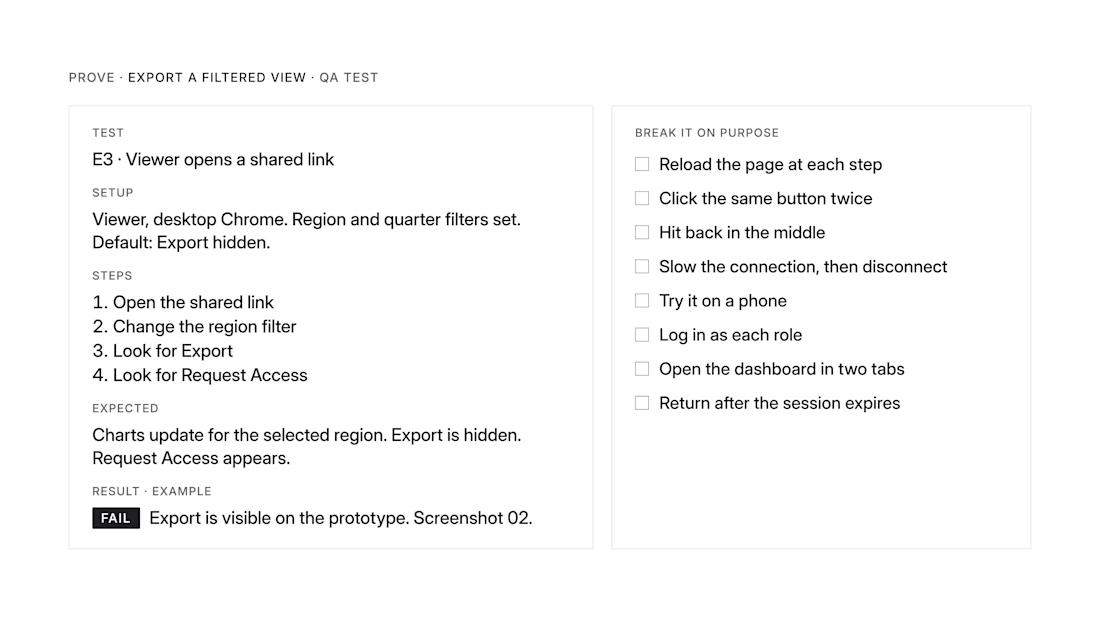
I've found writing QA tests before features are built is a cheat code for building quality software design.
Before you build, try testing what yours does when you:
- Interrupt it: reload, hit back, let the login expire. It should keep the user's progress.
- Repeat it: double-click, open two tabs. It should run once.
- Feed it bad input: the wrong file, a huge one, an empty one. It should say what's wrong and how to fix it.
- Change who or where: a different role, a phone, no internet. It should show only what that user can do, with a way back.

Hot take: AI builders made "good enough" design free, so "good enough" is now worth nothing.
Every AI-built app ships with the same rounded cards, the same gray shadcn look, the same Inter. Clients can spot it now.
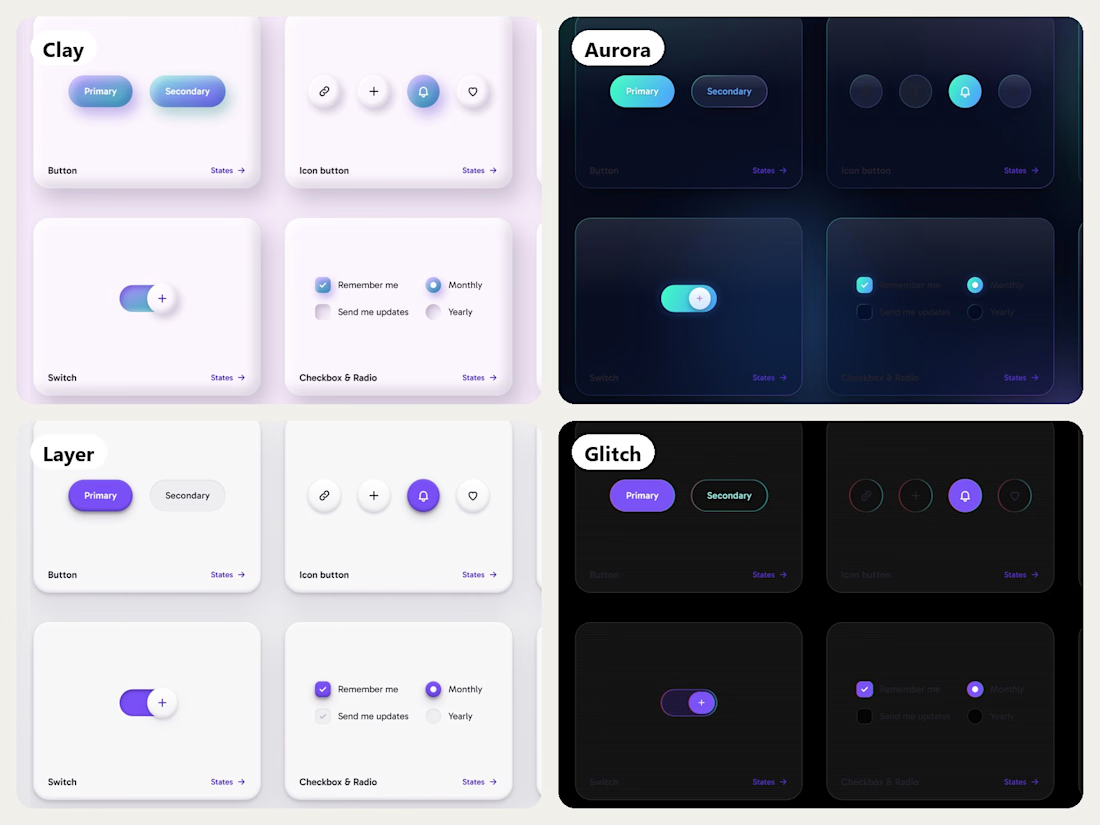
What still stands out: a real type choice, a texture, one effect done properly. Same components, four completely different feels, that's what I've been building with modui.
Where do you draw the line between using AI and letting it design for you?

Building MLOpsLab has taught me something interesting:
Most workflow problems aren't caused by missing automation.
They're caused by missing visibility.
A form gets submitted.
A webhook fires.
An API responds.
Everyone assumes the process worked.
Then days later someone discovers a missing lead, duplicate record, failed sync, or unexplained gap.
Lately I've been spending time building and testing workflow reliability scenarios around:
• Intake validation
• Duplicate event handling
• Failure detection
• API and database integrations
I'm documenting what works, what fails, and where assumptions break.
If you've ever spent hours tracking down a workflow issue that "should have worked", I'd be interested in hearing what the failure looked like.
#automation #n8n #api #workflow #supabase #buildinpublic

The hardest one to catch is the green run that did nothing. An API returns 200 with an empty list, every later step runs on zero items, and nothing errors. A cheap guard: count items in and items written at the end of the run, and alert when they differ. Are you testing that case in MLOpsLab, or mostly hard failures?