The network for creativity
Join 1.25M professional creatives like you
Connect with clients, get discovered, and run your business 100% commission-free
Creatives on Contra have earned over $150M and we are just getting started
Back to feedPost

One of the biggest myths in cloud computing is that bigger servers mean better performance.
They don't.
In many cases, oversized infrastructure simply means higher costs.
A well-architected system doesn't rely on the largest instance available.
It relies on:
✅ Proper load balancing
✅ Auto scaling
✅ Efficient resource utilization
✅ Monitoring and observability
✅ Smart architectural decisions
The cloud gives businesses something that traditional infrastructure never could:
The ability to scale based on demand.
Why pay for peak capacity 24/7 when you can scale up when traffic increases and scale down when it doesn't?
That's the real power of cloud computing.
The goal isn't to build the biggest infrastructure.
The goal is to build the most efficient one.
Because in cloud engineering, optimization isn't just a technical skill.
It's a business advantage.
#CloudComputing #AWS #DevOps #CloudArchitecture #AutoScaling #CostOptimization #Technology #SystemDesign #LearningInPublic #Tech
The network for creativity
Join 1.25M professional creatives like you
Connect with clients, get discovered, and run your business 100% commission-free
Creatives on Contra have earned over $150M and we are just getting started
Related posts


The property cards look really tidy.

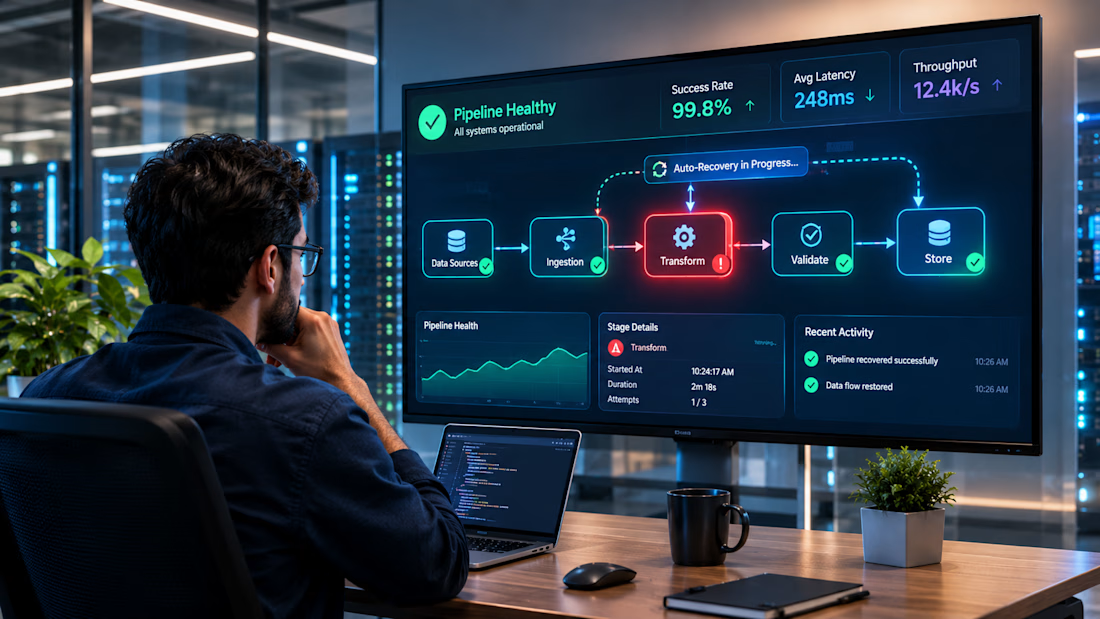
🚀 WHAT IF YOUR DATA PIPELINE COULD FIX ITSELF?
Most AI conversations focus on chatbots, content generation, and coding assistants.
But one of the more interesting shifts is happening behind the scenes: AI is moving into the infrastructure that keeps software products running.
Today, Snowflake announced new autonomous data engineering capabilities that bring AI agents into recurring data-pipeline tasks, including identifying and repairing issues.
Why does this matter?
A broken or outdated data pipeline can affect everything built on top of it — dashboards, business reports, recommendations, and even AI-powered decisions.
Here's what this shift could mean for engineering teams:
⚙️ 1. Self-healing workflows
AI agents can help identify recurring pipeline failures and suggest or perform fixes within defined guardrails.
📊 2. More reliable data
Better pipeline health means applications and AI systems can work with fresher, more dependable information.
🛡️ 3. Human-controlled automation
Engineers still define rules, review critical changes, and decide what goes into production.
🧠 4. More time for real engineering
Less time spent on repetitive maintenance means more time for architecture, performance, and product innovation.
My perspective as an AI Engineer & Full Stack Developer:
The next generation of AI-powered products won't just need intelligent models.
They'll need reliable data pipelines, robust APIs, monitoring, automation, and systems that can recover gracefully when something goes wrong.
That's where AI engineering becomes real software engineering.
Would you trust an AI agent to repair production data pipelines under strict guardrails?
#AIEngineering #DataEngineering #ArtificialIntelligence #Automation #Snowflake #SoftwareDevelopment #CloudComputing #LLM #FullStackDevelopment #TechInnovation #Contra


Cloud Infrastructure & PropTech Visual Identity