The network for creativity
Join 1.25M professional creatives like you
Connect with clients, get discovered, and run your business 100% commission-free
Creatives on Contra have earned over $150M and we are just getting started
Back to feedPost

About wordpress
WordPress rests on four key pillars. Full Site Editing uses the Gutenberg block editor, letting users visually build pages, headers, footers and templates with reusable blocks instead of relying only on code. A massive ecosystem of tens of thousands of free and commercial plugins and themes extends a site into e-commerce (WooCommerce), membership communities, learning management systems or custom web apps. Self-hosted WordPress (WordPress.org) gives complete ownership of code, database and hosting, unlike closed hosted platforms such as Wix or Squarespace. Recent 2026 releases (e.g., WordPress 7.1) add modern performance and tooling: browser-side image compression, native AVIF/HEIC support, per-device responsive block controls, and built-in developer APIs for AI and interactive frontends.
WordPress.org is free, open-source software you install on your own web host, offering unrestricted customization, custom plugins and full monetization control. WordPress.com is a commercial managed hosting service built on the software that handles servers, security and backups, with tiered paid plans for advanced plugins and custom code.


The network for creativity
Join 1.25M professional creatives like you
Connect with clients, get discovered, and run your business 100% commission-free
Creatives on Contra have earned over $150M and we are just getting started



Related posts

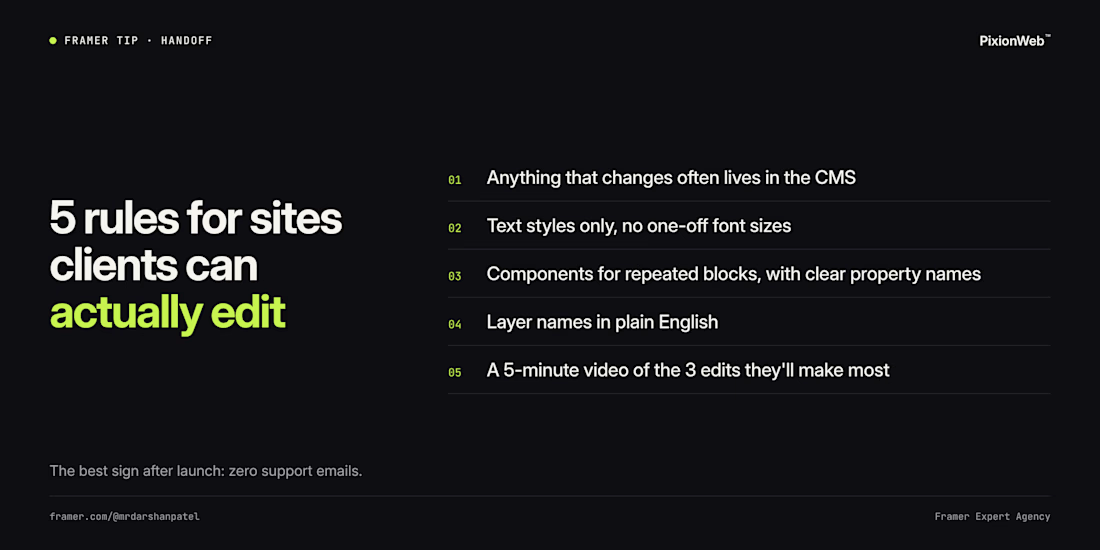
5 rules for Framer sites clients can actually edit ✍️
Anything that changes often lives in the CMS
Text styles only, no one-off font sizes
Components for repeated blocks, with clear property names
Layer names in plain English
A 5-minute video showing the 3 edits they'll make most
The best sign after launch is zero support emails.
What do clients break most often on your sites? 👇


Long CMS titles and portrait images dropped into square slots, every time. I add a dummy collection item with the longest plausible heading before handoff, so the overflow shows up while I can still fix it. Do you test with real client copy?

It's one of those projects that reminds me how much psychology goes into the decisions we make as designers.
One of the things I enjoyed most about working on Charsev was realizing that selling executive transportation isn't really about showing beautiful vehicles.
Imagine arriving in a country you've never visited before. What would make you feel comfortable trusting a transportation company you found online?
That question shaped much of my approach to this project, from the communication strategy and art direction to the UX/UI design, video editing, and WordPress development.
I wanted the website to feel elegant and professional, but more importantly, to communicate a sense of safety, reliability, and confidence before the passenger even begins their journey.
I'm curious, fellow designers: when you're designing a website where trust is essential, what do you prioritize most — visual design, messaging, or the overall user experience?


Nice deisgns

Village Global's new portfolio: every company opens right in the page. No reloads, no losing your place. Click, read, go back, keep browsing.
Designed by Carrara and built in Webflow by yours truly.

The in-page company view is the right call. Is each one getting its own URL though? Deep links and a back button that restores the exact scroll position are what usually make or break this pattern after launch. Curious how you handled history.


