The network for creativity
Join 1.25M professional creatives like you
Connect with clients, get discovered, and run your business 100% commission-free
Creatives on Contra have earned over $150M and we are just getting started
Back to feedPost

💰 Understanding Double-Entry Accounting Through a Conversation
A common misconception is that an account owns transactions.
It doesn't.
An account only owns a copy of the transaction's effect on its balance.
The real owner of the story is the Transaction.
👨💼 Auditor: "Transaction, what happened here? 😳"
🧾 Transaction: "A user deposited some cash."
👨💼 Auditor: "Interesting... but where did the money go? 💸"
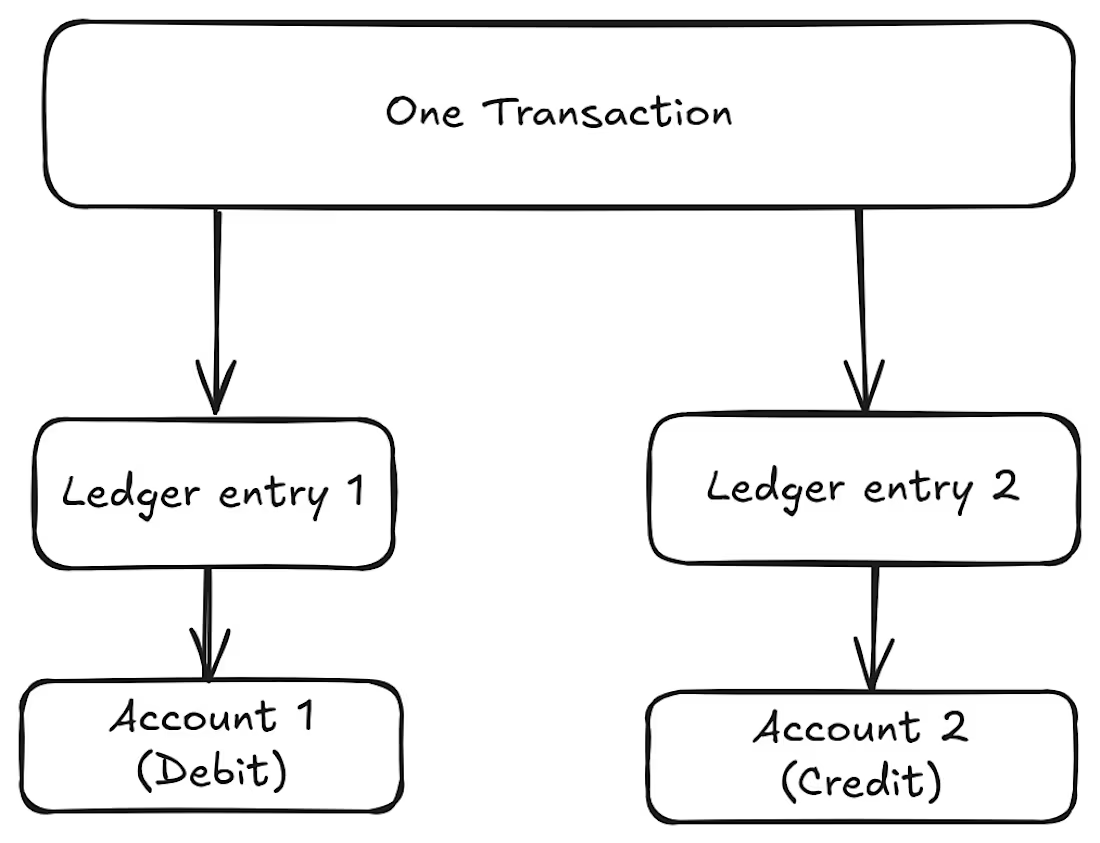
🧾 Transaction: "Ledger, can you bring out the entries connected to me? (transaction.entries[])"
📒 Ledger: "Right here."
➕ Entry #1: Credited the user's account.
➖ Entry #2: Debited the source account.
📒 Ledger: "As you can see, every movement has an equal and opposite movement. Everything balances."
👨💼 Auditor: "Perfect! Now I can explain exactly what happened to the administrator. 😊"
🧾 Transaction: "Happy to help, boss."
This is why every financial transaction creates at least two ledger entries:
✅ One entry shows where the money came from.
✅ Another entry shows where the money went.
The Transaction tells the story.
The Ledger provides the evidence.
The Auditor reconstructs the truth.
And because every debit has a matching credit, the books always stay balanced.
📚 That's the beauty of Double-Entry Accounting.


The network for creativity
Join 1.25M professional creatives like you
Connect with clients, get discovered, and run your business 100% commission-free
Creatives on Contra have earned over $150M and we are just getting started





Related posts

A bookkeeper who only reconciles is doing half the job. 📊
Debits equal credits. The bank statement matches. The books are "balanced." But do the numbers actually make sense?
Good bookkeeping isn't about matching figures. It's about understanding the business:
✅ How it really earns and spends, from scratch
✅ What the P&L, balance sheet and cash flow are telling you
✅ Where the business can go, based on the numbers it has today
When your numbers make sense, you can spot trends early, fix the leaks, and plan growth with confidence. That's the difference between a bookkeeper who records the past and one who helps shape the future.
Don't just balance the books. Understand the business. 💡
💬 What's the one number in your business you still don't fully understand? Tell me below.
Follow me for more bookkeeping and accounting insights.
#Bookkeeping #Accounting #SmallBusiness #UAEBusiness #USABusiness #Entrepreneurs #FinancialLiteracy #BusinessGrowth #CashFlow #Startups #Accountant #CountingCrux


Does a fintech brand actually need to look like fintech?
We don’t think it does.
For KRON, we wanted to move away from the visual language you’d normally associate with finance.
No banking blue.
No obvious financial symbols.
No trying to scream “AI.”
Instead, we started with one idea:
What if wealth had depth?
That led us toward a much more spatial identity built around form, movement, architecture, and dimension.
Even the K started becoming less of a letter and more of a structure we could build around.
Still exploring how far this system can go.
Would you know this was a fintech brand without being told?
And more importantly, does it need to?





Honestly this branding kit feels luxury specially with high contrast and soft colors good job 🎉🎉❤️❤️

Full-Stack Developer & AI Automation Engineer
I build scalable web applications, SaaS platforms, mobile apps, custom dashboards, and AI-powered automation systems that turn complex business workflows into reliable digital products.
My core stack includes Next.js, React, Node.js, NestJS, Python, PostgreSQL, MongoDB, and AI APIs.
I specialize in turning ideas into production-ready systems—from architecture and development to deployment, automation, and optimization.
Available for:
AI Automation • SaaS Development • Web Development • Mobile Apps • Custom Dashboards • API Development • Business Automation


Seeing how you stitch AI APIs into custom dashboards really cuts the manual data wrangling. The stack choice keeps the deployment pipeline smooth.