The network for creativity
Join 1.25M professional creatives like you
Connect with clients, get discovered, and run your business 100% commission-free
Creatives on Contra have earned over $150M and we are just getting started
Back to feedPost

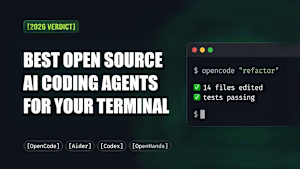
🚀 Can terminal AI agents replace your IDE?
OpenCode, Codex CLI, Aider, and more — which one fits your workflow?
📖 Find out: https://bit.ly/4iNk9XJ
#AI #Coding #DevTools
bit.ly
Are Terminal AI Coders Finally Ready to Replace IDEs?
Compare the top open source AI coding agents for your terminal in 2026 - OpenCode, Codex CLI, Aider, OpenHands & more. Local models & honest trade-offs.

Great roundup! I've been testing Aider vs Codex CLI - Aider feels more mature for terminal workflow but OpenCode is catching up fast.
Terminal agents won't fully replace IDEs yet, but for quick refactors and multi-file edits they're game changers. Thanks for sharing the comparison!
The network for creativity
Join 1.25M professional creatives like you
Connect with clients, get discovered, and run your business 100% commission-free
Creatives on Contra have earned over $150M and we are just getting started



Related posts

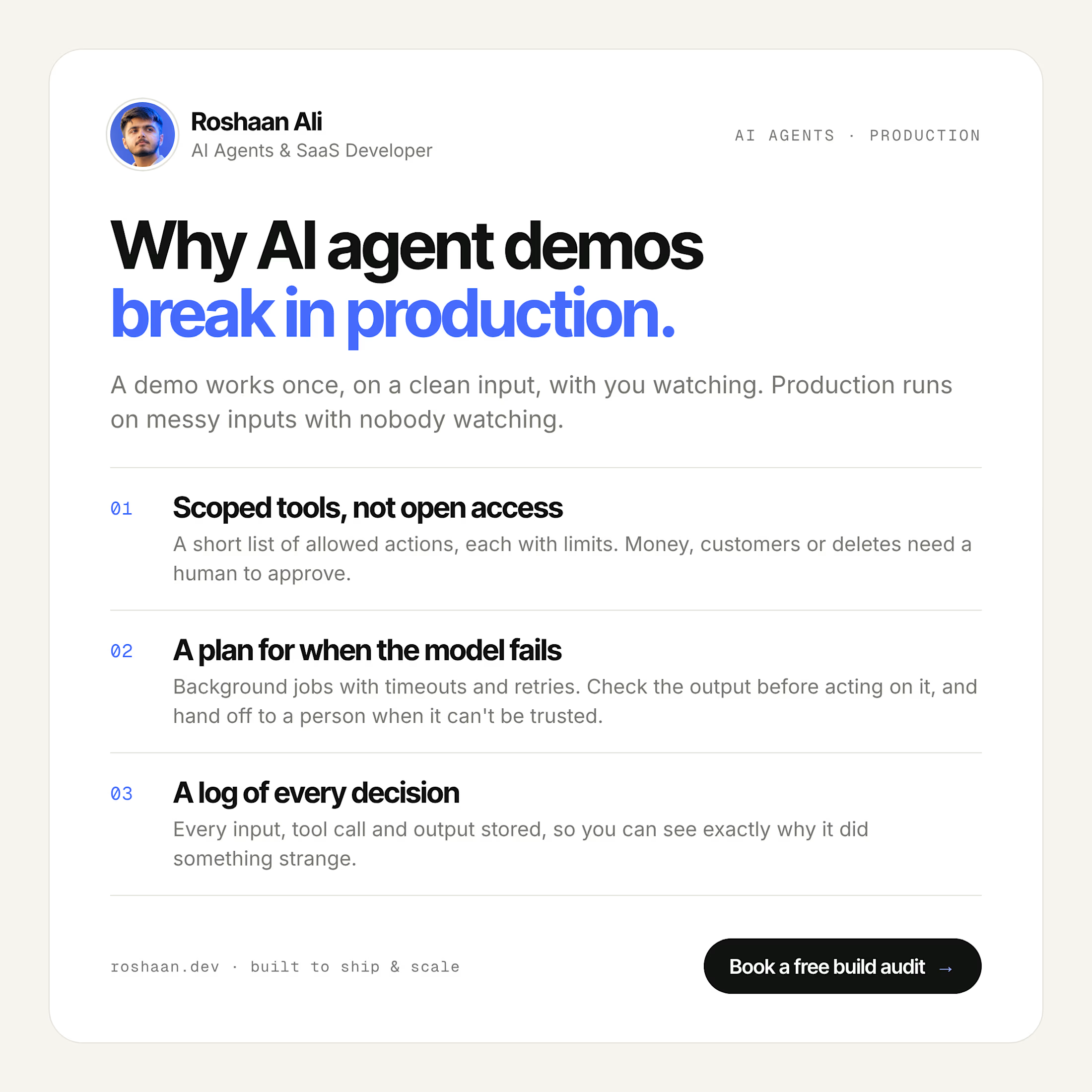
Why AI Agent Demos Break in Production
An AI agent demo only has to work once, on a clean input, with you watching. In production it runs again and again on messy real inputs, and nobody's watching.
I've built AI into real products, from a repricing engine that runs 24/7 for a US Amazon seller to a voice automation platform for a company in Germany. These are the three things I put in place before any agent goes live:
1. Scoped tools, not open access
Give the agent a short list of actions it's allowed to take, each with its own limits, instead of raw access to your database or APIs. Anything that touches money, customers or deleting data needs a human to approve it.
2. A plan for when the model fails
Model calls are slow, they time out, and sometimes they return something that makes no sense. Run agent work in background jobs with timeouts and retries, check the output before acting on it, and hand the task to a person when it still can't be trusted.
3. A log of every decision
Store every input, tool call and output. When the agent does something strange (and at some point it will), you can see exactly why and fix it instead of guessing.
None of this shows up in a demo. All of it decides whether the agent is still running a month later.
Planning an AI agent for your product? I offer a free build audit: calendly.com/roshaanali-business

"Works once with you watching" is the best way I've heard it put. Timeouts and a human fallback are the parts most demos skip.

Which one you guys prefer.
A or B
I used recraft.ai today, and I have to say it’s the best AI tool for cohesive, pleasing designs. From just a prompt, I got such clear visuals. I was amazed! Check this out- this is my creation for a collection I’m working on.


8 votes
Ends in 4h


Vibe coding looks easy… until your app breaks. 😅
“Just tell AI what you want and it will build it.”
Sounds great.
Until you spend credits asking it to fix the same bug 10 different ways.
Then another feature breaks.
You fix that one.
Something else stops working.
Then you're staring at the same error for hours thinking:
“Why is this still happening?”
That's the part people don't show you about vibe coding.
AI can write code incredibly fast, but fast code doesn't automatically mean good code.
You still need to understand:
→ How the application is structured
→ Where the bug is actually coming from
→ How different features affect each other
→ When an AI-generated solution is making things worse
→ How to debug instead of blindly regenerating code
And sometimes the biggest time killer isn't building a feature.
It's getting stuck on one tiny bug that refuses to die.
That's why I don't see vibe coding as:
“Tell AI what to build.”
I see it as:
Human problem-solving + AI development.
The AI can help you move faster.
But you still need someone who knows where to go when things stop working.
That's where the real skill comes in.
What has been your biggest headache with vibe coding? 👇
— Optimum Studio


the same bug fixed 10 different ways is painfully accurate lol