The network for creativity
Join 1.25M professional creatives like you
Connect with clients, get discovered, and run your business 100% commission-free
Creatives on Contra have earned over $150M and we are just getting started
Back to feedPost
Why your multi-tenant database has a Load Average of 100: It isn't a hardware problem; it's an architectural indexing disaster.
When application performance tanks, the knee-jerk reaction is almost always: "We need a bigger cloud instance. Double the vCPUs and give it 64GB of RAM."
We recently triaged an enterprise SaaS client where their core MariaDB host was thrashing with a Load Average consistently exceeding 100. CPU was pinned at 100%, disk I/O queues were overflowing, and web workers were piling up until hitting ``max_connections``.
Doubling instance size wouldn't have fixed a thing. Here is what forensic inspection actually uncovered:
1. The Missing Tenant Index: 115 multi-tenant tables contained the primary tenant identifier column, but not a single one had an index on it. Every query filtered by company forced a full table scan across millions of rows.
2. Silent Index Invalidation: In 74 operational tables, a critical relational column was defined as INT(11), while the master lookup table defined it as VARCHAR(10). During SQL JOINs, the database engine had to dynamically cast types on every row, silently throwing existing indexes out the window.
3. Table-Level Locking: Obsolete storage engines (MyISAM) were still active on tracking tables. A single 45-second analytical query locked the entire table, freezing all concurrent application transactions.
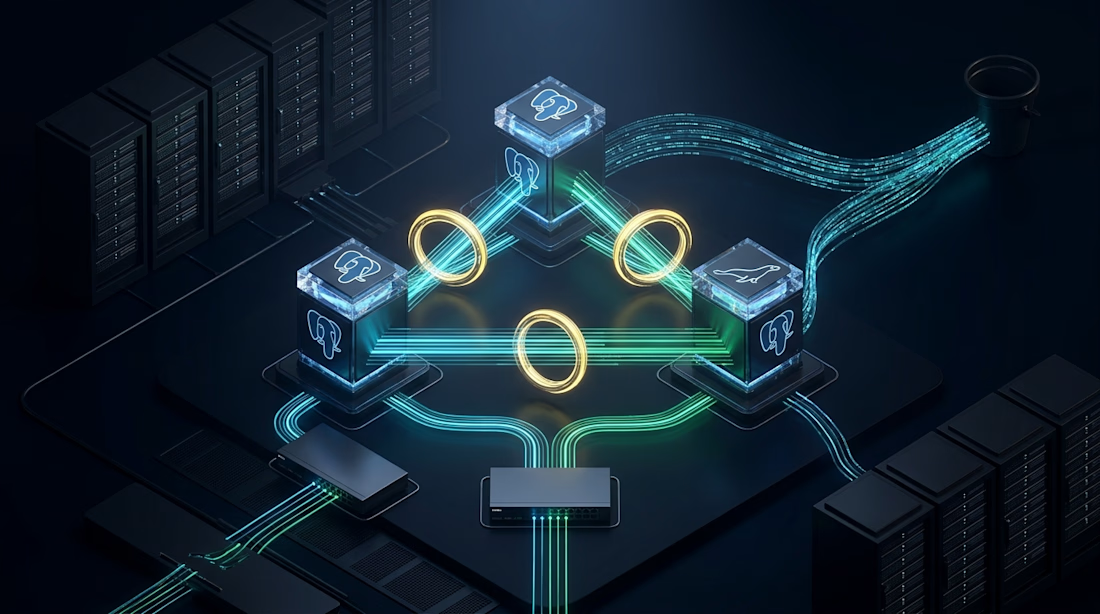
The fix was not a $2,000/month AWS upgrade. It was an immutable zero-downtime remediation: • Shadow table migrations to avoid locking production tables during schema alteration. • Compound composite indexes matching real-world access patterns. • Enforced data type parity across all foreign key relationships. • Conversion of legacy tables to modern InnoDB/Patroni engines with tuned buffer pools.
If your database is choking, don't throw more compute at broken queries. Diagnose the root schema bottlenecks.
Explore our 2-week High-Availability Database Cluster Deployment & Hardening Sprint on Contra: https://contra.com/s/QbN6svWo-high-availability-database-cluster-deployment-and-hardening
#Database #PostgreSQL #MariaDB #SRE #Performance #DevOps #Backend


The network for creativity
Join 1.25M professional creatives like you
Connect with clients, get discovered, and run your business 100% commission-free
Creatives on Contra have earned over $150M and we are just getting started




Related posts

GPU infrastructure gets expensive fast, especially when teams are running multiple models, clusters, and workloads at the same time.
Corebit explores a SaaS dashboard experience built to make GPU cost monitoring easier to understand and act on.
The dashboard surfaces compute spend, idle GPUs, workload utilization, potential savings, and optimization opportunities in one clear workspace, helping teams see where capacity is being wasted and what they can improve next.


Why clock drift in production servers cascades into split-brains, expired tokens, and silent database corruption.
In modern infrastructure, time synchronization is often treated as an invisible background detail: "We have systemd-timesyncd or default NTP running; time is fine."
In virtualized and multi-cloud environments, virtual machine clocks drift constantly due to hypervisor CPU overcommit, live migrations, and hardware timer interrupt variations.
When system clocks drift by just a few hundred milliseconds, catastrophic distributed failures begin: 1. Distributed Consensus Split-Brains: Raft clusters (etcd, Consul, Patroni) rely on precise election timeouts. Clock skew can cause healthy nodes to believe the leader has timed out, triggering non-stop leader elections and cluster paralysis. 2. Kerberos & Auth Ticket Rejections: Kerberos protocols strictly enforce a 5-minute clock skew window. A drifted node suddenly rejects valid authentication tokens, locking engineers and services out of production. 3. Cryptographic Invalidation: TLS certificates evaluated against a skewed system clock appear expired or "not yet valid," breaking API handshakes without warning. 4. Transaction Sequencing Corruption: Database engines relying on timestamps for conflict resolution or multi-version concurrency control (MVCC) silently overwrite newer data with older records.
Modern infrastructure solves this with hardened **Chrony NTP**: • Sub-millisecond tracking against curated Stratum-1 hardware or atomic time sources. • Kernel-level PPS (Pulse Per Second) discipline and hardware timestamping. • Frequency drift slew calibration: smoothly adjusting clock speed rather than introducing jarring time jumps that corrupt transactional databases. • Restrictive firewalld and systemd sandboxing protecting time daemons from spoofing attacks.
Don't let silent clock drift corrupt your state.
Deploy hardened core network services with our 1-week Core Sovereign Network Services Sprint on Contra: https://contra.com/s/mrP3E36W-core-sovereign-network-services-bind9-dnssec-kea-dhcp-and-chrony-ntp
#Networking #Database #Infrastructure #Architecture #Performance #Linux #DevOps #SRE



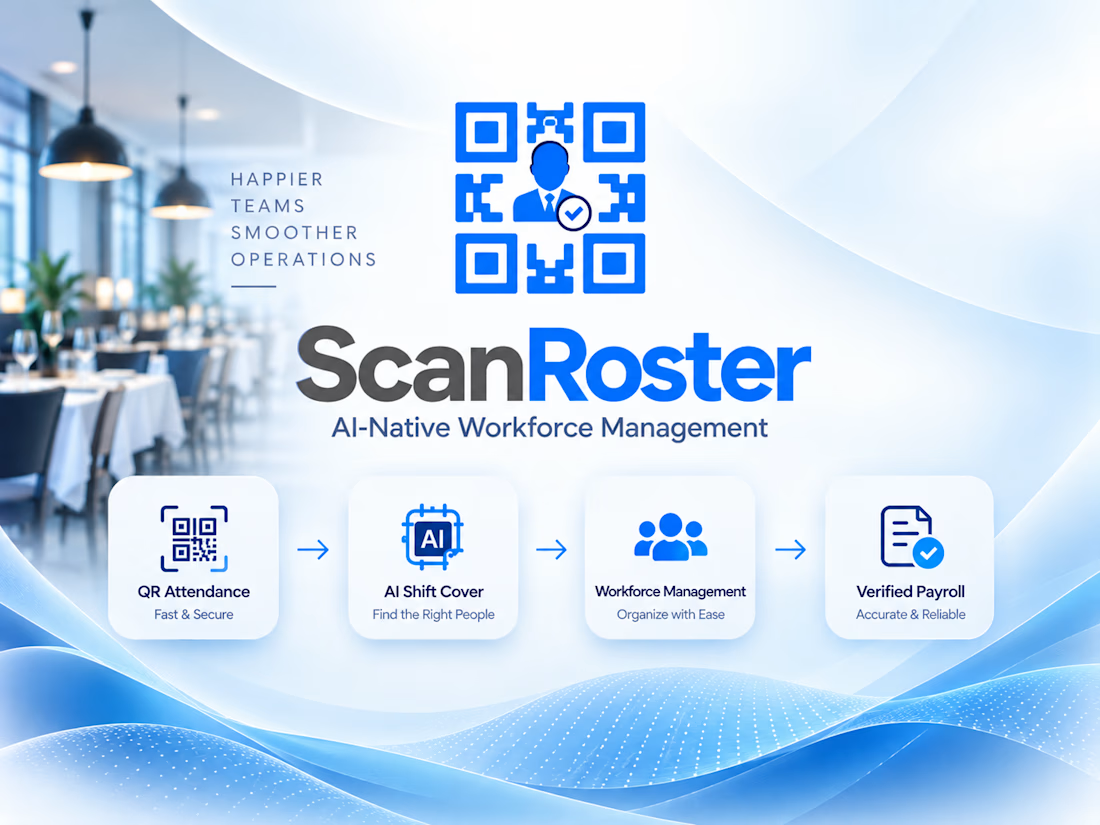
ScanRoster :- AI-Native Workforce Management
Smarter workforce operations powered by AI, automation and real-time data.
Project description
ScanRoster is an AI-native workforce management platform designed for hospitality and shift-based businesses. I worked across the product lifecycle, from understanding operational challenges and designing workflows to product engineering, data-driven features and AI-powered automation. The platform brings workforce scheduling, QR-based attendance, intelligent shift coverage, timesheets and payroll workflows into one connected system, helping teams reduce manual administration and manage day-to-day workforce operations more efficiently.
Key capabilities
QR Attendance - streamlined employee check-in and attendance tracking
AI Shift Cover - intelligent support for finding suitable replacements when shifts need coverage
Workforce Management - centralized scheduling, staff and operational workflows
Timesheets & Payroll - turning verified attendance data into reliable working-hour and payroll workflows
Operational Intelligence - workforce data and analytics for better visibility and decision-making
My role
Product Engineer · AI & Data Product Development