The network for creativity
Join 1.25M professional creatives like you
Connect with clients, get discovered, and run your business 100% commission-free
Creatives on Contra have earned over $150M and we are just getting started
Back to feedPost

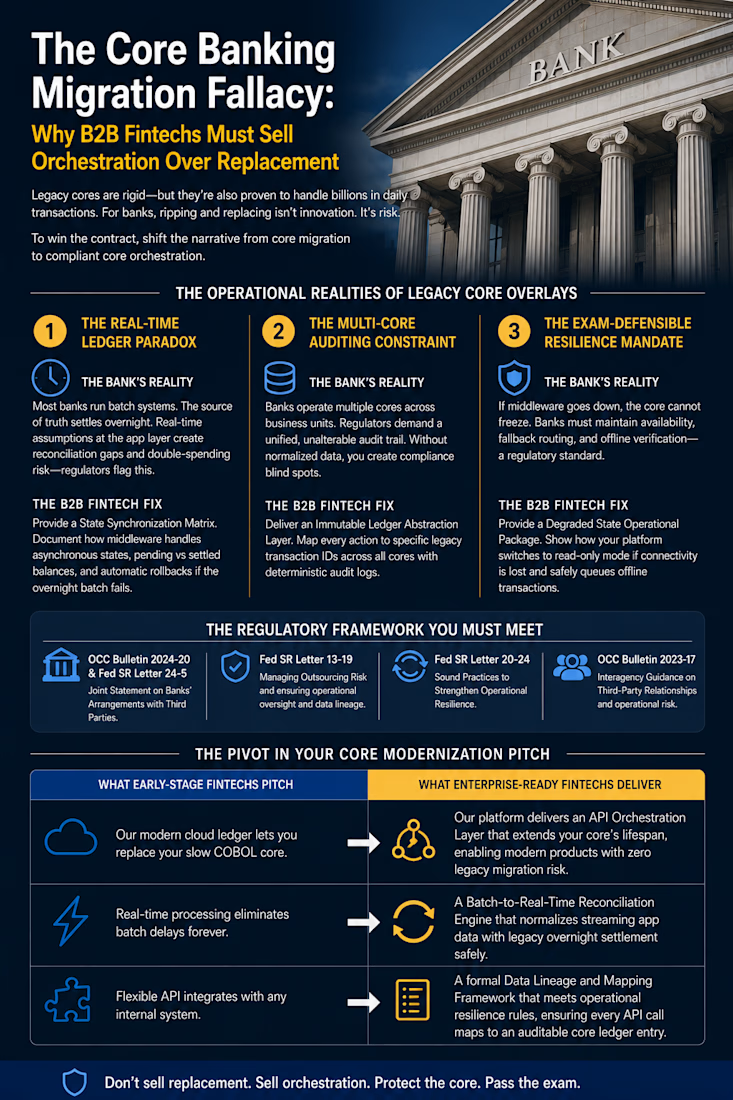
The Core Banking Migration Fallacy: Why B2B Fintechs Must Sell Orchestration Over Replacement
When a next-generation fintech vendor pitches a core banking overlay or a modern ledger system to a tier-one bank, the deck usually sells agility. Break free from COBOL. Real-time ledgers. Launch products in days, not quarters.
To a bank’s Chief Risk Officer and core engineering team, that sounds different. Pulling out a legacy core isn’t an innovation project. It’s open-heart surgery on a patient that’s still running.
Legacy cores are rigid. They also handle billions in daily transactions with deterministic consistency. Move to an unproven architecture and you introduce fiduciary and operational risk. For bank executives, structural safety beats technological purity every time.
If your platform forces a bank to rip and replace its foundational accounting ledger, your sales cycle stalls. To win the contract, shift the narrative from core migration to compliant core orchestration.
The Operational Realities of Legacy Core Overlays
Banks operate under strict, multi-agency rules. Those rules cover third-party dependencies, cyber risk, and tech failures. When your software transforms data, manages ledgers, or runs financial logic, it hits the same standards as Model Risk Management. Regulators demand mathematical and operational traceability for any asset that touches the balance sheet.
When you sit on top of a bank’s core, procurement will audit how you keep data intact across legacy boundaries. If your GTM plan doesn’t include answers for that, you won’t pass due diligence.
The Real-Time Ledger Paradox
Modern fintechs use real-time event streaming. Instant visibility. Balances update live at the app layer.
The Bank’s Reality: Most tier-one banks still run batch systems. The source of truth settles overnight. If your app assumes real-time settlement while the core waits for end-of-day processing, you create reconciliation gaps and double-spending risk. Regulators flag this. See the federal regulators’ Joint Statement on Banks' Arrangements with Third Parties to Deliver Bank Deposit Products and Services in OCC Bulletin 2024-20 and Federal Reserve SR Letter 24-5. They scrutinize middleware that weakens a bank’s control, recordkeeping, and visibility over the system of record.
The B2B Fintech Fix: Stop pretending the batch core doesn’t exist. Provide a State Synchronization Matrix. Document how your middleware handles asynchronous ledger states. Show how you calculate pending vs settled balances. Explain how your platform rolls back transactions if the overnight batch fails.
The Multi-Core Auditing Constraint
Banks grow through mergers. That leaves them with fragmented cores from FIS, Fiserv, Jack Henry across business units.
The Bank’s Reality: Regulators demand a unified, unalterable audit trail. If your API layer doesn’t normalize data across those cores, you create a compliance blind spot. Under Federal Reserve SR Letter 13-19 on Managing Outsourcing Risk and related supervisory guidance, audit and risk teams reject platforms that decouple the bank from operational oversight and transaction data lineage.
The B2B Fintech Fix: Deliver an Immutable Ledger Abstraction Layer. Give buyers deterministic audit logs that map actions to specific legacy transaction IDs across every integrated core. Prove your software is a single, exam-defensible source of truth for data lineage.
The Exam-Defensible Resilience Mandate
In an exam, bank executives must prove vendors won’t cause an operational shutdown if a link drops.
The Bank’s Reality: If your API middleware goes down, the core cannot freeze. The bank must keep ledger availability, fallback routing, and offline account verification. That’s the standard in the interagency Sound Practices to Strengthen Operational Resilience from Federal Reserve SR Letter 20-24 and OCC Bulletin 2023-17.
The B2B Fintech Fix: Arm the tech team with a Degraded State Operational Package. Provide tested documentation showing how your software switches to localized read-only mode if cloud connectivity is lost. Show how it queues offline transactions without breaking the core’s state integrity.
The Pivot in Your Core Modernization Pitch
Stop selling cloud-native core replacement. Sell an exam-defensible overlay that protects what’s already there.
What Early-Stage Fintechs Pitch What Enterprise-Ready Fintechs Deliver
Our modern cloud ledger lets you replace your slow COBOL core. Our platform delivers an API Orchestration Layer that extends your core’s lifespan, enabling modern products with zero legacy migration risk.
Real-time processing eliminates batch delays forever. A Batch-to-Real-Time Reconciliation Engine that normalizes streaming app data with legacy overnight settlement safely.
Flexible API integrates with any internal system. A formal Data Lineage and Mapping Framework that meets operational resilience rules, ensuring every API call maps to an auditable core ledger entry.


The network for creativity
Join 1.25M professional creatives like you
Connect with clients, get discovered, and run your business 100% commission-free
Creatives on Contra have earned over $150M and we are just getting started
Related posts


👋 Hey, we’re Lynksen.
We build digital products and websites that don’t just work - they win hearts.
For 5+ years, we’ve been the go-to team for startups and brands chasing big ideas - turning raw sparks into products that fuel millions of daily clicks, swipes, and sign-ups.
We move fast, combining product thinking, clear UX, and real business needs to create smooth, high-converting products for brands ready to make an impact.
👉 Have a project idea? We are available for new projects hello@lynksen.com or DM us!


post is awesome love the person who edited it lol




Awesome work! Highly functional, intuitive, and every pixel is exactly where it needs to be. Looking forward to seeing more projects! ✨🙌

What if digital creation felt as natural as working with real clay?
Mitti is a gesture-controlled pottery experience that lets anyone sculpt virtual clay using hand movements. Instead of learning complex tools, users simply shape, narrow, widen, and refine pottery through natural interaction.
Start with different pottery styles, adjust wheel speed, and save finished creations to your personal collection.
Mitti explores how creative software can become more intuitive by replacing menus and controls with direct physical interaction.
Built using the Figma ecosystem for the Config Makeathon.
Links












Trending

Claude
Claude has entered the design space. How are you using Claude Design?

Contra University
Learn from expert creatives how to earn more using next-gen AI tools.

MagicPath
The canvas is infinite, and exploration is becoming the workflow. How are you using MagicPath?
creativeaiflow
Creative AI workflows are evolving. What tools do you use, and what are their strengths and weaknesses?
freelancerlife
Freelancer life is wins, pivots, and everything in between. What’s yours right now?