The network for creativity
Join 1.25M professional creatives like you
Connect with clients, get discovered, and run your business 100% commission-free
Creatives on Contra have earned over $150M and we are just getting started
Back to feedPost

Most businesses don't actually need a highly advanced AI tool.
They just need one repetitive workflow written out clearly.
Because it feels so basic, nobody wants to do it. But this boring groundwork is exactly where automation either succeeds or fails.
Think about a typical service business: leads pour in from website forms, phone calls, emails, and social media. Everyone is slammed. The first reply goes out fine, but the second follow-up is completely dependent on someone's memory.
Eventually, the founder steps in and asks: “𝗗𝗶𝗱 𝗮𝗻𝘆𝗼𝗻𝗲 𝗲𝘃𝗲𝗿 𝗴𝗲𝘁 𝗯𝗮𝗰𝗸 𝘁𝗼 𝘁𝗵𝗶𝘀 𝗽𝗲𝗿𝘀𝗼𝗻?”
That isn't a sales problem. It’s a handoff problem.
At SpidLabs, this is exactly where we start mapping things out:
Where does the workflow actually begin?
Who owns the very next action?
What specific information is required?
What part should the AI handle?
What part must stay with a human?
Where is the project status being updated?
When does the entire workflow get reviewed?
Only when you have these answers does building an AI agent make sense.
𝗪𝗵𝘆? Because now the agent has a concrete job description. Its role isn't a vague, unhelpful "𝗵𝗮𝗻𝗱𝗹𝗲 𝗹𝗲𝗮𝗱𝘀."
Instead, its job is to: summarize the inquiry, draft the initial reply, remind the owner, update the system status, and flag stuck leads.
That’s practical automation. Not marketing hype.
If your team repeats the same process every single week, fix the handoff first. The tools can wait

The network for creativity
Join 1.25M professional creatives like you
Connect with clients, get discovered, and run your business 100% commission-free
Creatives on Contra have earned over $150M and we are just getting started





Related posts

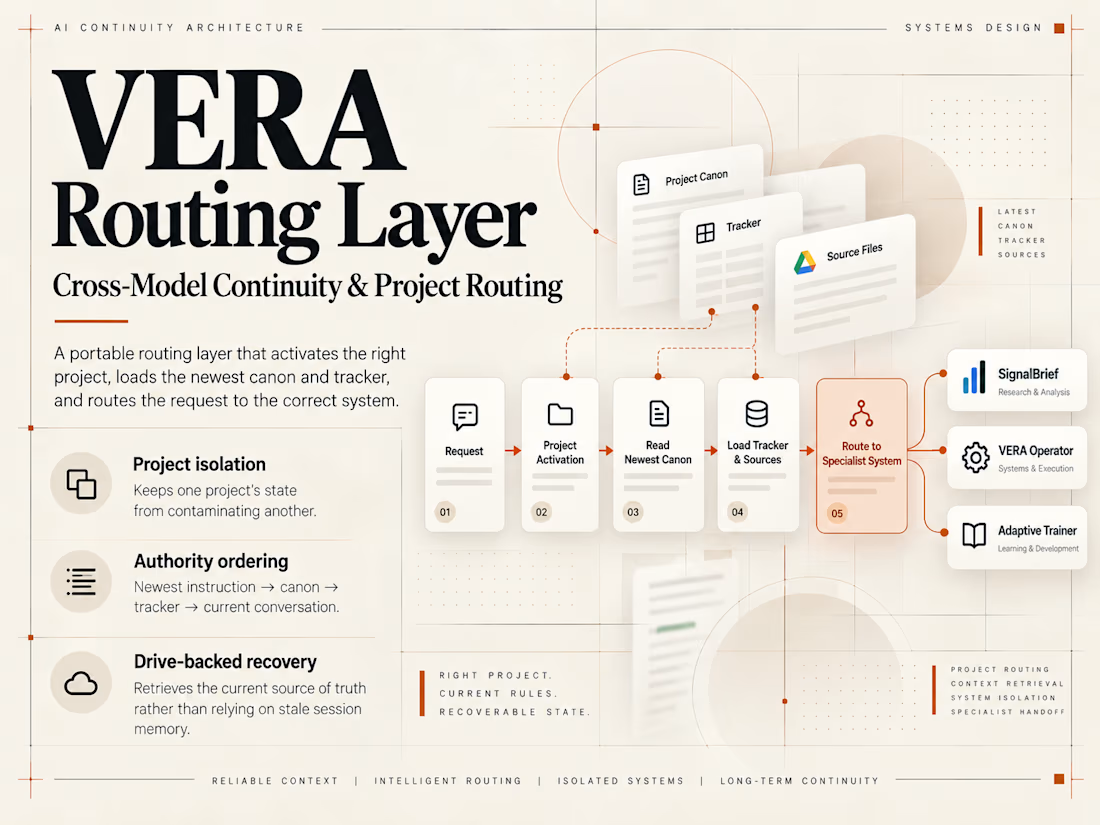
A strong specialist skill is useless if the wrong system gets invoked. Long-running AI work breaks in boring, expensive ways.
That is not a prompting problem. It is a routing and authority problem.
How I can help you:
I build project routers for teams using multiple AI workflows, agents, or specialist assistants so that they work with each other as a team.
I design source-of-truth resolutions so your agents retrieve the current rules instead of improvising or relying on assumptions or stale chat data.
I create reusable skill registries and specialist handoff logic hardened by determined and dedicated flow states reducing the need for model reliance on its own internal and displaced memory context.
I separate project states with individualized canonical states bound by rules living under essential model instructions and routed properly so unrelated workflows do not contaminate one another, but exist with awareness of the role each project plays, enabling a persistently growing ecosystem to develop organically.
I add governance wrappers, escalation hooks, and recovery mirrors around existing AI stacks so that trust is designed at the root, and variance is eliminated with rule based source archiving and implementation.
Trust means closing your eyes at night and sleeping soundly because your agents got your back. And I can put it all together for you, precision results sourced and undisputed because I got tired of doing things the hard way.

Phillip, agree that routing is where it breaks. In our builds the worst bugs came from an agent pulling an old rule from chat history instead of the current source. Pinning one source of truth per project fixed more than any prompt change did.


Turning complex AI workflows into a calm, monochrome experience, brought to life with motion. We'd love to hear your thoughts!


👋 I'm new to Contra and I did my first post without realizing I hadn't even introduced myself!
Hey I'm Katya, I'm an AI Systems Architect, marketer and yoga teacher.
I build AI systems that bring in business and handle the work behind it. A voice agent that calls new leads back within seconds and books the appointment. A pipeline that traced 16,900+ leads to the ads that brought them. Listing videos made from the photos a real estate agent already has.
The marketing side came first. I built the multi-channel campaign for Jay Shetty's launch (22 million followers). After that I discovered the tech world and when AI came along, I realized I'm a builder at heart and never looked back! Building is so much fun 🤍
Here's what I've shared:
My first post: on building a fully AI-made YouTube video, end to end, because I'm camera shy 🙈 https://contra.com/community/MP9mFRuT-im-building-my-first-fully-ai-made
Last thing, if you're building with AI video or automation, I'd like to see what you're working on
And if you're hiring: I may be new to Contra but definitely not new to this work. Reach out for AI agent builds, apps, websites or anything in between.
P.s The video below is my AI avatar. My profile video is the real me :)


Nice Portrait....Has everything from a great pose, great composition and lighting and perfect environment setting.


