The network for creativity
Join 1.25M professional creatives like you
Connect with clients, get discovered, and run your business 100% commission-free
Creatives on Contra have earned over $150M and we are just getting started
Back to feedPost
No Figma exports, no images, no Lottie. Every illustration on this page is a Framer code component I drew in code.
Holdout is a concept for an AI evals startup, and the brand idea is a sealed crate whose blue tape breaks only when a change is scored.
Live at holdout.framer.website


Drawing every illustration in code is such a power move. No export pipeline, no asset weight, and the sealed crate illustrations are probably crisp at any resolution because of it. The metaphor is perfect for AI evals too. Was building them as code components actually faster...

Thanks Timothy! Honestly, the first scene was slower than exporting, because I had to write a small isometric renderer first. After that each new scene was just boxes and a timeline, so the rest went fast. The bigger payoff is consistency. Same light and corners everywhere, and...

Drawing every illustration as code is a bold choice. The sealed crate idea fits an evals startup.
The network for creativity
Join 1.25M professional creatives like you
Connect with clients, get discovered, and run your business 100% commission-free
Creatives on Contra have earned over $150M and we are just getting started



Related posts

Photographer Portfolio Website
"Capturing light, emotion, and the moments you never want to forget." That line set the tone, and the layout follows it.
The hero is one motion-blurred portrait washed in red. The photographer's name runs across the bottom in a condensed white face, so large the screen cuts it off. The photo keeps its soft focus, and the name still reads first.
Thin grid lines split the page into narrow columns, and the small copy sits justified inside them. The loose photo gets a strict structure to lean on.
A single round red button with an arrow sits right on the letters and marks where to go next.
Designed by the Hue & Machine team.
#WebDesign #Photography #PortfolioWebsite #EditorialDesign #Typography #UIDesign #ProductDesign #CreativeDirection #ResponsiveDesign #FigmaDesign


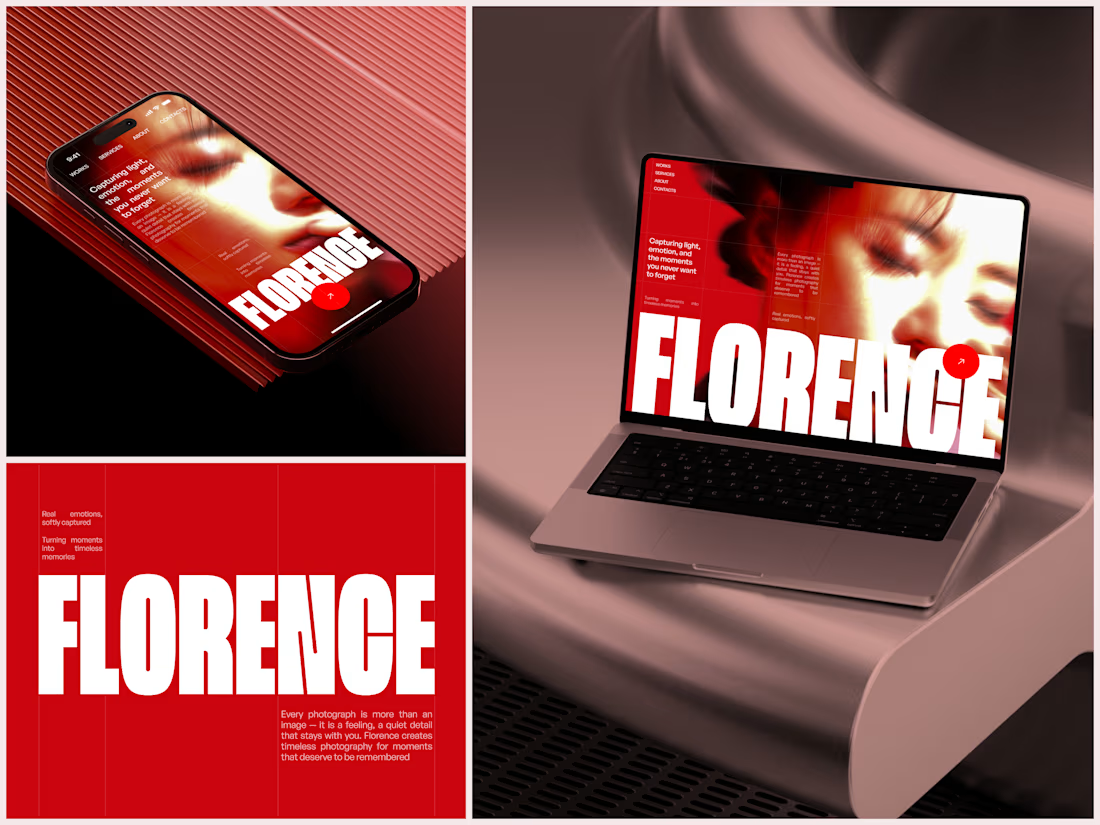

The heavy condensed white FLORENCE over the red portrait is bold, and keeping the same red across phone, laptop and type tile makes the case study read as one system. Did the red come from the photographer's own work, or was it your call?

Rebuilt my portfolio with AI and added new case studies.
Brand, web, and product UI. All custom coded, all in one page.

One page with brand, web and product UI together is a strong move. Clients see the range without clicking around. Rebuilding mine with AI coding tools taught me the same thing: the speed lets you spend the saved time on the case study writing, which is what actually wins work.


How do you sell houses that are not built yet?
On kalotespusynas.lt people pick their home on a map.
Switch between 3D and a flat 2D plan, zoom in, show only the cottages. Green means free, orange means reserved. Some plots hold two homes, so they split into A and B, each with its own size and plot.
One map instead of a price list PDF. Buyers get it in seconds.
This is so much better than a price list PDF. I build PlotToBuild, a sales tool for real estate firms selling plots in Nigeria, and the free / reserved / sold status is exactly what buyers ask about first. Splitting plots into A and B is a smart touch.