The network for creativity
Join 1.25M professional creatives like you
Connect with clients, get discovered, and run your business 100% commission-free
Creatives on Contra have earned over $150M and we are just getting started
Back to feedPost

Practical & Motivated Lighting in Cinema — Applied to AI Filmmaking
Why do we use practicals in the first place?
One reason is that they help the viewer understand where the light in a scene is coming from.
If a character’s face is illuminated but there’s no visible or implied source — no window, lamp, candle, screen, streetlight, or other logical source — the lighting can start to feel artificial or arbitrary.
This is where practicals and motivated lighting come in.
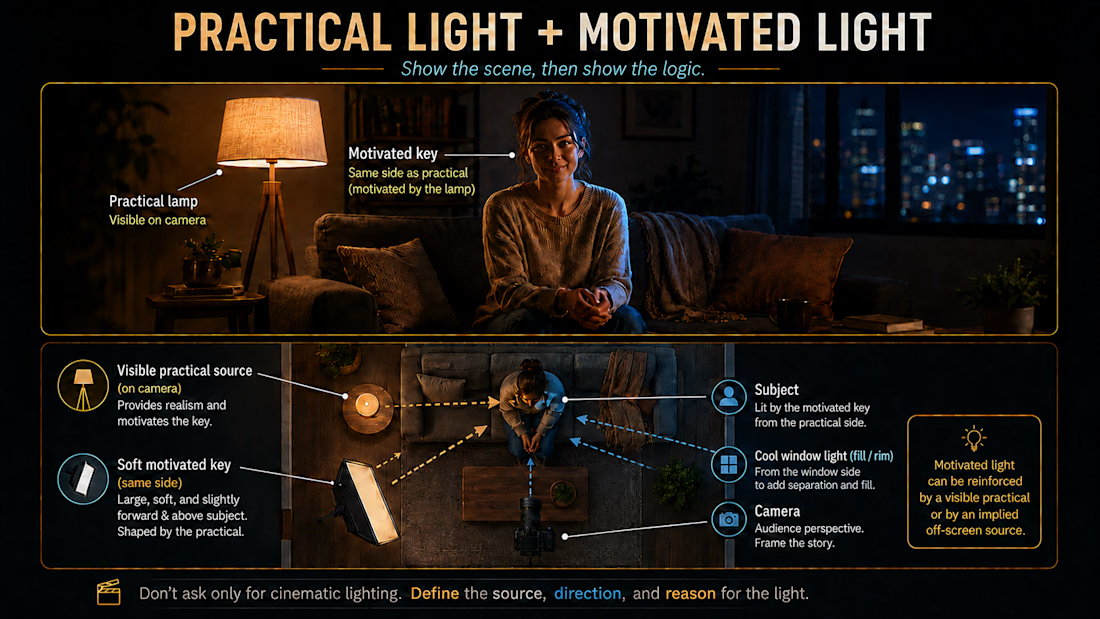
A practical is a light source that exists within the scene and is visible in frame: a table lamp, floor lamp, candle, neon sign, car headlights, TV screen, and so on.
On a real film set, however, a practical is often not enough on its own to properly shape or expose the actor.
So cinematographers may place an additional light outside the frame to reinforce the practical. Its direction, color, intensity, and quality are shaped to feel consistent with the source we see in the scene.
That is motivated lighting.
But motivated lighting doesn’t always need a visible practical to reinforce. It can also be motivated by an implied or off-screen source — for example, moonlight through a window, a streetlight outside, or passing headlights.
For example:A table lamp visible in frame = a practical
A large soft source placed just off camera, shaped to feel like it comes from that lamp = a motivated key
The same principle works in AI image and video generation.
Instead of simply asking for “cinematic lighting,” we can describe the actual lighting logic of the scene:
Practical: visible table lamp in frame
Motivated key: soft off-camera source shaped to feel motivated by the lamp
Color: warm tungsten light
Quality of light: soft and diffused, with gentle falloff
Prompt example:
“A warm table lamp is visible in frame as a practical. A soft motivated key from the same direction reinforces the warm tungsten glow on the character’s face, with gentle falloff and controlled contrast.”
Now we’re not simply asking the model to make the lighting “look cinematic.”
We’re giving it a believable lighting logic for the scene.
And that usually leads to much more intentional and coherent results.
The network for creativity
Join 1.25M professional creatives like you
Connect with clients, get discovered, and run your business 100% commission-free
Creatives on Contra have earned over $150M and we are just getting started





Related posts

AI cinematic short film: Hide and Seek


Top notch

Some things can't be rushed. They can only be heard.
"One Note" is a 30-second short about a master luthier in Cremona, 200 hours of craft, and a single note to prove it all.
The idea: make sound visible. When the bow touches the string, the air fills with gold light and the whole workshop answers.
I built it entirely with @Invideo: I wrote the script and shot design, and the invideo agent handled the look, characters, score and final edit. Scoring first and cutting the picture to the music changed everything: the dust, the glass ripple and every reaction land exactly on the note.
If you're a video editor or a designer, try the invideo editor. It's free to try, and it turns a clear idea into a finished film faster than I expected.
Tools: invideo agent, Seedance 2.5, GPT Image 2.5, Lyria 3 Pro
#Invideo #AIVideo #Cinematic


The effect describes the sound well. Nice work!

Light or dark, which one wins? ☀️🌙
Same site, two moods. Warm stone and lacquer red, or the same build after dark.
Both are hand-built with a 3D paper crumple, real physics, a stick-figure film drawn in code, and a receipt that gets a bicycle kick. 🔊 Sound on.
Tell me which you'd ship: light or dark? 👇
26 voted
59%
18 voted
41%
44 votes
Closed

I really like how the light version looks, but it has some legibility issues. Since readability is more important for users than visual appeal, I think the dark version is the better option.
BTW, I initially voted for the light version, but after analyzing both options more closely, I changed my mind 😄