The network for creativity
Join 1.25M professional creatives like you
Connect with clients, get discovered, and run your business 100% commission-free
Creatives on Contra have earned over $150M and we are just getting started
Back to feedPost

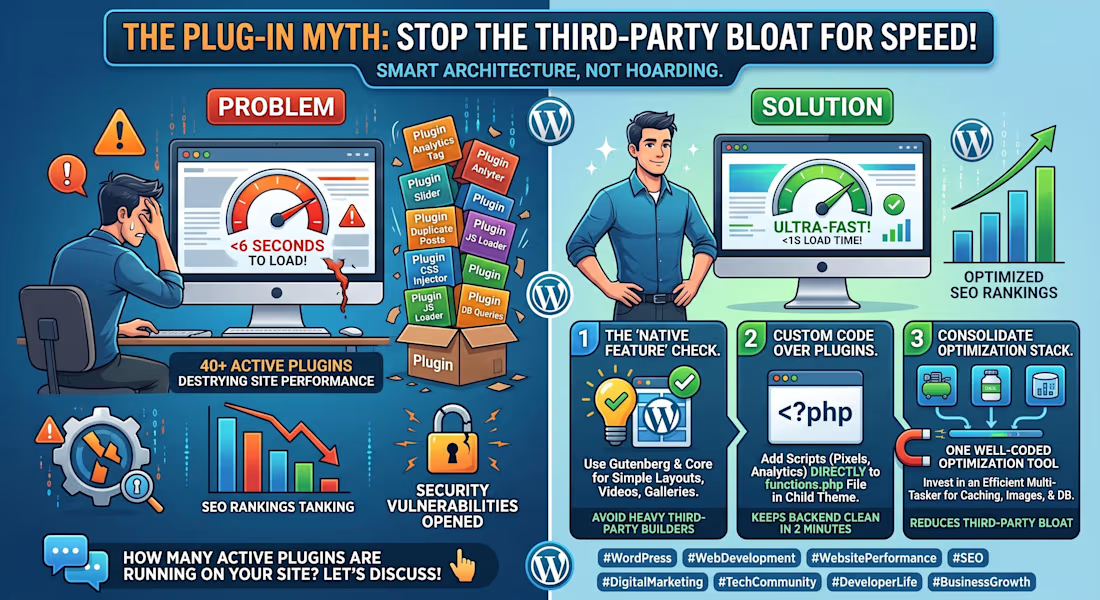
Installing a new WordPress plugin for every minor feature is the fastest way to destroy your website's performance.
The Problem:
I audit client websites all the time, and it is not uncommon to see 40+ active plugins on a standard local business site. One plugin for inserting a Google Analytics tag, another for a slider, and one just to duplicate posts.
Every single plugin you install injects extra CSS, JavaScript, and database queries into your site. Before you know it, your pages take 6 seconds to load, your SEO rankings tank because of the slow speed, and you have unknowingly opened up massive security vulnerabilities.
The Solution:
Stop treating plugins like a magic fix for everything. A high-performing, secure website relies on smart architecture, not third-party bloat. Here is the 3-step audit process I use to clean up and optimize heavy WordPress sites:
The "Native Feature" Check:
Are you using a plugin for something WordPress natively handles? Since the recent Gutenberg updates, you don't need heavy third-party page builders for simple layouts, and you definitely don't need a plugin to embed a video or create a standard gallery. Use core features whenever possible.
Custom Code Over Plugins:
Need to add a Facebook Pixel or Google Analytics tracking script? Don't install a "Header and Footer Injector" plugin. Just add those 5 lines of code directly to your child theme's functions.php file. It takes two minutes and keeps your backend completely clean.
Consolidate Your Optimization Stack:
If you absolutely must use performance plugins, find ones that handle multiple tasks efficiently. Instead of running three separate plugins for image compression, page caching, and database cleanup, invest in a single, well-coded optimization tool that handles it all under one roof.
A website should be built to run fast and convert visitors, not to hoard third-party software.
How many active plugins are currently running on your website? Have you checked recently? Let's discuss in the comments! 👇

The network for creativity
Join 1.25M professional creatives like you
Connect with clients, get discovered, and run your business 100% commission-free
Creatives on Contra have earned over $150M and we are just getting started





Related posts


What I built & why
I built PawRoute, a smart booking and automation experience for a fictional solo mobile dog groomer, Maya, based in Austin, Texas.
I chose mobile dog grooming because booking isn't as simple as finding an empty calendar slot. Every new inquiry can require the owner to check the customer's location, understand the dog’s needs, recommend a service, calculate pricing, find a time that works with the driving route, confirm the appointment, send reminders, and handle cancellations.
I wanted to answer one question:
How can I turn “Can I book?” into “You’re booked” with as little work from the business owner as possible?
So I designed PawRoute around a simple 3-step customer booking experience. Customers provide their location and dog details, receive a recommended service with clear pricing, and choose from available appointment times.
I also created Best Route Match, which prioritizes appointments when Maya is already working nearby instead of treating every available time equally.
Behind the customer experience, PawRoute handles the repetitive work: booking confirmations, reminders, customer information, route updates, rescheduling, and automation activity.
I also designed an owner dashboard where Maya can see appointments, customers, her driving schedule, and what PawRoute has automated.
Finally, I added a cancellation-recovery workflow. When an appointment opens up, PawRoute can help identify suitable waitlisted customers and refill the slot instead of requiring Maya to manually message people.
The goal wasn't simply to build another booking website. It was to design a system where the customer sees simplicity while the complexity is handled behind the scenes.
3 steps for customers. Less scheduling work for Maya.
Built with Lovable for the Lovable Challenge.

That works. If the screen recording clearly demonstrates the product, your written explanation can carry the “what I built and why” story.
Here’s a polished version you can use for your Contra challenge submission:
What I built & why
I built PawRoute, a smart booking and automation experience for a fictional solo mobile dog groomer, Maya, based in Austin, Texas.
I chose mobile dog grooming because booking isn't as simple as finding an empty calendar slot. Every new inquiry can require the owner to check the customer's location, understand the dog’s needs, recommend a service, calculate pricing, find a time that works with the driving route, confirm the appointment, send reminders, and handle cancellations.
I wanted to answer one question:
How can I turn “Can I book?” into “You’re booked” with as little work from the business owner as possible?
So I designed PawRoute around a simple 3-step customer booking experience. Customers provide their location and dog details, receive a recommended service with clear pricing, and choose from available appointment times.
I also created Best Route Match, which prioritizes appointments when Maya is already working nearby instead of treating every available time equally.
Behind the customer experience, PawRoute handles the repetitive work: booking confirmations, reminders, customer information, route updates, rescheduling, and automation activity.
I also designed an owner dashboard where Maya can see appointments, customers, her driving schedule, and what PawRoute has automated.
Finally, I added a cancellation-recovery workflow. When an appointment opens up, PawRoute can help identify suitable waitlisted customers and refill the slot instead of requiring Maya to manually message people.
The goal wasn't simply to build another booking website. It was to design a system where the customer sees simplicity while the complexity is handled behind the scenes.
3 steps for customers. Less scheduling work for Maya.
Built with Lovable for the Lovable Challenge.


"A Windows 95-style 2D physics engine that generates live audio synthesis based on particle collisions, built in one HTML file"
I built this sandbox engine to merge tactile 2D physics with real-time web audio synthesis, all wrapped inside a nostalgic Windows 95 desktop simulation. The idea was to create a musical playground where gravity, bounce, and spatial collisions dictate the rhythm and melody, making it feel like a complex piece of forgotten 90s software.
WHAT IT CAN DO:
Users can spawn particles into a physics sandbox and route them through custom tracks. The toolbox includes sounding pegs, spring like bouncers, splitters that clone balls, gravity wells, accelerators, and portals. Every time a particle hits an object, it triggers a musical note.
The right panel acts as a full synthesizer console. You can switch between FM bells, Karplus-Strong plucks, or deep sub-bass, quantize notes to different musical scales (Lydian, Pentatonic, Aeolian, etc.), and map specific pitch offsets to individual pegs. At the bottom, there is an analog-style FX rack with rotatable knobs for reverb, delay, master gain, and a live oscilloscope that visualizes the audio output. Users can even drag and drop their own .WAV/.MP3 samples to trigger instead of the built-in synths, and record their jam sessions directly to a WebM file.
THE TECHNICAL SIDE:
Everything sits inside one single HTML file. No frameworks, no external libraries, zero build tools.
The UI is built with pure CSS and vanilla JavaScript, recreating the classic Win95 bevels, title bars, and dropdown menus. The sandbox runs on a custom 2D physics engine I wrote from scratch using HTML5 Canvas, featuring spatial sub-stepping, dynamic collision resolution, and vector math.
The audio engine relies strictly on the Web Audio API. It routes synthesized oscillators through custom delay nodes, biquad filters, and a dynamics compressor to prevent clipping when hundreds of collisions happen at once.
WHAT I LEARNED:
The hardest part was keeping the physics and audio perfectly synced without dropping frames. When you have dozens of balls hitting pegs at the exact same time, the audio context can easily get overwhelmed. I had to implement physics sub-stepping (calculating 4 smaller simulation steps per visual frame) to prevent high-speed objects from clipping through drawn lines. I also added a slight trigger throttle so the synthesizer wouldn't distort during massive collision clusters.
Building the math for the analog FX knobs was also a fun challenge; calculating mouse drag deltas and mapping them smoothly to both the visual CSS rotation and the Web Audio delay parameters.


the retro inspired design concept is spot on.😍 Massive "W" on the overall UI💯 💯 💯 👍