The network for creativity
Join 1.25M professional creatives like you
Connect with clients, get discovered, and run your business 100% commission-free
Creatives on Contra have earned over $150M and we are just getting started
Back to feedPost

A lead fills out a form at 8 PM.
Most businesses respond the next morning at 10 AM. By then? That lead has already spoken to two competitors and booked elsewhere.
In 2026, speed-to-lead isn't a bonus—it's the whole game.
This is why traditional forms are shifting toward conversational AI Voice Agents.
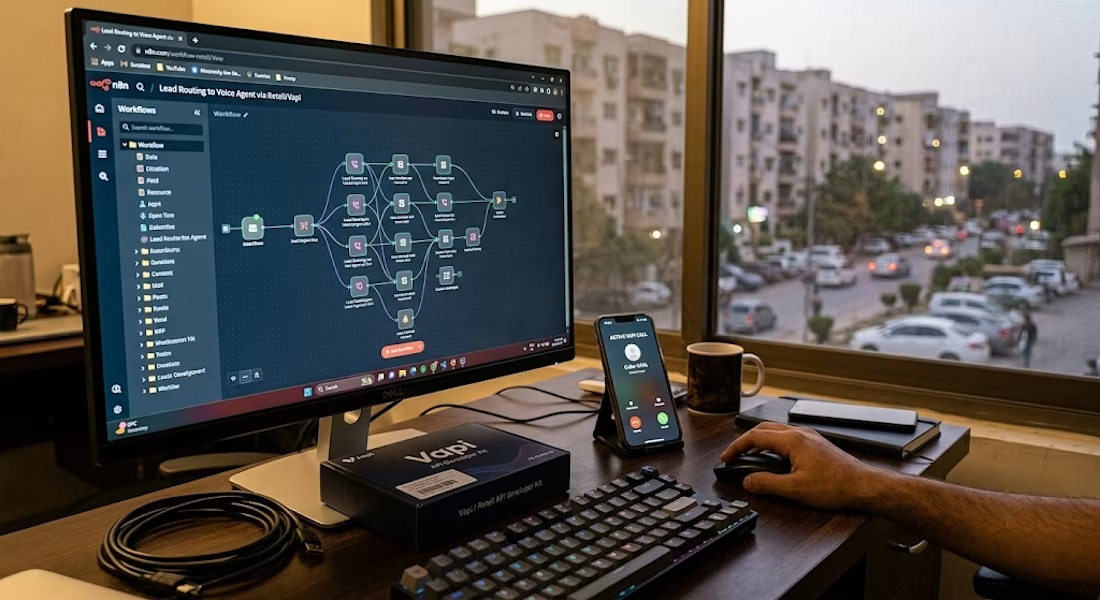
Here is what happens when you plug a Voice Agent into your lead capture:
Instant Inbound Handling: When a prospective customer calls or submits a high-intent inquiry, an AI Voice Agent connects in under 3 seconds.
Natural Qualification: Instead of static dropdowns, the agent asks real qualifying questions (budget, timeline, service requirements) in fluent, natural conversation.
Live Calendar Booking: It syncs directly with Google Calendar / Calendly to lock in the appointment on the spot.
CRM Synchronization: The call recording, transcript, and key data points are pushed straight to Airtable, HubSpot, or Google Sheets via n8n webhooks.
No missed calls after 6 PM. No manual follow-up reminders. No lost ad budget.
For inbound-heavy businesses (dental clinics, real estate, home services), this single shift turns dead ad traffic into qualified meetings on autopilot.
How is your team currently handling inbound calls and form follow-ups outside business hours?
#VoiceAI #Automation #n8n #LeadGeneration #AIAgents #BusinessGrowth


The network for creativity
Join 1.25M professional creatives like you
Connect with clients, get discovered, and run your business 100% commission-free
Creatives on Contra have earned over $150M and we are just getting started

Challenges
View all


Related posts

Agent products resist normal product marketing. There's no single interface to screenshot and the category vocabulary has gone generic, so a feature list communicates almost nothing.
We built Heron's explanation as a four-beat scroll that runs the agent's actual loop. The model appears and is watched. Violations surface with plain language and a real IBC clause. An edit is applied after approval. The system learns the firm's standards.
Pacing was the main design problem. Each beat needed enough scroll distance to register as a separate action, without the section becoming so long that people bail before the payoff. The sequence carries the technical detail that would otherwise sit in a spec table.


The four-beat scroll is a smart way to make the agent’s loop feel tangible—much clearer than a static feature list. The restrained visual system gives the interaction room to breathe.

I desired to learn Framer deeply, with infusion of AI and this is my first live Project.
MacBook inspired Retro Portfolio Piece.


Congrats on your first live Framer project! Fun concept to explore.


First contract on Contra finished!


How was it?