The network for creativity
Join 1.25M professional creatives like you
Connect with clients, get discovered, and run your business 100% commission-free
Creatives on Contra have earned over $150M and we are just getting started
Back to feedPost

Recently identified a publicly accessible Spring Boot Actuator /env endpoint during a security assessment.
What initially appeared to be a routine configuration exposure turned out to reveal:
• Internal service architecture
• Backend microservice endpoints
• Internal hostnames and network information
• Deployment and filesystem details
• Security configuration settings
• Credentials and encryption-related secrets
This serves as a reminder that management interfaces can expose far more than operational metadata when left accessible in production environments.
Key lessons:
✓ Restrict Actuator endpoints to trusted administrative networks
✓ Avoid exposing /env in production
✓ Review environment variables and configuration repositories for secrets
✓ Rotate any exposed credentials immediately
✓ Use least-privilege exposure lists rather than wildcard endpoint exposure
Small configuration mistakes can create a complete roadmap of an organization's internal infrastructure.
#CyberSecurity #AppSec #SpringBoot #DevSecOps #BugBounty #SecurityResearch #OWASP #InfoSec


The network for creativity
Join 1.25M professional creatives like you
Connect with clients, get discovered, and run your business 100% commission-free
Creatives on Contra have earned over $150M and we are just getting started


Related posts

Why relying on public CAs for internal infrastructure is an operational time bomb: The case for your own private Root and Sub-CA.
How many times has your engineering team been paged at 3:00 AM because an internal TLS certificate expired, taking down database connection pools, internal APIs, or background workers?
When securing internal networks, teams usually fall into one of three traps:
1. The Self-Signed Disaster: Generating ad-hoc self-signed certificates and scattering them across servers. Developers end up adding --insecure or insecure_skip_verify: true to application code, completely gutting transport security.
2. The Public ACME Workaround: Trying to use Let's Encrypt on non-routable internal hostnames (like .internal or RFC 1918 IPs). This requires leaking internal network topology to public DNS or storing sensitive DNS API credentials on every internal host.
3. The Spreadsheet Calendar: Tracking certificate expiration on calendar reminders until an un-tracked intermediate cert inevitably lapses.
Enterprise sovereign infrastructure solves this permanently with a dedicated, multi-tier Private Public Key Infrastructure (PKI):
• Offline Enterprise Root CA: An ultra-secure, isolated trust anchor that signs only subordinate issuing authorities and never touches online network traffic.
• High-Availability Subordinate Issuing CAs (Sub-CAs): Domain-level issuing authorities (Dogtag PKI/FreeIPA) handling day-to-day certificate issuance.
• Zero-Touch Automated Renewal: Using certmonger on Linux hosts to continuously monitor certificate lifecycles, automatically re-requesting certificates 30 days prior to expiration and reloading daemons hitlessly.
• Mutual TLS (mTLS) Enforcement: Cryptographic workload identity verifying both server and client authenticity across internal database listeners, microservices, and admin interfaces.
Stop debugging expired certificates during outages. Deploy an automated private PKI foundation.
Deploy your sovereign PKI with our 2-week Enterprise FreeIPA HA & Centralized PKI/CA Sprint on Contra:
#Security #CyberSecurity #Cryptography #Infrastructure #Linux #DevOps #SRE #Architecture



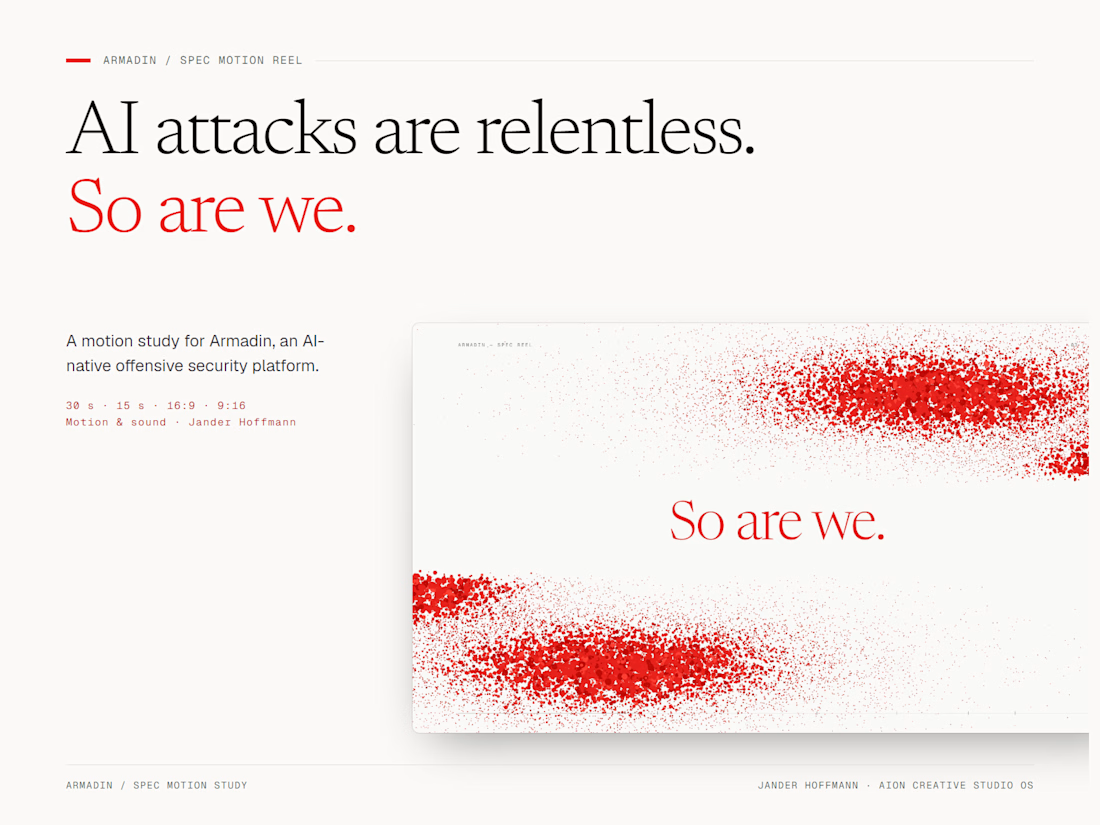
Cybersecurity doesn’t have to look like a hacker movie.
Armadin’s brand is editorial and restrained, so the film avoids the usual dark noise. The agents are a single particle system [swarm, fingerprint, 3D attack map] and the only colour is the brand’s signal red.
What cliché would you ban from your category?






Really nice use of color and texture in this! Great job!