The network for creativity
Join 1.25M professional creatives like you
Connect with clients, get discovered, and run your business 100% commission-free
Creatives on Contra have earned over $150M and we are just getting started
Back to feedPost

Your Website Gets 50 Milliseconds to Earn Trust — Here's What Visitors Actually Judge
Most business owners think visitors read their website before deciding. They don't. They judge it first, and read later — if they stay at all.
Research keeps pointing to the same uncomfortable fact: around 94% of first impressions are design-related, visitors form an opinion in about 50 milliseconds, and 75% of people judge a company's credibility based on its website design. On mobile it is even less forgiving — 57% of users say they won't recommend a business with a poorly designed mobile site, and 88% are less likely to return after a bad experience on a site.
After building 300+ WordPress and Shopify sites for small businesses in the UK, US and UAE with a small expert team, I can tell you the trust leaks are rarely dramatic. They are small, everyday things: an outdated hero image, a vague headline, stock photos instead of the real business, no clear next step. In fact, around 70% of small business homepages lack a clear call to action, so a visitor who actually wants to enquire is left guessing what to do next.
Five fixes that genuinely move the needle:
First, one clear headline above the fold: who you help, what you do, and where. If a visitor has to work it out, you have already lost them.
Second, show real proof before pretty decoration. Real photos of your work, your team or your premises, plus genuine reviews, beat another stock image every time.
Third, give people one primary action and repeat it. Call, book, or enquire — pick the one that matters most and make it obvious on every key page, not just the contact page.
Fourth, check the site the way your customers actually see it: on a phone, on a normal connection. Menus, buttons, forms and pricing must work with a thumb, without pinching or sideways scrolling.
Fifth, treat speed as a trust signal, not a technical detail. A page that stalls feels unreliable before a single word is read, and a fast, stable page quietly says this business is organised.
None of this needs a redesign every year. It needs someone to look at the site the way a first-time visitor does, fix the leaks in order of impact, and keep the parts that already work.
If you run a small business, open your own homepage on your phone right now and ask one question: in the first five seconds, would a stranger trust this business enough to enquire? If the answer is not a clear yes, that is where the work starts. Happy to give an honest second opinion in the comments if you want one.

The network for creativity
Join 1.25M professional creatives like you
Connect with clients, get discovered, and run your business 100% commission-free
Creatives on Contra have earned over $150M and we are just getting started








Related posts

The Good Times website is live 👀
Most app sites start with a phone mockup and a list of features. This one starts with the problem, so you can see yourself in it first. The app shows up after that, as the answer.
https://goodtimestimer.com/
Built with Astro.


Great concept


Three weeks into building the Pasted website, after the design was approved, an 11-page document arrived with a whole new vision.
It was beautiful work, and it described a different project at the agreed price.
I asked them to decide: keep the approved scope, or pause and price the new idea separately. On day six, they chose the original. We shipped two weeks later.
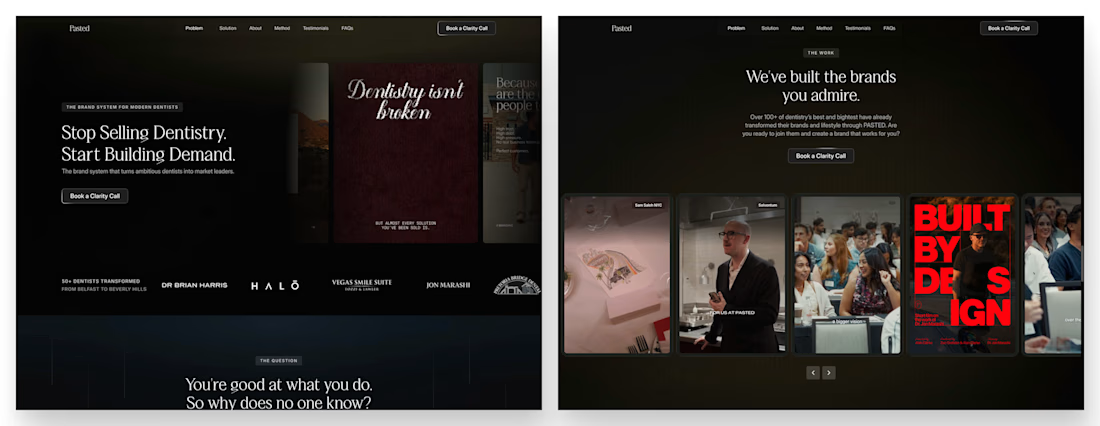

Offering to price the new vision as its own phase also lets the client see what the idea costs without it feeling like a no. Was a change-order process already written into your contract, or did you build that path on the spot?

I've been working on Cervia, a @Framer website for a single product.
A good single-product site combines the landing page and the store in one page, so the call to action is the purchase itself. Visitors learn what the product is, see why it’s better, and add it to the cart without leaving the page.
The challenge is making one page do both jobs. It has to look like a landing page, with room to explain the product and show it well, and still work like a store product page, with the price, colors and Add to cart always close at hand.
Every extra step between arriving and paying loses some buyers, so I kept the steps to a minimum.


This is so well put Heron! 🔥 Single-product site logic is spot on - landing + store in one page removes friction, CTA is purchase itself. No wandering around. Visitors learn what it is, why it's better, add to cart without scrolling through 5 pages - that's conversion gold!...