The network for creativity
Join 1.25M professional creatives like you
Connect with clients, get discovered, and run your business 100% commission-free
Creatives on Contra have earned over $150M and we are just getting started
Back to feedPost

What it actually takes to build a multi-tenant edtech SaaS from scratch
Everyone wants to build a SaaS. Few people talk about what happens when 500+ schools hit your system at the same time, each expecting their data to be completely isolated.
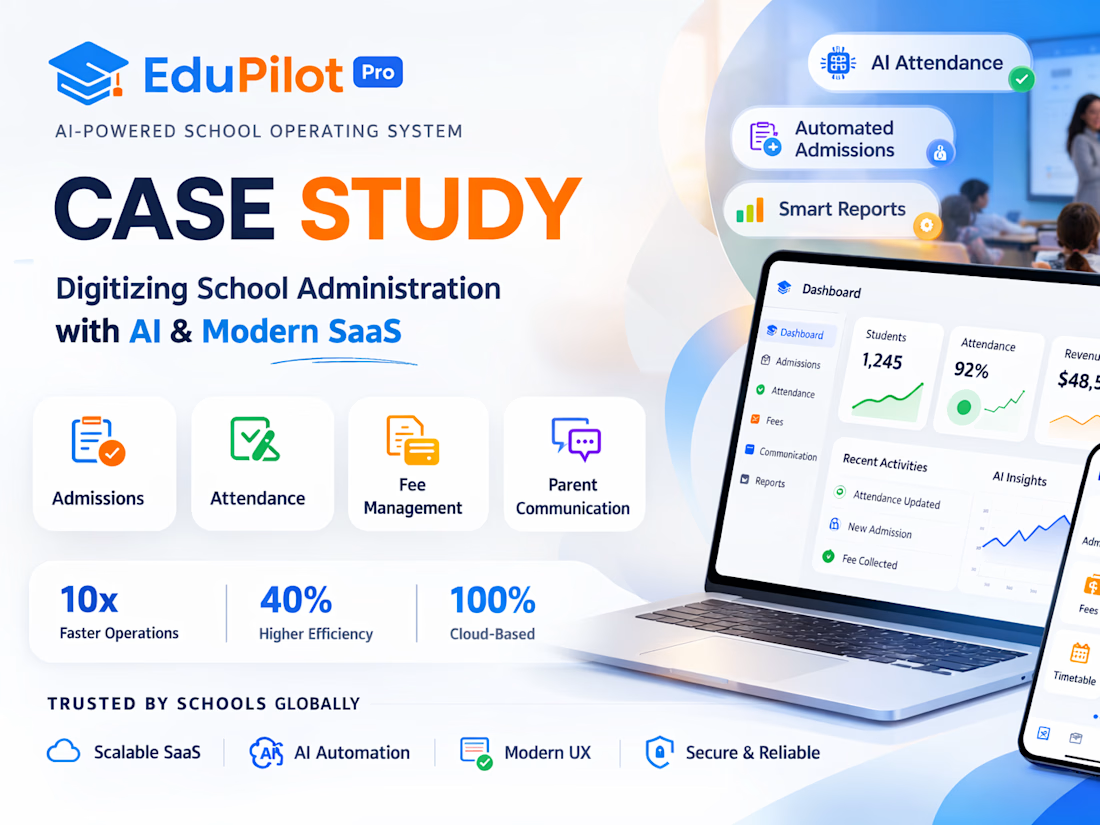
I built EduPilotPro, an AI-powered school operating system serving schools across South Asia, the Middle East, and Africa. Here's what the "multi-tenant SaaS" part actually looked like:
Tenant isolation is the first real decision. Every school needs to feel like they own the platform. Their data, their config, their branding. But you're running one codebase, one database cluster, one deployment. We used PostgreSQL with row-level isolation on self-hosted Supabase. Each school gets its own logical boundary without the cost of spinning up separate infrastructure per tenant.
The 8:45 AM problem. Schools don't use software evenly throughout the day. At 8:45 AM, every teacher in every school marks attendance simultaneously. That's a traffic spike that would embarrass most startups. We used Redis + BullMQ to queue attendance writes and process them asynchronously, so the UI stays responsive even when thousands of classrooms hit the system at once.
AI agents, not AI features. We didn't bolt a chatbot onto a school ERP. We built 6 purpose-built AI agents: attendance, admissions, fees, communication, reporting, and scheduling. Each one handles a specific administrative function end-to-end. A teacher types "All students present except Ali who is sick and Ahmed who is 10 minutes late" and the attendance agent parses it, records it, and notifies parents. No forms. No checkboxes.
The stack: Next.js + React + TypeScript on the frontend. Node.js + self-hosted Supabase on the backend. PostgreSQL + Redis + BullMQ for data and queuing. Railway for cloud infrastructure.
What I'd tell any founder about to build multi-tenant SaaS:
Design your tenant model before you write a single feature. Retrofitting isolation is painful.
Assume your traffic will be spiky, not smooth. Queue everything you can.
If you're adding AI, make it do the whole job, not half of it. A half-automated workflow is worse than a manual one because now nobody knows who's responsible.
→ Full case study: EduPilotPro on Contra

The data-isolation part is exactly where most multi-tenant builds quietly break. Are you doing row-level security or a schema per tenant?
thanks @Jasper Rexford
Yes, our approach is Row-Level Security (RLS) with Supabase.
Every request is authenticated and tenant-aware, with RLS policies enforcing that each school can only access its own data.
As always, RLS is just one layer, we also validate tenant context in the application layer as a defense-in-depth approach.

The line that jumps out is "each school wants to feel like they own the platform, their data, their config, their branding." Tenant isolation usually gets framed as a database problem, but the branding side is where perception lives: if a school's identity renders inconsistently...
Great question, and you're right that this is where trust actually lives for the end user.
We went with a hybrid approach. Every school gets:
Custom subdomain + landing page (so parents land on their school's domain, not ours)
Custom logo, colors, and fonts across all UI...
The network for creativity
Join 1.25M professional creatives like you
Connect with clients, get discovered, and run your business 100% commission-free
Creatives on Contra have earned over $150M and we are just getting started


Related posts

Just Launched: The Pharmazest
Excited to share one of my latest projects! I had the opportunity to design and develop the complete website for The Pharmazest from scratch.
The goal was to create a modern, professional, and user-friendly healthcare website with a clean UI, responsive layout, fast performance, and SEO-focused structure that delivers an excellent experience across all devices.
🔹 Custom Website Design
🔹 Frontend & Backend Development
🔹 Responsive Web Design
🔹 Performance Optimization
🔹 SEO-Friendly Structure
🔹 Modern UI/UX
🔹 Healthcare & Pharmaceutical Website
🌐 Live Website: The Pharmazest
If you're looking for a Web Designer & Full Stack Developer who builds fast, modern, and conversion-focused websites for businesses, startups, or healthcare brands, let's connect.
#WebDesign #WebDevelopment #WebsiteDesigner #FullStackDeveloper #FrontendDeveloper #ResponsiveDesign #UIDesign #UXDesign #HealthcareWebsite #PharmaceuticalWebsite #BusinessWebsite #SEO #WordPress #CustomWebsite #Portfolio #Contra #FreelanceDeveloper



Inspirational 💯

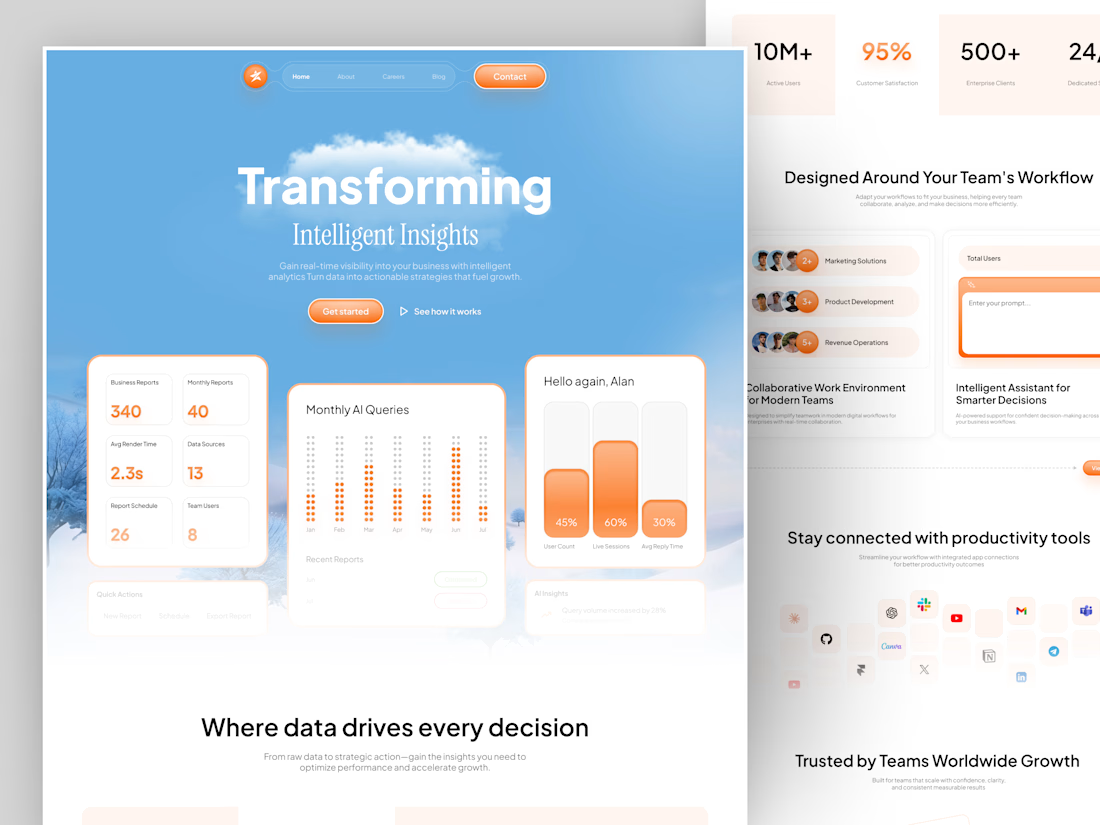

Most SaaS websites don't need more animations.
They need better hierarchy.
CoreSpace was designed to make products easier to understand through structure, typography and storytelling—not visual noise.


Nice




Trending

Claude
Claude has entered the design space. How are you using Claude Design?

Contra University
Learn from expert creatives how to earn more using next-gen AI tools.

MagicPath
The canvas is infinite, and exploration is becoming the workflow. How are you using MagicPath?
creativeaiflow
Creative AI workflows are evolving. What tools do you use, and what are their strengths and weaknesses?
freelancerlife
Freelancer life is wins, pivots, and everything in between. What’s yours right now?