The network for creativity
Join 1.25M professional creatives like you
Connect with clients, get discovered, and run your business 100% commission-free
Creatives on Contra have earned over $150M and we are just getting started
Back to feedPost

Sub-400ms voice agent: Eliminating audio lag in conversational AI 🎙️⚡
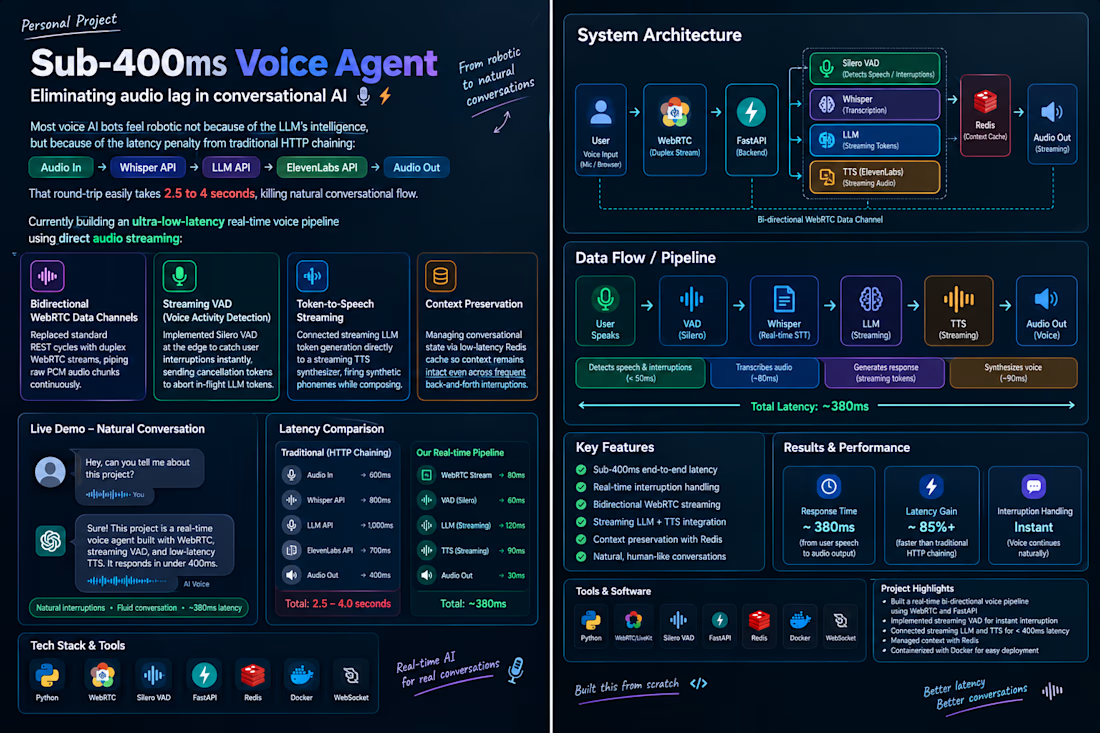
Most voice AI bots feel robotic not because of the LLM's intelligence, but because of the latency penalty from traditional HTTP chaining: Audio In ➔ Whisper API ➔ LLM API ➔ ElevenLabs API ➔ Audio Out. That round-trip easily takes 2.5 to 4 seconds, killing natural conversational flow.
Currently building an ultra-low-latency real-time voice pipeline using direct audio streaming:
Bidirectional WebRTC Data Channels: Replaced standard REST request-response cycles with duplex WebRTC streams, piping raw PCM audio chunks continuously.
Streaming VAD (Voice Activity Detection): Implemented Silero VAD at the edge to catch user interruptions instantly, immediately sending cancellation tokens to abort in-flight LLM token generation.
Token-to-Speech Streaming: Connected streaming LLM token generation directly to a streaming TTS synthesizer, firing synthetic phonemes while the sentence is still being composed.
Context Preservation: Managing conversational state via low-latency Redis cache so context remains intact even across frequent back-and-forth interruptions.
Achieving natural, fluid interruptions and dropping perceived latency down to human conversational speeds (~380ms).
Architecture flow and latency breakdown below! 👇
#VoiceAI #WebRTC #Python #FastAPI #AudioEngineering #GenerativeAI #BuildInPublic



cutting the HTTP chain to get voice latency under 400ms is what makes a bot feel human
The network for creativity
Join 1.25M professional creatives like you
Connect with clients, get discovered, and run your business 100% commission-free
Creatives on Contra have earned over $150M and we are just getting started



Related posts


I just launched a sound platform for UI.
Every sound plays inside a small interface animation, so you hear the toggle when you flip the toggle, and the notification when it lands. No more guessing from file names.
147 minimal UI sounds to start: taps, toggles, notifications, success and error cues, purchases, loading and more. Listening is free.
penroseaudiostudio.com
Hope you enjoy it

This feels like a brand that knows exactly who it is. Curious about your process here, did the concept come first or visuals?

Grok bot is COOKING🔥, which one better for promoting letmotion.com?
9 voted
69%
4 voted
31%
13 votes
Closed

Tactile Kinetic catches my eye.

AI lead follow-up for contractors: why response speed beats price
The fastest way to lose a remodeling lead isn't price. It's silence.
A homeowner fills in your website form at 7 PM. Nobody sees it until the next morning. By then they've booked site visits with two other contractors.
An AI lead follow-up automation fixes this without a night shift. Here's how it works.
• Form submitted, the lead lands in your CRM (GoHighLevel, HubSpot or JobTread)
• AI reads the message and replies in under a minute, in your company's tone
• It asks two qualifying questions (scope, budget, timeline) and offers site-visit times
• Your estimator gets a short AI summary, not a raw form
• The customer and job are created in JobTread or Buildertrend automatically
I build these for construction companies with n8n or Zapier plus Claude, connected to the tools you already pay for.
None of this replaces the human call. It just makes sure you're the first contractor who answered.
How fast does your team reply to a new lead right now?


Nobody seeing a 7 PM form until morning is exactly how these leads disappear. What happens when the homeowner doesn't answer the two qualifying questions? A second short follow-up the next morning is often where a quiet lead finally replies, so I'm curious whether the system sends one or hands it straight to the estimator.