The network for creativity
Join 1.25M professional creatives like you
Connect with clients, get discovered, and run your business 100% commission-free
Creatives on Contra have earned over $150M and we are just getting started
Back to feedPost

SimpleRent - Contra Submission Post
Google Stitch Challenge Entry
PROJECT LINK
PROJECT TITLE
SimpleRent - Student Rental Platform for Sri Lanka
Every year, university students in Sri Lanka leave their hometowns to study in Colombo. They arrive with no local knowledge and no housing plan. No platform was built specifically for them.
SimpleRent is a student-first rental interface that solves two linked problems in one product: find a safe rental near your campus or find a compatible roommate to share the cost.
Google Maps-centered property search, NIC verification flow, roommate board, landlord dashboard, multi-step onboarding, messaging interface, and more - entirely designed and iterated inside Google Stitch.
HOW I USED STITCH
Before generating a single screen, I designed my own logo - a map pin housing a rooftop icon - and imported it into Stitch to generate a design.md brand file. Stitch scanned the logo and produced a complete design system: color palette, typography, card radius, shadow depth, and spacing. Every screen inherited that system automatically from the start.
Each of the 18 screens was then streamed live to the canvas - letting me review and plan refinements on one screen while the next was still being generated.
Once screens were on the canvas, I used Stitch's in-place AI edit feature to refine specific elements without regenerating anything. I clicked directly on a footer, typed a prompt, and only the footer changed. Same for card layouts, button colors, and badge styling - precise, targeted iteration on exactly the element I chose.
For motion, I used Stitch's native HTML canvas to build the NIC verification animation: the ID card shakes first as a visual cue, then flips smoothly on double-click. Property cards lift and shadow on hover. Because Stitch renders native HTML by default, every animation played in real time directly on the canvas as I built it.
For the code pipeline, I used Stitch's MCP connection to import Antigravity. Antigravity handled the code-side refinements - the logic and structure that go beyond what a visual canvas touches. Stitch for design. Antigravity for code. A full design-to-code pipeline, linked through MCP.
FEEDBACK ON STITCH
The real-time streaming canvas changed how I design. You stop waiting for a result and start collaborating with it - refining the previous screen while the next one is still being generated. That shift alone made the process feel genuinely different from any other tool I have used.
The in-place edit feature removed the biggest frustration of AI design tools: the fear of regenerating something good just to fix something small. Clicking directly on an element and prompting only that element to change is the kind of control that makes iteration feel safe.
The MCP integration with Antigravity was the unexpected part. It bridges the gap between a design prototype and a real codebase in a way I did not expect from a design tool.
Stitch did not just speed up how I work. It improved the ideas I had while I was working.


Love how much thought went into the process, not just the final screens. The logo to design system workflow is pretty clever.
I also submitted a project to the challenge:
https://on.contra.com/pnfJBQ
Happy to exchange feedback.

on.contra.com
Introducing Voya: Revolutionize Your Travel Planning Experience
Connect with next-gen talent and tools to get work underway. Hire more independents. Start more projects. Get more creative.

Beyond impressed with how this came together.

This is the gold standard right here! Absolutely spectacular.
The network for creativity
Join 1.25M professional creatives like you
Connect with clients, get discovered, and run your business 100% commission-free
Creatives on Contra have earned over $150M and we are just getting started
Related posts

Another client website went live yesterday. Built in Framer in collaboration with Black Prism.



Congrats on shipping this. Collaborating with Black Prism on the build sounds like a solid setup. The visual direction looks really distinct.

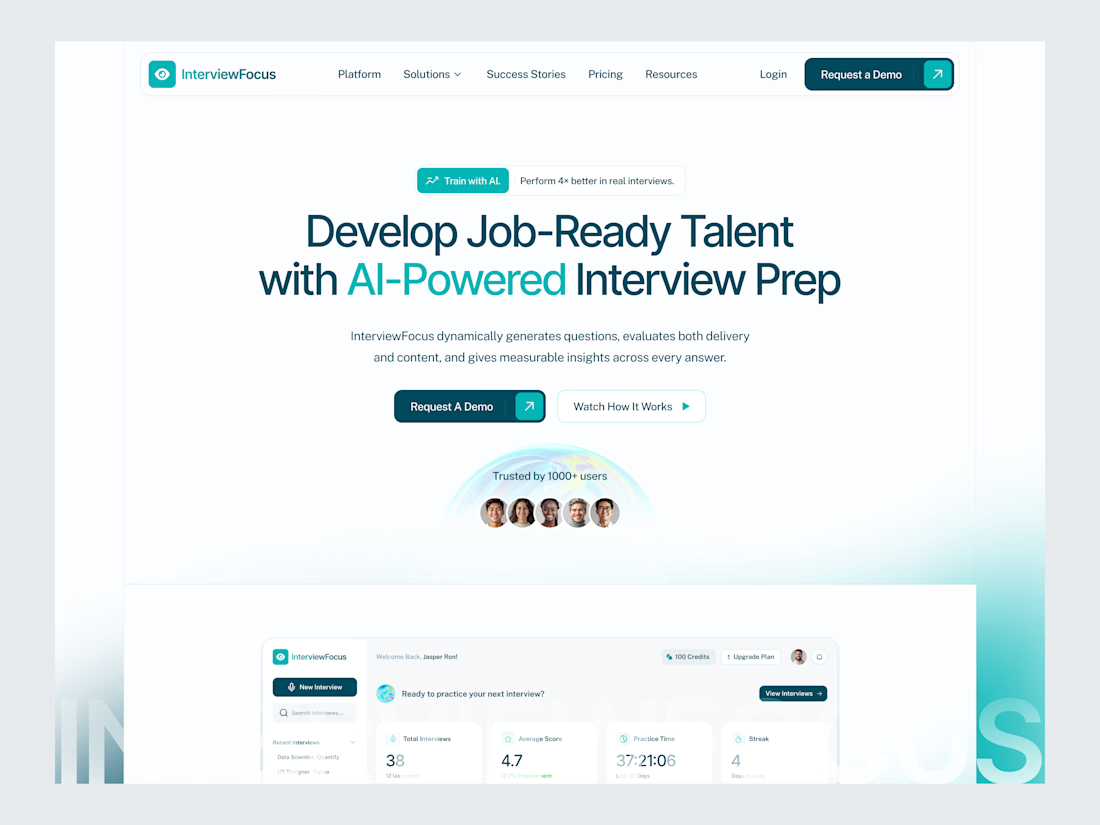
Designed a modern SaaS website for InterviewFocus – AI-Powered Interview Preparation Platform.
Clean and professional UI focused on helping users develop job-ready talent through intelligent interview training, real-time feedback, performance analytics, and practice tracking.

Nice work as usual

Website Design Showcase
Clean layouts, modern aesthetics, and a seamless user experience.
📩 Available for SaaS, AI, Web App, and Dashboard UI/UX projects.
👉 Book a call: https://calendly.com/gopi-uiux/30min
👉 Dribble: https://dribbble.com/OptimityLogics
👉 Behance: https://www.behance.net/optimitylogics
👉 Portfolio: https://gopi-prajapati-portfolio.vercel.app
This deserves more than just a like

















Trending

Claude
Claude has entered the design space. How are you using Claude Design?

Contra University
Learn from expert creatives how to earn more using next-gen AI tools.

MagicPath
The canvas is infinite, and exploration is becoming the workflow. How are you using MagicPath?
creativeaiflow
Creative AI workflows are evolving. What tools do you use, and what are their strengths and weaknesses?
freelancerlife
Freelancer life is wins, pivots, and everything in between. What’s yours right now?