The network for creativity
Join 1.25M professional creatives like you
Connect with clients, get discovered, and run your business 100% commission-free
Creatives on Contra have earned over $150M and we are just getting started
Back to feedPost

CASE STUDY: Engineering a Lockless, Sub-Microsecond Multi-Process IPC Transport Fabric in C
🏷️ Overview & Impact
Role: Independent Systems & Performance Infrastructure Engineer
Scope: Low-Latency Data Plane Engineering, Core Concurrency Optimization, Memory Safety
Stack: C11, Linux Architecture, POSIX Shared Memory, Hardware Core Pinned Execution
Core Output: Developed an enterprise-grade multi-process inter-process communication (IPC) ingestion engine (forge-core) that eliminates kernel-level context switching and ensures deterministic state coordination across isolated hardware nodes.
Business Value Metric: Bypasses operating system thread scheduling delays, allowing decoupled background daemons to stream and process hundreds of thousands of structured telemetry frames over shared RAM with zero memory-copy mutations and zero packet drops.
🚨 The Infrastructure Bottleneck (The Problem)
Modern high-throughput telemetry pipelines often suffer from unpredictable latency spikes, CPU cache-line thrashing, and high compute overhead. This degradation is typically driven by two foundational architectural flaws:
Kernel-Level Syscall Taxes: Relying on traditional socket structures or bloated network wrappers introduces thousands of kernel-to-userspace context switches per second.
Memory Alignment & Drift Vulnerabilities: When independent producer and consumer processes operate over shared memory segments, uncoordinated hot reboots risk leaving background daemons attached to uninitialized, stale "ghost slabs" of RAM bytes, resulting in silent data corruption.
🛡️ The Engineering Strategy & Invariants (The Solution)
I architected and deployed a deterministic, bare-metal IPC Transport Fabric (v5.0) designed to achieve sub-microsecond cross-core transit completely in user-space RAM.
Deterministic Control Plane Initialization (forge_init.c)
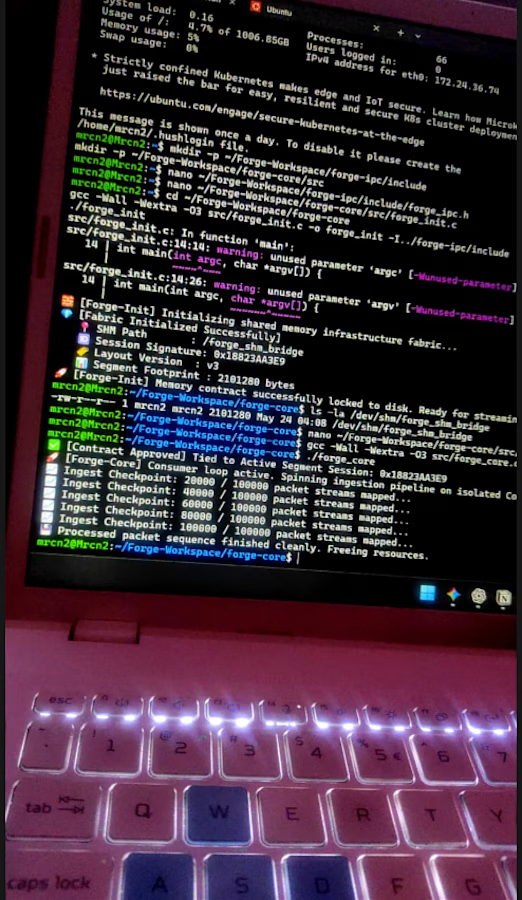
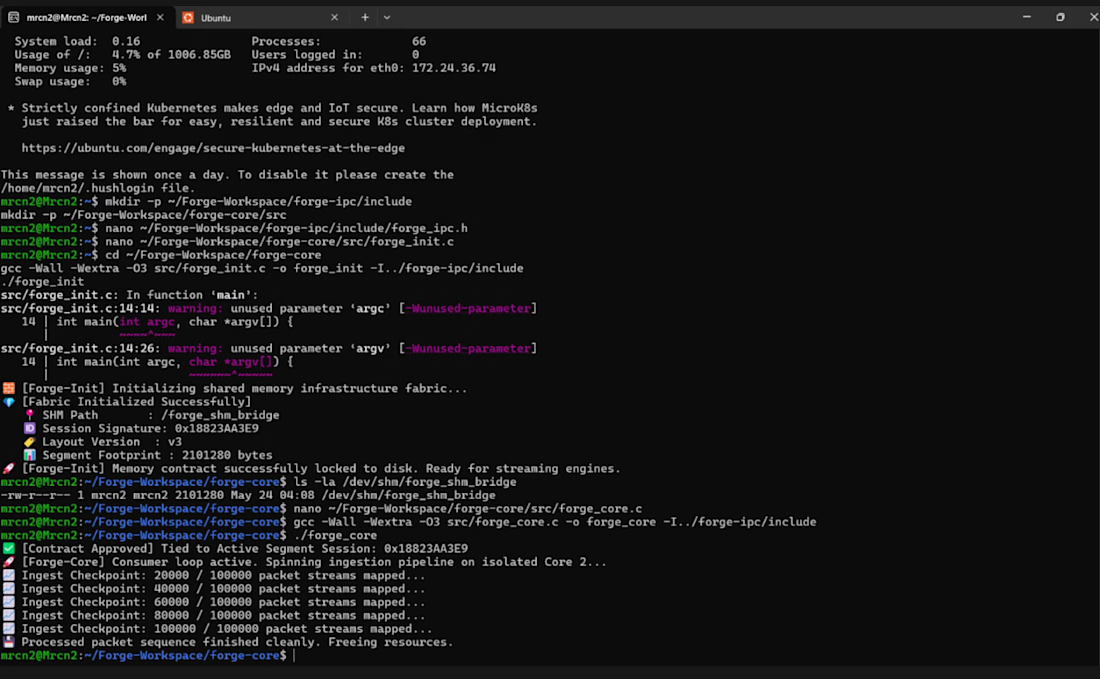
To prevent lifecycle desynchronization, I engineered a dedicated workspace bootstrapper daemon. The module forces clean-state allocation via shm_open(O_CREAT | O_RDWR | O_TRUNC), resizes the virtual block to exact dimensions via ftruncate, and executes a comprehensive memset pass to clear raw RAM electrical garbage bits. At boot, a unique, nanosecond-precision monotonic signature (session_id) is injected into the segment header via clock_gettime(). Downstream daemons continuously validate this signature mid-run, triggering a crash-fast protocol before data corruption can cascade.
Compile-Time Layout Hardening
Structure layout drift across separately compiled binaries will break low-level memory maps. I enforced memory uniformity by clamping all primary message slots and buffer boundaries to strict 8-byte cache-line alignment fields (attribute((aligned(8)))). The build pipeline leverages strict _Static_assert validations, forcing the compilation to safely break if unexpected padding drift alters structure geometries by a single byte:
C
_Static_assert(sizeof(ForgeSlot) == 4104, "ForgeSlot size layout drift detected!");
_Static_assert(sizeof(ForgeRingBuffer) == 2101280, "ForgeRingBuffer footprint drift detected!");
3. Cache-Line Memory Barriers & Affinity Maps
To bypass standard operating system thread migration latencies entirely, the execution daemons are pinned directly to isolated physical hardware processors via sched_setaffinity:
CPU Core 1: Hard-allocated to the Transport Gateway Producer (forge_stream.c).
CPU Core 2: Hard-allocated to the Ingestion Tracking Consumer (forge_core.c).
Synchronization is driven exclusively via lockless user-space indexing using hardware-enforced C11 atomic primitives (__atomic_load_n / __atomic_store_n) mapped to strict acquire/release memory fences (__ATOMIC_ACQUIRE / __ATOMIC_RELEASE).
📈 Verified Telemetry Results
Under rigorous synthetic load testing, the standalone architecture demonstrated flawless core-transit capabilities:
Throughput Saturated: 100,000 structured packets successfully offloaded down the pipeline without a single dropped tracking element.
Kernel Overhead: Reduced to 0% across the hot data path by shifting entirely to user-space lockless ring indexing.
Resource Optimization: Pinned processing loops successfully broke userspace busy-spin cycles via assembly-level pause hints, minimizing power consumption and maximize pipeline utilization on target nodes.
💼 Services I Provide for Technical Teams
This project validates the exact proof-of-work I bring to engineering teams globally. You can hire me for specialized independent contract work focusing on:
Log Processing & Ingestion Optimization: Eliminating file I/O blockades and multi-threading bottlenecks by replacing standard pipelines with vectorized, zero-copy memory architectures.
Low-Latency Data Plane Tooling: Designing lock-free, concurrent synchronization architectures and low-overhead IPC systems tailored for sub-microsecond performance requirements.
Linux Infrastructure Engineering: Hardening performance boundaries via custom memory mapping (mmap), system-level daemon orchestration, and core isolation affinity pinning to reduce enterprise cloud compute footprints.
🔗 Code Audit & System Source Tracks
The complete compiling codebase, technical specifications, and build matrices are open-source and verified:
👉 GitHub Repository Link: https://github.com/Forge-Systems-Lab/forge-core
The network for creativity
Join 1.25M professional creatives like you
Connect with clients, get discovered, and run your business 100% commission-free
Creatives on Contra have earned over $150M and we are just getting started
Related posts

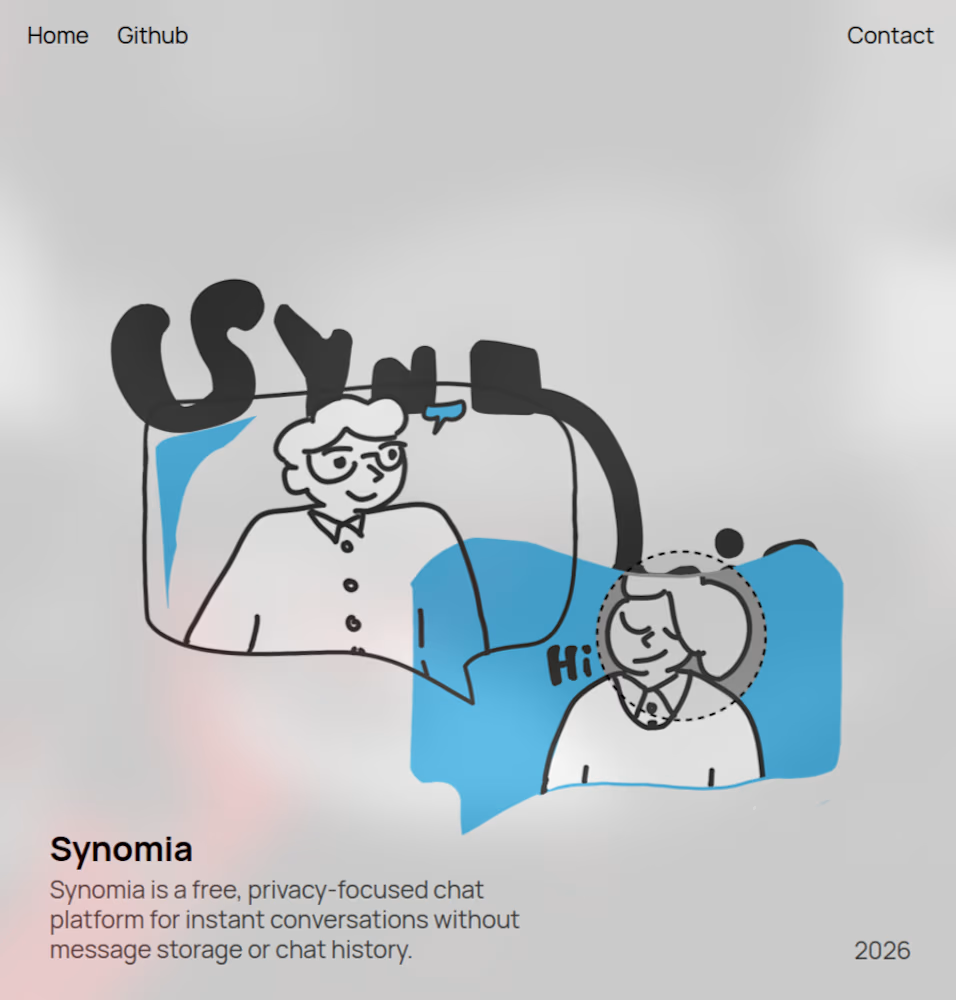
Synomia: Persistent Free Private and safe communication.



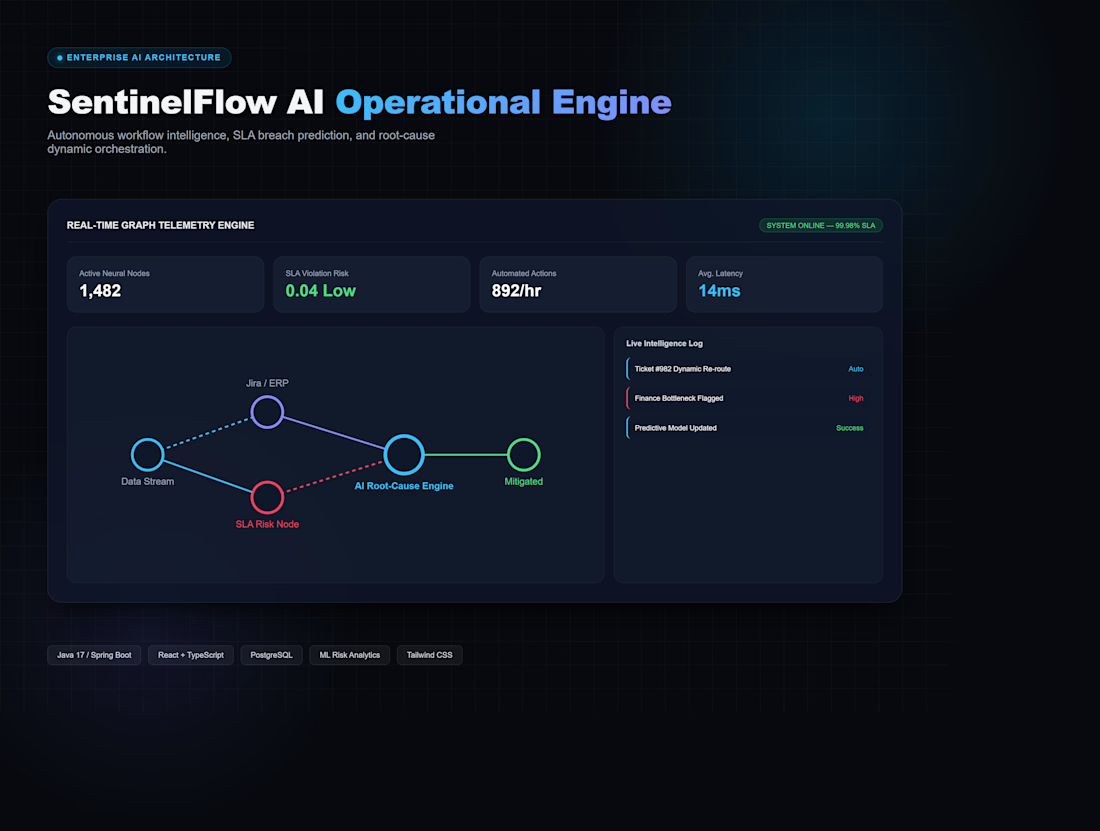
SentinelFlow AI — Autonomous Enterprise Operational Intelligence Platform
Large enterprise operations suffer from fragmented tool stacks (Jira, ServiceNow, ERPs), leading to undetected SLA breaches, manual approval bottlenecks, and data silos. SentinelFlow AI serves as an intelligent operational orchestration layer that continuously monitors enterprise workflows, predicts failures before they happen, and automates risk escalation.
The AI Brain for Enterprise Operations — SLA Breach Prediction & Workflow Orchestration:



Using MCP + Claude to accelerate my design workflow.
Turning product ideas into polished UI/UX concepts in minutes.
Exploring AI-assisted design, rapid prototyping, and system thinking.
Focusing less on repetitive tasks and more on solving real user problems.
Excited to see how far AI-powered design workflows can go.


The rapid prototyping of today makes it a really exciting time to be building websites!









Trending

Claude
Claude has entered the design space. How are you using Claude Design?

Contra University
Learn from expert creatives how to earn more using next-gen AI tools.
creativeaiflow
Creative AI workflows are evolving. What tools do you use, and what are their strengths and weaknesses?
freelancerlife
Freelancer life is wins, pivots, and everything in between. What’s yours right now?