The network for creativity
Join 1.25M professional creatives like you
Connect with clients, get discovered, and run your business 100% commission-free
Creatives on Contra have earned over $150M and we are just getting started
Back to feedPost

The product you ship is never the product you end up with.
You start with a clear thesis. Architecture, interfaces, roadmap. Then the market gets involved.
Users build rituals around features you considered minor. The codebase develops gravitational pulls — some futures become effortless, others prohibitively expensive. Somewhere between commit one and commit one thousand, the product stops being yours. It becomes itself.
This is telos — the inherent direction of a living thing. We treat software as pure engineering, as if plans determine outcomes. But products, like children, unfold according to their own nature. You can shape conditions. You cannot dictate results.
Founders and engineers must learn to listen — not to their original vision, but to what the product is trying to become.

The network for creativity
Join 1.25M professional creatives like you
Connect with clients, get discovered, and run your business 100% commission-free
Creatives on Contra have earned over $150M and we are just getting started
Related posts

Explaining "unlimited development" in 30 seconds is harder than it sounds.
That was the brief from figue.ai: a subscription where startups get a dev team without hiring one. Great product, but abstract. So I skipped the buzzwords and showed what it actually feels like: you ask, it gets built, you ask again.
Every interface in the video is rebuilt from scratch, so the product feels real instead of mocked up.
Really enjoyed this one! If you're launching something that's hard to explain, that's exactly the kind of project I love.


TOP!!

Your SaaS product might be solving the wrong problem. And most designers don't realize it.
Before jumping into Figma, designing dashboards, or creating beautiful interfaces, there's something much more important to understand.
The difference between a Business Problem and a User Problem.
In Part 01 of my SaaS Product Design Masterclass, I'm breaking down:
🔹 1.1 — Start with the Business Problem
🔹 1.2 — Understand the Business Impact
🔹 1.3 — Identify the User Problem
🔹 1.4 — How Business Problems and User Problems are connected, but different.
Here's an important thought:
A business wants to achieve a goal.
A user wants to solve a problem.
Great digital products understand both.
This is where meaningful product differentiation begins — not with UI, but with problem understanding.
🎯 This is Part 01 of my 10-hour practical SaaS Product Design series, where I'll walk through the complete process of understanding and designing a SaaS product.
If you're a UX/UI Designer, Product Designer, aspiring designer, or SaaS founder, this series is for you.
One question: Do you start your design process with business problems or user problems?
Share your thoughts below!
#SaaSProductDesign #UXDesign #ProductDesign #UXResearch #DigitalProduct


Business problem first, but I don't design until I can name the user problem underneath it. Example from Usetally, an invoicing SaaS I built: the business problem was small businesses getting paid late. The user problem was that owners hate chasing customers. So the fix wasn't a...

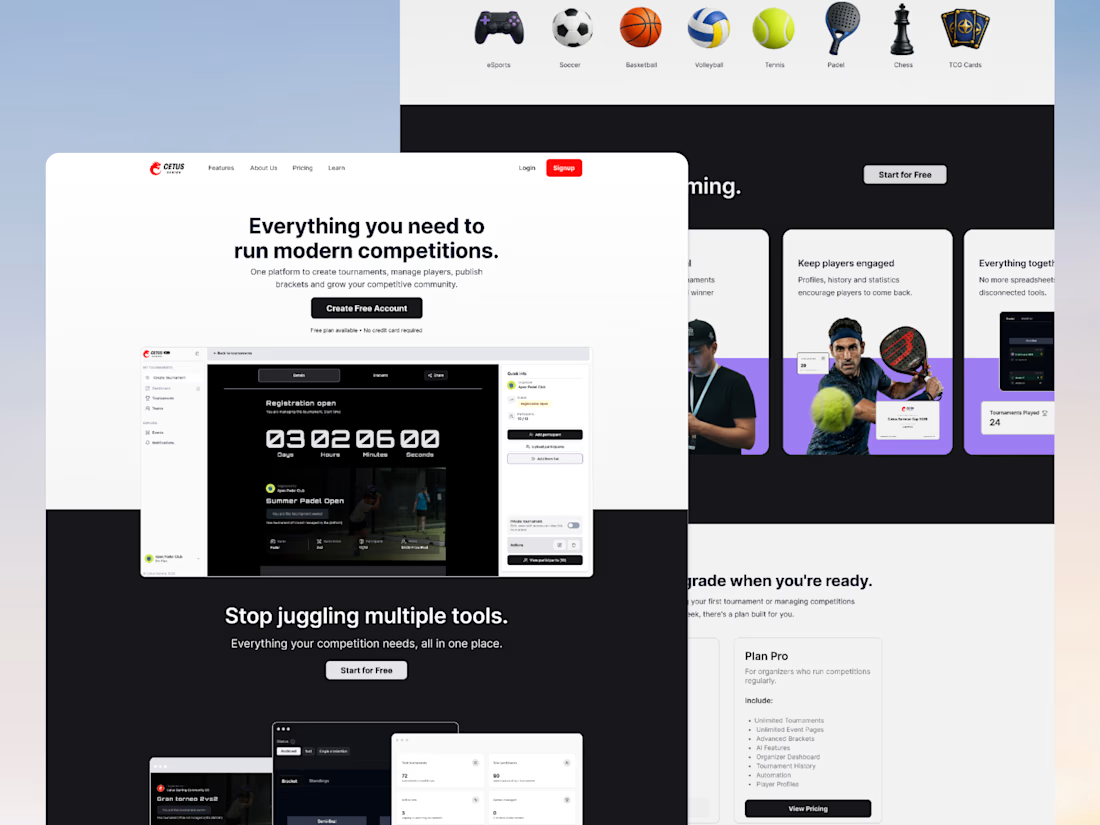
🚀 From product thinking to a live marketing website — introducing Cetus Gaming!
Building a SaaS product is not just about creating great features. It's also about making sure people understand its value.
For Cetus Gaming, I worked on the product experience and marketing website, helping communicate how tournament organizers can manage competitions without relying on spreadsheets, scattered messages, or disconnected tools.
My work included:
✨ Product positioning and content structure
✨ UI/UX design and responsive layouts
✨ Feature-driven storytelling
✨ Conversion-focused website experience
✨ WordPress development using Elementor, Blocksy, and custom CSS
✨ SEO-focused blog structure
The goal was to create a clear, engaging experience that connects the product's capabilities with the needs of its audience.
A project where product design, visual design, and development come together!
🔗 Explore the project: Check it out