The network for creativity
Join 1.25M professional creatives like you
Connect with clients, get discovered, and run your business 100% commission-free
Creatives on Contra have earned over $150M and we are just getting started
Back to feedPost

Before you add AI to a business website, write down where human review belongs.
A useful brief answers four questions:
• What information does the customer provide?
• What rules stay fixed for every request?
• What should a usable result contain?
• What needs a person’s approval before it is shared or acted on?
For example, an AI-generated event description may be a useful draft, but the date, price and booking link still need checking. Name the reviewer and the next step in the brief. This is a planning example, not a claimed client outcome.
Lucete AI Lab’s Brand Strategy, Website Messaging & AI Workflow Brief connects those decisions to your offer and website messaging. The fixed scope covers one brand, one core offer and one target market, including three AI workflow guides with example outputs and human review checklists.
USD $3,000. Final PDF and editable text, with one consolidated revision. Website implementation and AI integrations are scoped separately. Written English communication with translation support.
View the full scope and enquire through Contra:
https://contra.com/s/AvocoLOo-brand-strategy-website-messaging-and-ai-workflow-brief

contra.com
Brand Strategy, Website Messaging & AI Workflow Brief by Lucete AI Lab
Read more about Brand Strategy, Website Messaging & AI Workflow Brief by Lucete AI Lab on Contra.
The network for creativity
Join 1.25M professional creatives like you
Connect with clients, get discovered, and run your business 100% commission-free
Creatives on Contra have earned over $150M and we are just getting started







Related posts


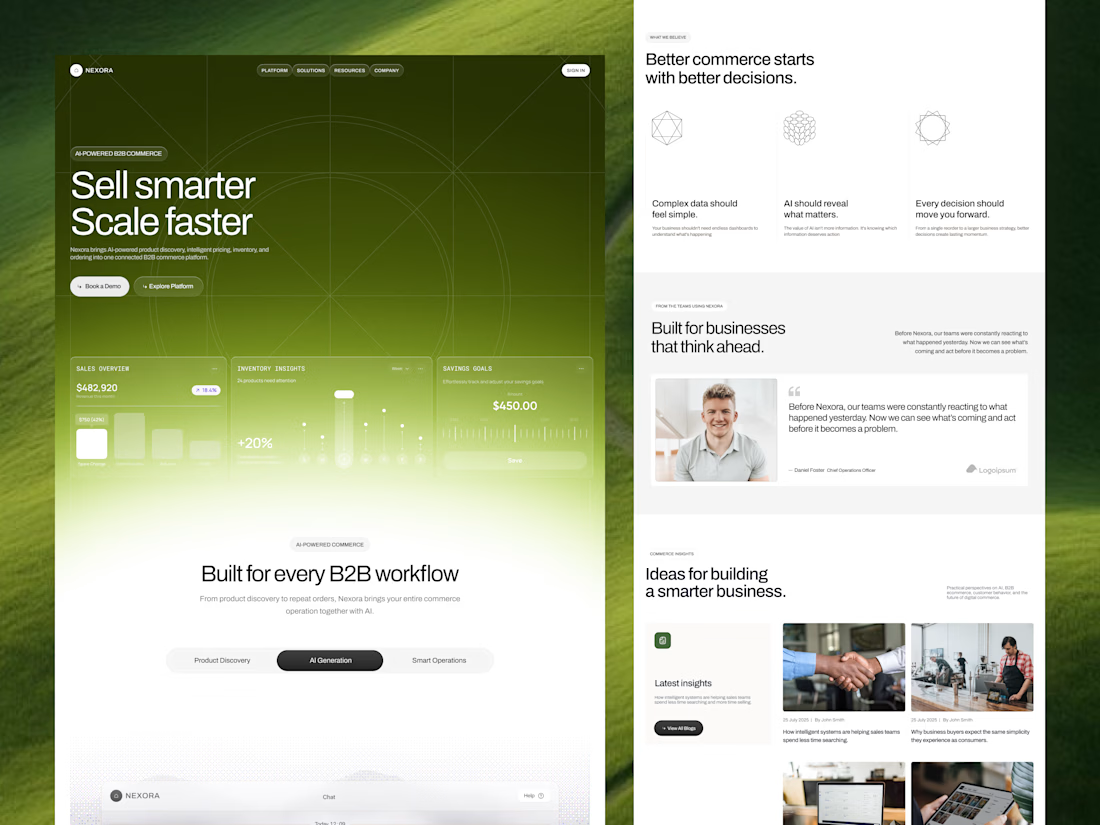
Our goal was to make pricing, inventory and ordering data feel simple and human for an AI-powered B2B commerce platform. We'd love to hear your thoughts!

Engaging background and nice gradient to not make the section look seprate 🔥

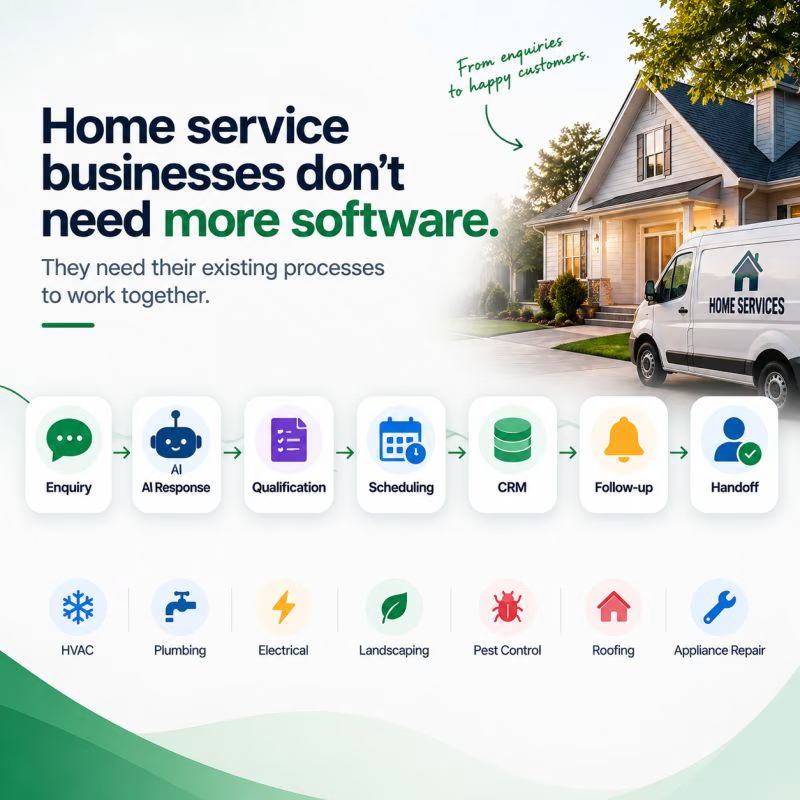
Home service businesses don't need more software. They need their existing processes to work together.
Think about a typical customer journey:
A homeowner needs an HVAC repair.
They call the business.
The call is missed because the technician is on-site.
They leave a voicemail.
Nobody follows up until later.
Then the customer calls another company.
This isn't a lead-generation problem.
It's a workflow problem.
AI automation can connect the entire process:
Customer enquiry → AI response → Qualification → Scheduling → CRM → Follow-up → Human handoff
For example, an AI system can:
• Respond to calls, texts, WhatsApp, or website enquiries
• Understand what service the customer needs
• Collect location and job details
• Check technician availability
• Schedule appointments
• Send confirmations and reminders
• Follow up on estimates
• Update the CRM automatically
• Escalate urgent or complex requests to the team
The important part is that AI doesn't need to replace the technician.
It handles the operational work around the technician.
That means fewer missed calls, faster responses, less administrative work, and a smoother customer experience.
And this applies across:
HVAC
Plumbing
Electrical
Cleaning
Landscaping
Pest Control
Roofing
Appliance Repair
The biggest opportunity for home service businesses isn't simply getting more enquiries.
It's building a system that makes sure every enquiry gets the right response and the right next step.
That's where AI automation can become a real business advantage.

AI Behavioral Health Documentation Platform
AI-Powered Clinical Documentation Built for Behavioral Healthcare Workflows
Overview
Designed an AI-powered documentation platform focused on real clinical workflows across mental health and addiction treatment. The platform transforms live conversations and uploaded transcripts into structured clinical documentation while using custom knowledge-base logic to maintain domain-specific context.
The architecture was designed around security, scalability, healthcare interoperability, and AI-assisted clinical workflows, providing a foundation for integration with existing EMR systems.
The Challenge
Behavioral health documentation requires more than basic transcription. Clinical notes need to capture nuance, context, treatment terminology, and relevant patient information while fitting naturally into existing healthcare workflows.
The platform needed to:
Convert conversations into structured clinical notes
Understand behavioral health and addiction-treatment terminology
Ground AI outputs in custom clinical knowledge
Support transcript and speech-based inputs
Maintain secure handling of sensitive healthcare data
Provide a scalable foundation for EMR interoperability
AI-Powered Documentation
The system combines speech-to-text, LLM-based summarization, clinical nuance detection, and retrieval-augmented generation (RAG) to transform raw conversations into meaningful documentation.
Custom knowledge-base logic and semantic search help ground generated content in relevant clinical information rather than relying solely on general-purpose model knowledge.
Intelligent AI Architecture
The platform uses an agent-oriented architecture combining:
AI summarization
Clinical context and nuance detection
RAG pipelines
Semantic search
Vector-based knowledge retrieval
Private LLM deployment
LLM fine-tuning capabilities
Custom healthcare knowledge bases
This creates a flexible foundation for specialized behavioral-health documentation workflows.
Healthcare-Ready Infrastructure
Security and interoperability were considered at the architecture level, including:
HIPAA-ready cloud architecture
Encryption at rest
Secure backend infrastructure
PostgreSQL + pgvector
Healthcare interoperability support
HL7/FHIR integration readiness
EMR integration support
Serverless backend architecture
Technology Stack
Frontend: React, Vite
Backend: Python, FastAPI
AI/LLM: AWS Bedrock, Anthropic Claude, AI Agents
AI Infrastructure: RAG, Vector Database, pgvector, Semantic Search, LLM Fine-tuning
Database: PostgreSQL
Healthcare: HL7/FHIR, EMR Integration
Cloud & Security: AWS, HIPAA-ready architecture, Encryption at Rest
Speech: Speech-to-Text APIs
The Result
A scalable AI clinical documentation platform built specifically around behavioral healthcare workflows—combining conversational AI, clinical knowledge retrieval, secure infrastructure, and healthcare interoperability into a unified system.


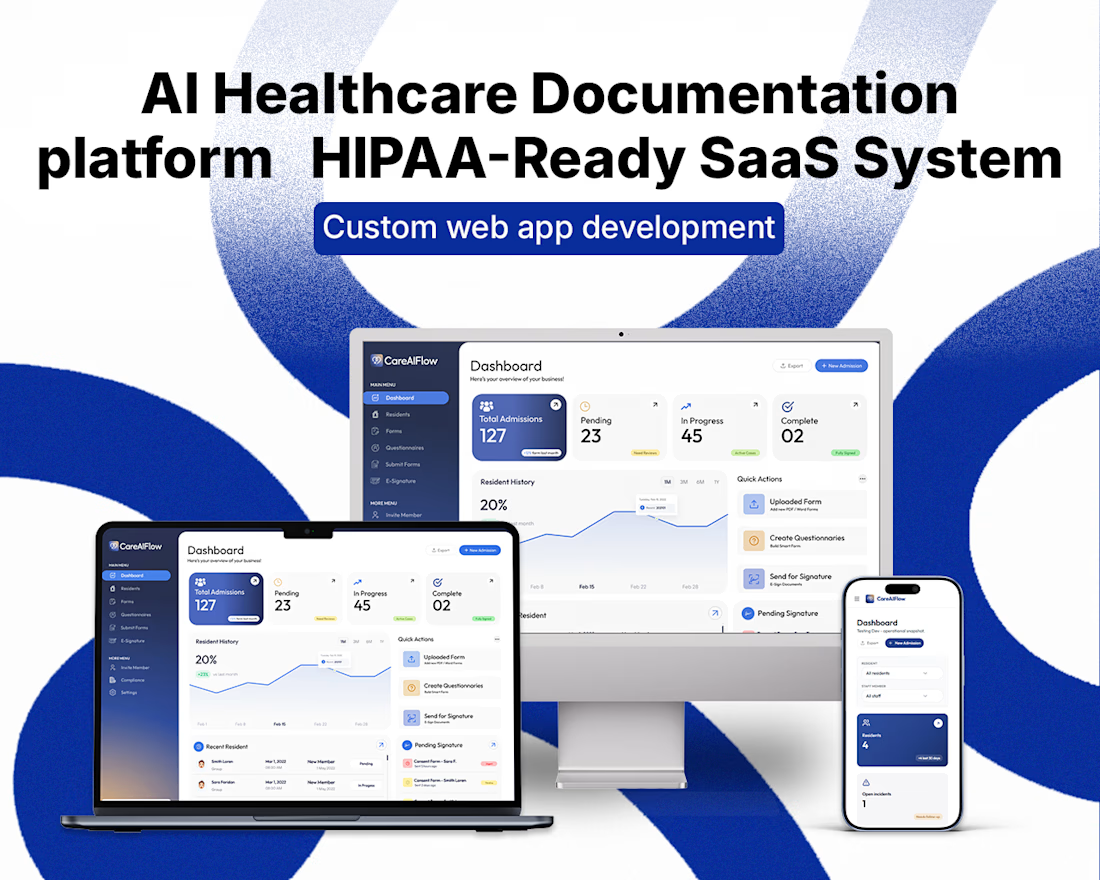

therapists lose so many hours on notes, this solves a real problem