The network for creativity
Join 1.25M professional creatives like you
Connect with clients, get discovered, and run your business 100% commission-free
Creatives on Contra have earned over $150M and we are just getting started
Back to feedPost

Most apps don't fail because of a bad idea. They fail because of things nobody checked before launch.
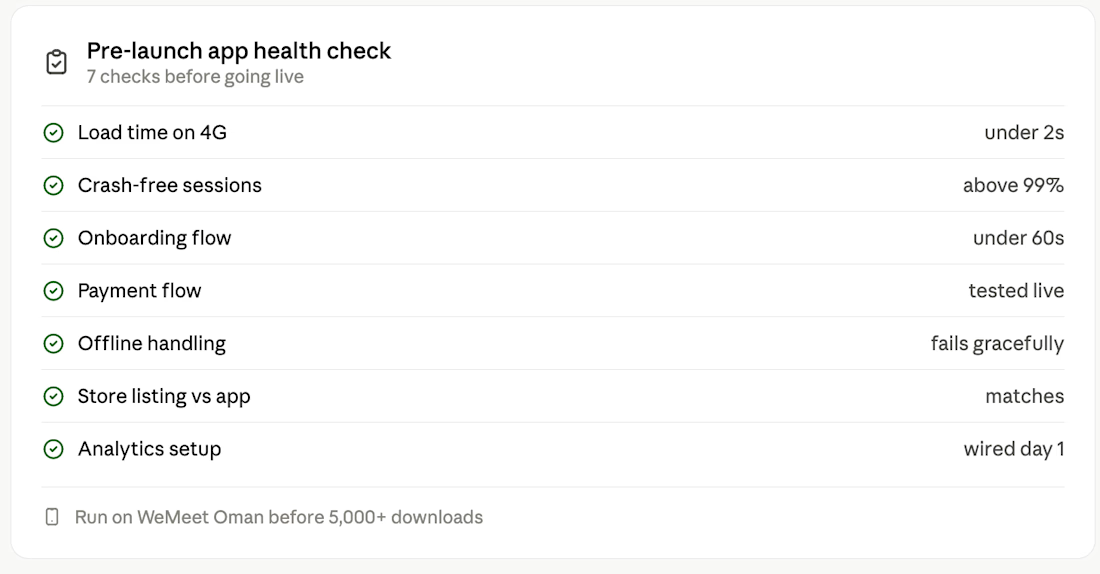
Here's the 7-point health check I run on every app before it ships — the same one I ran on WeMeet Oman before it crossed 5,000 downloads:
Load time on 4G — under 2 seconds, not just on wifi in the office.
Crash-free sessions — above 99%. Below that, users don't complain, they just leave.
Onboarding flow — under 60 seconds from install to first real action.
Payment flow — tested on real cards, not just sandbox mode.
Offline handling — the app should fail gracefully, not freeze or blank out.
Store listing vs actual app — if your screenshots promise something the app doesn't deliver, that's where 1-star reviews come from.
Analytics — wired in before day 1. You can't fix what you can't see.
Building something right now, or already live and not sure where you stand? Send me your Play Store or App Store link and I'll run this checklist against it — free. If you're missing more than two, that's probably where your drop-off is coming from.
#Flutter #MobileAppDevelopment #Freelance #StartupTips #AppDevelopment


The network for creativity
Join 1.25M professional creatives like you
Connect with clients, get discovered, and run your business 100% commission-free
Creatives on Contra have earned over $150M and we are just getting started


Related posts


The little green dot moving through the grid is so satisfying

Landing page for B2B search analytics platform.
For startups, converting users is extremely crucial.
You might have 3~5 seconds to get the user's attention, so it's very important how the design looks and feels.
Premium design + animation like this helps turn users into sign-ups. Proud of this one.

Nice work

EchoMind is live on the Framer Marketplace.
It’s a calm, editorial shop template for brands that make physical things: hardware, objects, small product lines. I designed the brand, generated the product photography and built every page in Framer.
What’s inside:
20 pages, each designed for desktop, tablet and phone
CMS-driven shop with working price sort
Product pages with gallery, specs and FAQs
A build-your-own configurator with live pricing
A bag with quantities and discount codes
Journal with hover image previews
Launch, studio, support and gift card pages
The product itself is fictional: a modular mixing desk where one core listens to your mix and suggests one fix at a time. I wanted the template to feel like a real brand from day one, so it’s been built and photographed like one.
Get the template: https://www.framer.com/marketplace/templates/echomind/


Congrats on the launch, Jonathan. Designing the brand, the photography and every page yourself gives it a clear voice. What was the hardest part of building a shop template in Framer?