The network for creativity
Join 1.25M professional creatives like you
Connect with clients, get discovered, and run your business 100% commission-free
Creatives on Contra have earned over $150M and we are just getting started
Back to feedPost

Cloud Implementation and Industry Solution Analytics


The network for creativity
Join 1.25M professional creatives like you
Connect with clients, get discovered, and run your business 100% commission-free
Creatives on Contra have earned over $150M and we are just getting started

Challenges
View all


Related posts

Accelera | Developer Tools & Cloud Infrastructure Logo


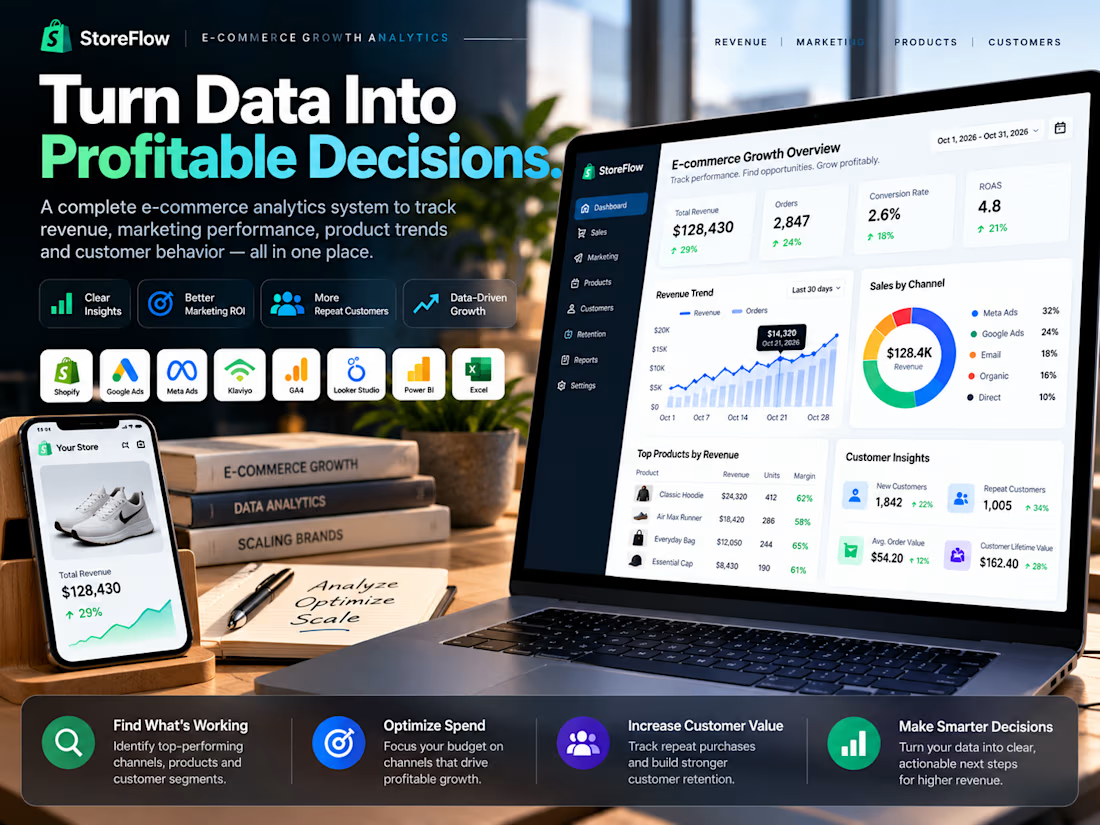
See exactly what’s driving revenue, where growth is leaking, and which products, channels, and customers deserve more investment.
I developed an e-commerce growth intelligence system around one question:
Where should the business invest next?
Most stores already have plenty of data. The harder problem is understanding what that data means for revenue, marketing spend, products, and customer growth.
So instead of building another dashboard full of charts, I’m structuring the system around decisions.
It brings together signals such as revenue, ROAS, CAC, conversion, product performance, repeat purchases, and retention to identify things like:
which channels deserve more budget, where acquisition is becoming inefficient, which products attract traffic but fail to convert, and where repeat customers are creating stronger value.
The goal isn’t just to answer:
“What happened?”
It’s to answer:
“What should we do next?”
Because the most useful analytics system isn’t the one with the most charts.
It’s the one that makes the next business decision clearer.
Tags: E-Commerce · Marketing Analytics · Data Analytics · Power BI · E-commerce Management
Marketing AnalyticsData AnalysisecommerceeCommerce ManagementMicrosoft ExcelMicrosoft Power BIShopify



Exactly. Analytics becomes much more valuable when it helps businesses make smarter decisions, not just track numbers.

Enterprise RAG AI: Private Doc Intelligence
A fast-growing B2B software firm needed a secure, enterprise-grade Retrieval-Augmented Generation (RAG) system to query thousands of confidential internal documents (legal contracts, technical architecture specs, Notion pages, and employee SOPs) in real time without third-party data leakage.
Key Challenges:
High hallucination risk and irrelevant context retrieval using standard keyword search.
Managing multi-format files (scanned PDFs, tables, markdown) with strict access control based on user hierarchy.
Technical Implementation & Solution:
• Engineered an automated ingestion pipeline in Python with LlamaIndex and LangChain for semantic chunking and metadata preservation.
• Integrated a hybrid vector search architecture pairing dense embeddings (OpenAI text-embedding-3) with sparse BM25 indexing in Qdrant.
• Added a cross-encoder re-ranking layer (Cohere Re-ranker) to prune low-relevance chunks, reducing API token costs by 40%.
• Built robust Role-Based Access Control (RBAC) via FastAPI endpoints, ensuring departmental data isolation.
Results & Impact:
• Dropped internal information retrieval time from 20 minutes to under 4 seconds.
• Attained 98% factual precision with traceable in-line page citations.
• Full on-prem Docker deployment ensuring 100% private data security.



I'd test revoking a user's document access mid-conversation. In your RBAC flow, do cached retrieval results get rechecked against current permissions before they're sent to the reranker or model?