The network for creativity
Join 1.25M professional creatives like you
Connect with clients, get discovered, and run your business 100% commission-free
Creatives on Contra have earned over $150M and we are just getting started
Back to feedPost

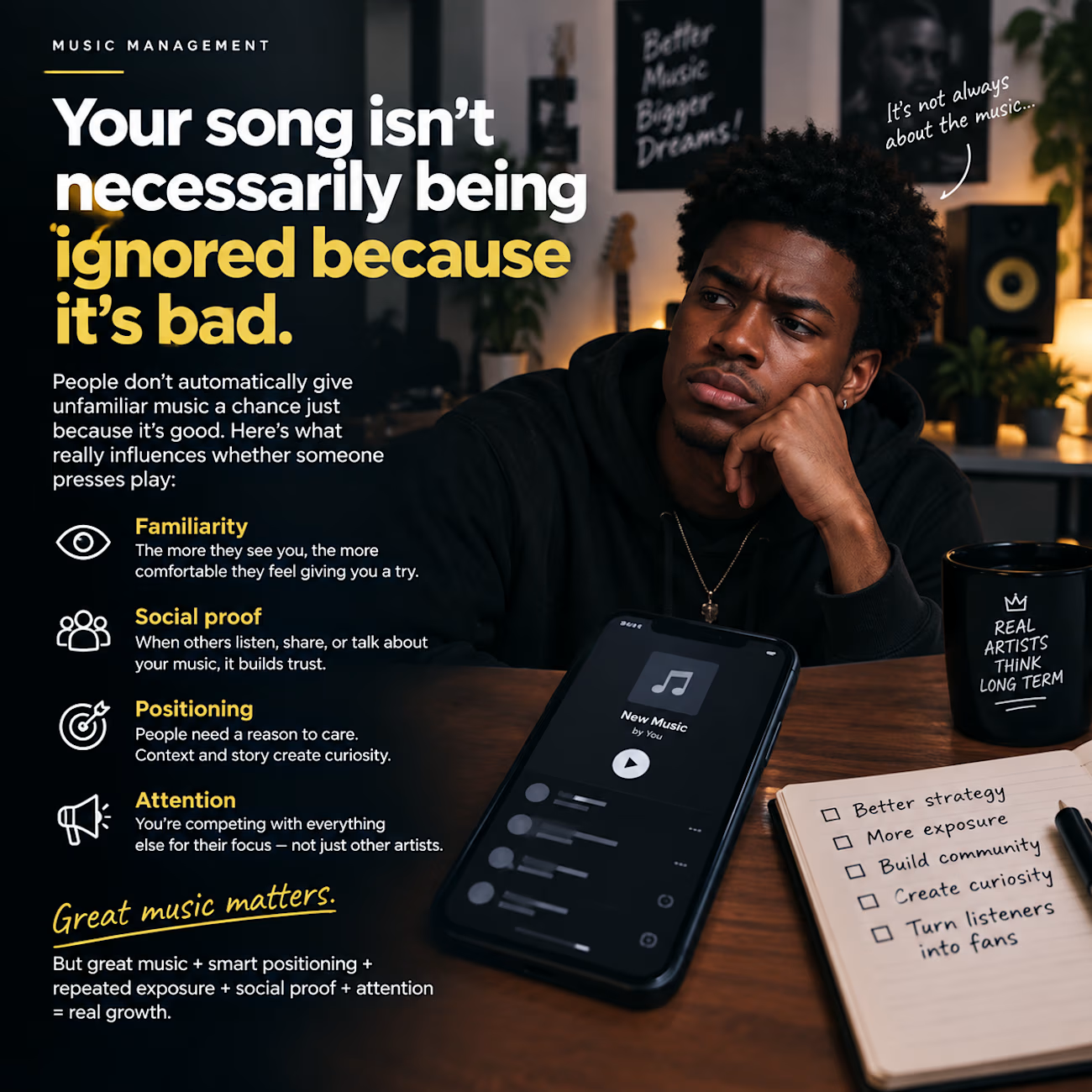
Your song isn't necessarily being ignored because it's bad.
I know that hurts to hear, especially after you spent weeks, months, or even years creating the song.
But here's the uncomfortable truth:
People don't automatically give unfamiliar music a chance just because it's good.
As a music manager, I see artists make this mistake all the time. They hear silence and immediately conclude:
“My song isn't good enough.”
Not necessarily.
Sometimes the real problem is how the listener's brain evaluates something unfamiliar.
Here are 4 things influencing that decision:
1. Familiarity
People tend to become more comfortable with things they've encountered repeatedly.
A listener who sees your song once may scroll past it.
The same listener who keeps seeing your name, visual identity, snippet, story, or song may eventually think:
“I've seen this artist before.”
That familiarity can reduce the psychological resistance to trying something new.
2. Social proof
When people see others listening, sharing, using, or talking about a song, it provides a signal:
“Maybe this is worth checking out.”
That's why comments, UGC, reactions, shares, live performances, and community activity can matter beyond vanity metrics.
You're not just showing numbers.
You're showing potential listeners that other people care.
3. Positioning
Your song may be good—but what does the listener understand about it?
“New single out now” isn't much of a reason to care.
Compare that with:
“The song I wrote after realizing I was staying in a relationship that had already ended.”
Now there is context.
There's a story.
There's a reason to become curious.
4. Attention
Your listener is being bombarded with music, videos, notifications, conversations, and advertisements.
You aren't competing only against other musicians.
You're competing against everything else demanding their attention.
So when your song doesn't get immediate traction, don't automatically conclude that the music failed.
Ask better questions:
Did I earn attention?
Did I create curiosity?
Did I give people a reason to care?
Did I make the artist memorable?
Did I create enough touchpoints for familiarity to develop?
Great music matters.
But great music + strategic positioning + repeated exposure + social proof + attention is a much stronger growth system.
As a music manager, my job isn't simply to say:
“Let's promote the song.”
It's to ask:
“Why would someone who doesn't know this artist care enough to stop, listen, remember, and come back?”
That's where real music marketing begins.
Artists: Have you ever assumed a song was bad when the real problem may have been how it was marketed? 👇
The network for creativity
Join 1.25M professional creatives like you
Connect with clients, get discovered, and run your business 100% commission-free
Creatives on Contra have earned over $150M and we are just getting started

Challenges
View all


Related posts

Want more sales for your brand? Meta Ads alone may not be enough.
Imagine this:
You launch high-quality Meta Ads.
A good creative. The right audience. A strong offer. A CTA leading directly to your website.
The person is interested and… doesn’t buy.
And this is where it gets interesting: 72% of internet users use social media to research brands and products before making a purchase.
This means that social media is no longer just a place where a brand “maintains a beautiful page.” It is part of the customer journey to purchase.
A person may see your ad → visit your website → open Instagram → watch Reels → look for reviews → see UGC → see how real people use the product → make sure the product actually solves their problem → and only then make a purchase.
That’s exactly why high-quality Meta Ads are not enough.
This is where content comes in.
ORGANIC CONTENT
UGC that:
→ builds trust
→ shows real experiences
→ addresses the audience’s problem
→ shows the product in real life
→ uses humor and everyday situations
→ shares interesting facts
→ shows results
→ addresses the customer’s doubts
For example, a brand can create a UGC video around a relatable everyday problem and play it out through humor. Does the video perform well organically?
You can promote it further.
So first, we look at what content actually resonates with the audience, and then we amplify it with paid advertising.
It becomes: Attention → Interest → Awareness → Trust → Consideration → Purchase.
And Meta Ads work a little differently.
The goal here is more specific to drive the person to take action: A click. A lead. A purchase.
That’s why these things matter: audience + offer + creative + CTA + landing page + advertising strategy.
But advertising can bring a person to your brand.
Content should help them believe in that brand.
Because a potential customer wants to see:
— real people;
— real reviews;
— the product in use;
— real results;
— proof that the product solves the problem;
— and, ultimately, an answer to the question: “Can I trust this brand?”
And now the question for brands:
How many sales are you potentially losing by bringing people to your brand through advertising, but not giving them enough reasons to trust you afterwards?
That’s exactly why a content creator is not just someone who makes beautiful videos.
They create the kind of content that helps a brand take the customer from: “I’ve seen this brand” to “Okay, I’m ready to buy.”
That’s why a strong strategy today is not about choosing between UGC or Meta Ads. It’s: UGC + Organic Content + Meta Ads + Strategy.
Content creates attention and trust. Meta Ads scales what works.
This is exactly what I do — all-in-one.
I’m ready to help you scale with high-quality, engaging content that drives brand awareness and sales.

I completely agree. These days, you can't succeed in sales without a comprehensive approach.


Every post on your calendar should have a reason to exist.
As a freelancer, your marketing time comes out of the same week as client delivery.
If people reach your profile but can't understand what you do, you might need a clearer explanation of your service and a relevant case study.
Those posts belong on the calendar because they solve a specific problem.
This clip is from my full marketing strategy guide. Watch it here:
https://youtu.be/xM7G509bsrk
Music: Beethoven Symphony No. 5, I. Allegro con brio. Skidmore College Orchestra, via Musopen / Wikimedia Commons.

Being relatable isn’t the same as being authentic.
I think brands sometimes try so hard to “sound human” that the writing ends up sounding even more manufactured.
Add some slang.
Throw in an emoji.
Start with “Hey guys!”
Use shorter sentences.
Say “we get it.”
And somehow… it still doesn’t feel human.
Because humans aren’t relatable just because they use casual language.
We’re relatable because we have something to say.
We have opinions.
We notice things.
We have preferences.
We disagree.
We tell stories.
We have a reason for choosing one thing over another.
That’s what gives our words personality.
So when I’m writing for a brand, I’m not only thinking:
“How do I make this sound less corporate?”
I’m thinking:
“What does this brand actually believe?”
If you remove the brand name, can I still tell it’s them speaking?
That’s the real test for me.
You don’t make a brand sound human by adding “Hey” to the beginning of a post.
You make it human by giving the words a mind behind them.
#brandVoice #Storytelling #ContentWriter #Writing #CreativeWriter