The network for creativity
Join 1.25M professional creatives like you
Connect with clients, get discovered, and run your business 100% commission-free
Creatives on Contra have earned over $150M and we are just getting started
Back to feedPost

Exploring Polkadot 2.0’s Agile Coretime through a visual
concept
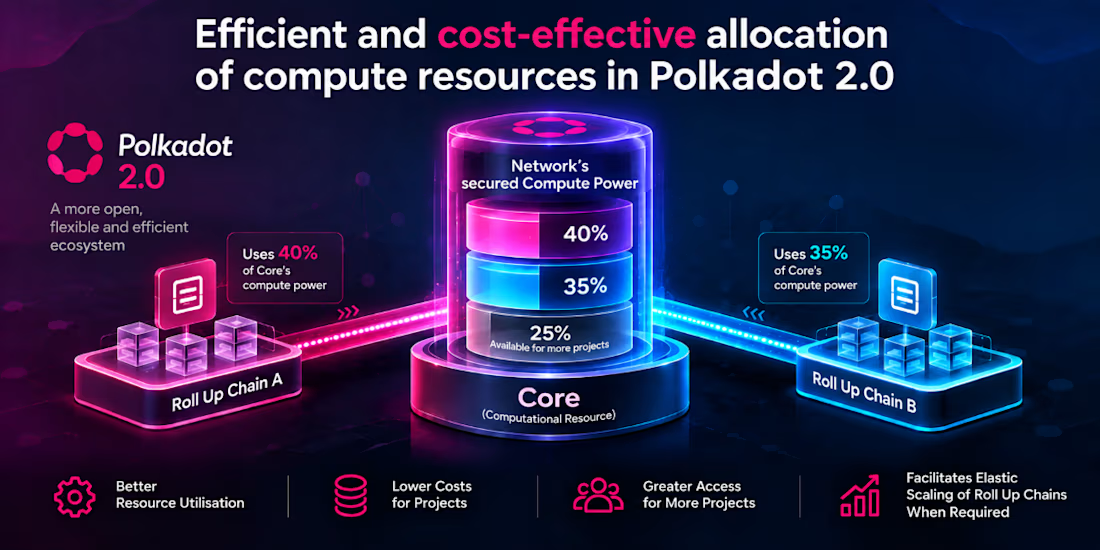
I created this banner using ChatGPT to visually explain how
Polkadot 2.0 changes the way its decentralized compute resources can be
allocated to Rollup chains.
The central idea I wanted the visual to communicate:
One Core → shared computational resource → multiple
Rollup chains
In Polkadot 1, a project that secured a dedicated Core
through the parachain auction had access to the computational resources of that
Core for its lease period.
This meant that when the project did not require the Core’s
full computational capacity, some of that resource could remain underutilised.
Polkadot 2.0’s Agile Coretime introduces a more
flexible way of accessing these resources.
The visual represents this by showing:
Rollup Chain A → 40% of the Core’s resource
Rollup Chain B → 35% of the Core’s resource
Remaining capacity → available for other usage
The purpose of the visual is not to represent an exact
protocol allocation, but to make the underlying resource-allocation concept
easier to understand:
Projects can acquire Coretime according to their
requirements, share or split Coretime, sell unused Coretime, and acquire
additional Coretime when they need to scale.
I created this visual as part of my article exploring Polkadot
2.0’s Agile Coretime framework and how it aims to make Polkadot’s computational
resources more efficiently accessible to Rollup projects.
#Polkadot #Web3 #Blockchain #Coretime #Crypto

The network for creativity
Join 1.25M professional creatives like you
Connect with clients, get discovered, and run your business 100% commission-free
Creatives on Contra have earned over $150M and we are just getting started
Challenges
View all


Related posts

What if an image grid could behave like liquid?
Just finished Chromatic Grid, a new experiment exploring how a traditional image gallery can become something more sculptural and interactive.
A few things I explored:
→ An hourglass-shaped 3D image grid.
→ Scroll-driven stretching and twisting.
→ Liquid distortions that respond to cursor movement.
→ Fluid reveals and color-to-B&W transitions.
The challenge was making everything feel like one continuous material rather than separate effects.
Built with Three.js, WebGL, GLSL & ChatGPT.
Would love to hear what you think!


Amazing work

hopify-style store dashboard, AI workflow connections, product cards and automation icons




Nice concept. Connecting store data with AI workflows can make e-commerce operations much more efficient.