The network for creativity
Join 1.25M professional creatives like you
Connect with clients, get discovered, and run your business 100% commission-free
Creatives on Contra have earned over $150M and we are just getting started
Back to feedPost

The MariaDB Galera split-brain trap: You deployed a "high-availability" 2-node cluster, but a minor network glitch took down your entire production application.
MariaDB Galera Cluster is renowned for synchronous, multi-master replication with zero data loss (RPO=0). Seeing the benefits, engineering teams frequently spin up two database servers: "Node A and Node B replicate synchronously; if Node A dies, Node B takes over."
In distributed consensus engineering, however, a 2-node cluster is an architectural illusion that guarantees total downtime during network partitions.
Here is the exact consensus failure mode:
1. Quorum & Split-Brain Prevention: Galera uses strict majority voting (quorum) to guarantee consistency. In a cluster of $N$ nodes, a partition must control more than 50% of the votes ($\lfloor N/2 \rfloor + 1$) to remain in the "Primary" state and accept writes. 2. The Partition: In a 2-node cluster ($N=2$), the majority threshold requires at least 2 votes. If a transient network glitch interrupts communication between Node A and Node B, each node can only see itself (1 vote out of 2, which is 50%, not a majority). 3. The Total Lockout: Because neither node can prove it has a majority, both nodes immediately switch to ``non-primary`` state to prevent data divergence (split-brain). Both databases refuse all read and write queries, resulting in 100% application outage despite both servers being completely healthy.
Building true high-availability requires respecting distributed consensus invariants: • Odd-Numbered Node Quorum: Always deploy a minimum of 3 voting members across independent failure domains (availability zones or server racks). In a 3-node cluster, losing 1 node leaves 2 votes (66.7%), allowing the cluster to continue operating seamlessly without interruption. • Lightweight Galera Arbitrator (garbd): When hosting 3 full database servers is cost-prohibitive, deploy ``garbd`` on a lightweight third node or application server. The arbitrator does not store data or execute queries; it solely participates in consensus voting as an objective tie-breaker. • Automated State Transfer Hardening: Configure State Snapshot Transfers (SST) using ``mariabackup`` over encrypted TLS tunnels, ensuring new or recovering nodes re-join the cluster with zero table locking on donor nodes.
Never deploy a distributed database that locks itself up when a single cable hiccups.
Harden and scale your database infrastructure with our 2-week High-Availability Database Cluster Sprint on Contra: https://contra.com/s/QbN6svWo-high-availability-database-cluster-deployment-and-hardening
#Database #MariaDB #HighAvailability #Infrastructure #Architecture #Linux #DevOps #SRE



The network for creativity
Join 1.25M professional creatives like you
Connect with clients, get discovered, and run your business 100% commission-free
Creatives on Contra have earned over $150M and we are just getting started





Related posts

CREARA is a Spain-based architectural firm with a unique selling point: creating spaces that align with the lifestyles desired by young families.
With a premium, minimalist aesthetic, the firm stands out by avoiding cookie-cutter designs, instead creating bespoke solutions tailored to each client's specific needs.
Focusing primarily on young families, the visual identity is soft, modern, and sustainable.


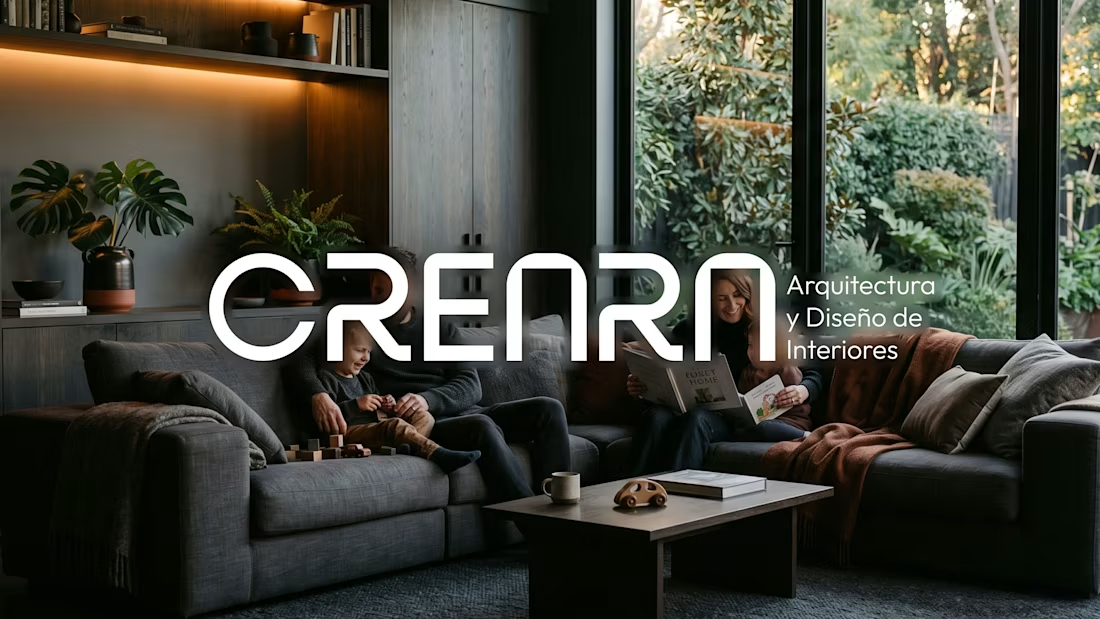
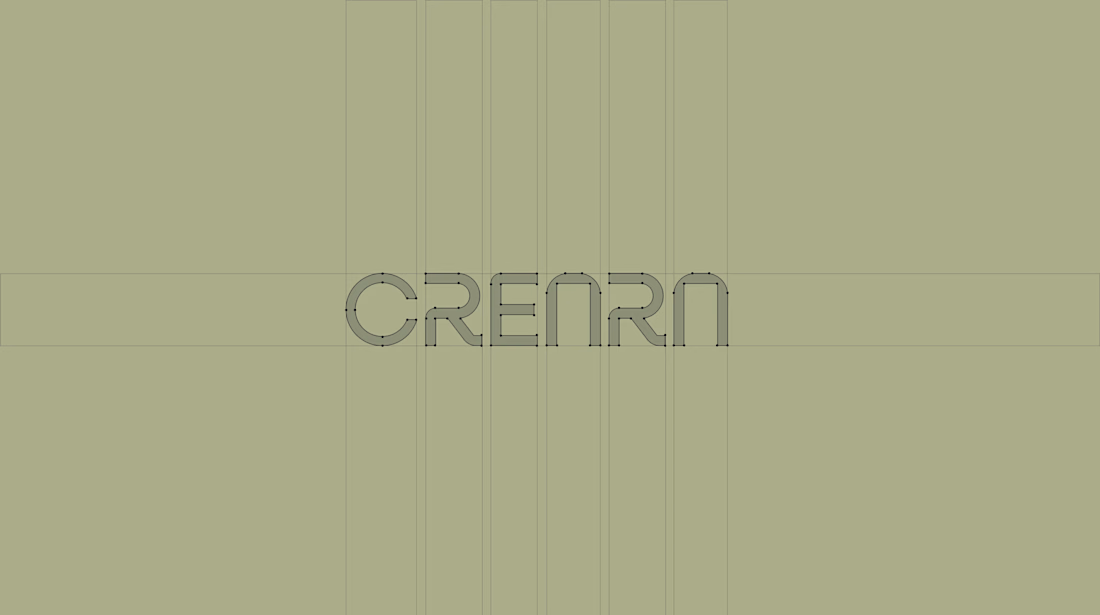
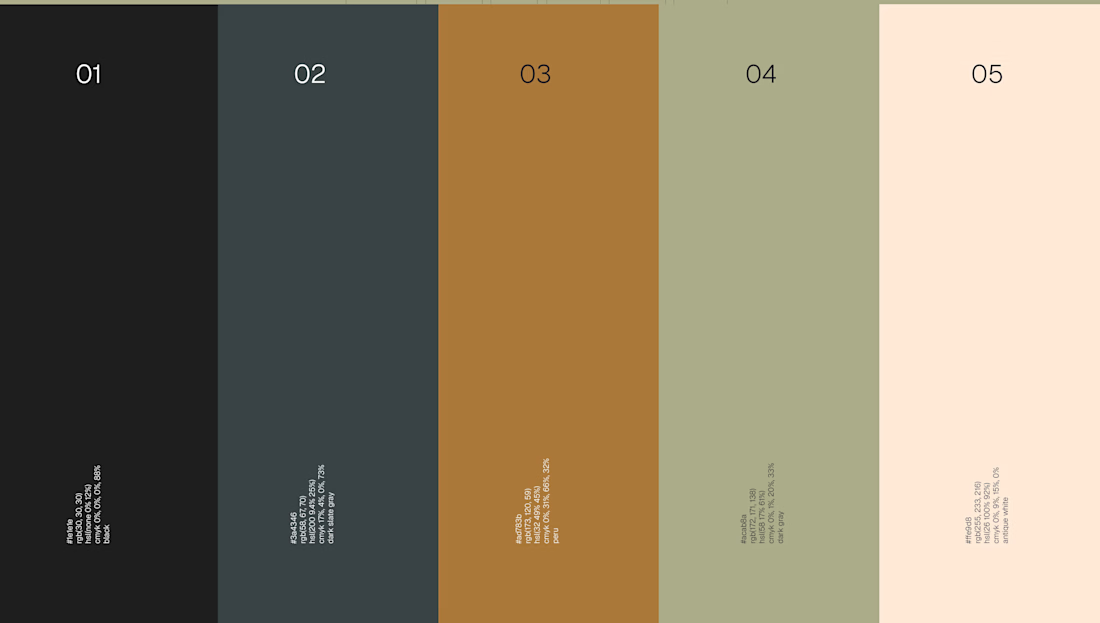


The young-families angle is the tricky constraint here, since premium minimal usually gets read as slightly untouchable and families are the audience least inclined to want that. The softened wordmark and the warmer half of the palette look like where that gets absorbed. Was the...

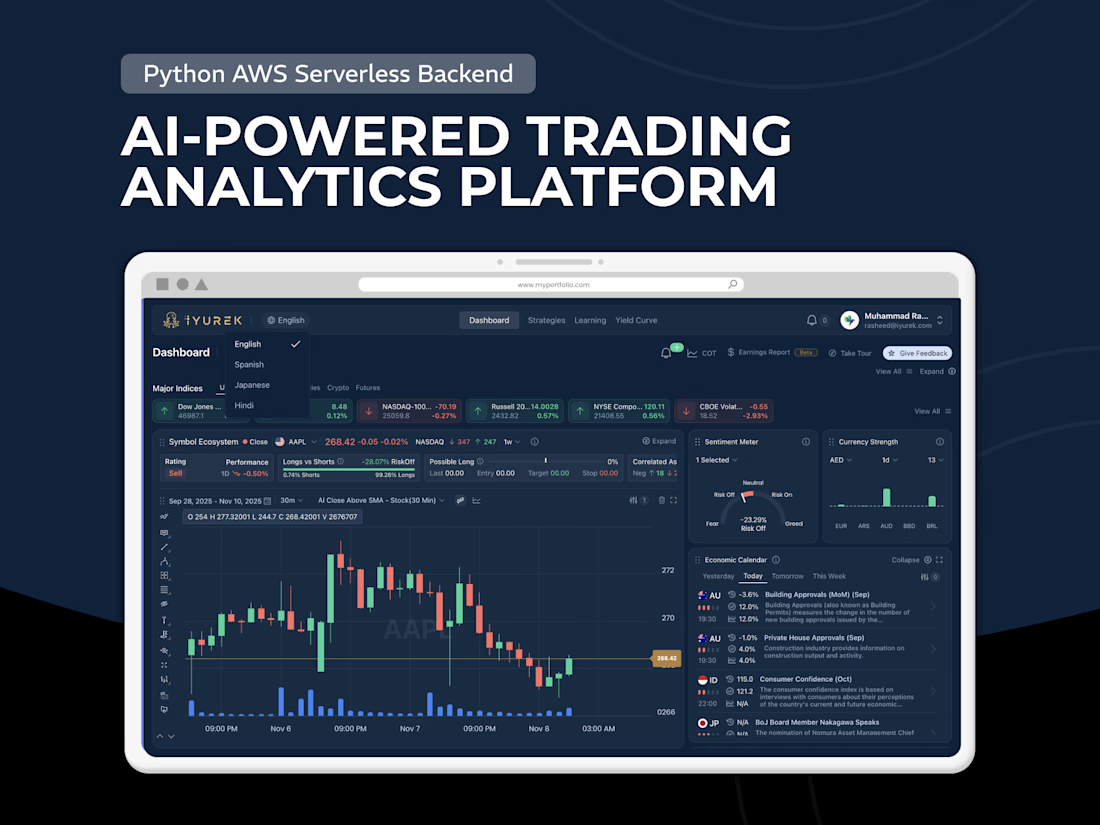
𝐀𝐈-𝐏𝐨𝐰𝐞𝐫𝐞𝐝 𝐓𝐫𝐚𝐝𝐢𝐧𝐠 𝐀𝐧𝐚𝐥𝐲𝐭𝐢𝐜𝐬 𝐏𝐥𝐚𝐭𝐟𝐨𝐫𝐦 | 𝐏𝐲𝐭𝐡𝐨𝐧, 𝐅𝐚𝐬𝐭𝐀𝐏𝐈 & 𝐋𝐋𝐌
𝐌𝐲 𝐫𝐨𝐥𝐞: Python Backend Engineer focused on AWS serverless architecture
𝐏𝐫𝐨𝐣𝐞𝐜𝐭 𝐝𝐞𝐬𝐜𝐫𝐢𝐩𝐭𝐢𝐨𝐧:
I built a serverless backend for an AI-driven trading platform handling real-time market data and analytics. I used AWS services like Lambda, API Gateway, RDS, and S3 to create a system that scales without manual infrastructure management. I designed pipelines for ingesting and processing live data to support trading signals and sentiment analysis. My focus was on keeping latency low, handling high concurrency, and ensuring the platform remained stable for global users.



AetherOS is a web desktop for AI agents. The entire project sits inside a single HTML file. It starts with a boot screen. Then it opens into a dark workspace. The background has black animated particles. Everything runs on plain CSS and vanilla JavaScript. The site loads zero external dependencies and zero sound files.
The bottom dock holds seven apps. These tools manage four AI agents: Atlas, Sage, Bolt, and Vega. The Agents app shows them chatting and passing tasks. Files lets you browse a drive. Memory shows a live graph of what the system knows. Users can also modify a history timeline. Studio lets you test prompts. Flows builds node pipelines, and Cost tracks token usage.
Every window can be moved, resized, minimized, or maximized. The top menu bar has a model switcher. It routes tasks to Claude Opus 4.7, GPT-5.2, Gemini 3 Pro, DeepSeek V4, or Llama 4. The OS also has Spotlight search, sound toggles, and local API key inputs. The interface uses dark glass panels with blue highlights.
Building the node graphs in one single HTML5 file was tough. At first, the physics nodes pushed apart too hard. They floated right off the screen. Dragging extra lines while getting zoomed in also threw off the precise positions. I fixed the center gravity math. Then I divided mouse positions by the zoom factor. That stopped the unnecessary movement and kept the OS stable.😊


