The network for creativity
Join 1.25M professional creatives like you
Connect with clients, get discovered, and run your business 100% commission-free
Creatives on Contra have earned over $150M and we are just getting started
Back to feedPost

Built a reproducible n8n workflow-repair fixture today. The broken version looked handled but had two structural defects: no bounded retry policy and an unwired separate error output, so failures could disappear. The repaired version adds 3 bounded attempts, routes the error branch to a sanitizer, and separates success and failure paths. Deterministic audit: broken 2 findings → repaired 0; repository tests 3/3 pass. Lab fixture, not a client result; reserved .invalid URL, no credentials or personal data. Full before/after proof: https://blaidlink-labs-services.rluriea.chatgpt.site/#repair-proof
blaidlink-labs-services.rluriea.chatgpt.site
Blaidlink Labs — Decision-ready public data signals
Blaidlink turns authorized public web and government data into source-linked, decision-ready signals.
The network for creativity
Join 1.25M professional creatives like you
Connect with clients, get discovered, and run your business 100% commission-free
Creatives on Contra have earned over $150M and we are just getting started





Related posts

Problem: Apps need a secure, organized backend to handle users, orders, products and AI features.
Solution: Built a centralized API Gateway (BFF) in n8n Cloud. One webhook handles validation, API key security and rate limiting, then routes to sub-workflows: Users (register/login), Orders (stock check, totals, status), Products (search), and AI (OpenAI chat, recommendations, review summaries). Supabase is the database.
Tools: n8n, Supabase, OpenAI API, Webhooks
Self-initiated demo project.


I'd test authorization separately for each sub-workflow, especially Orders. Does the gateway pass a verified user identity through, or does the Orders workflow check that the caller can access each order?
Problem: Apps need a secure, organized backend to handle users, orders, products and AI features.
Solution: Built a centralized API Gateway (BFF) in n8n Cloud. One webhook handles validation, API key security and rate limiting, then routes to sub-workflows: Users (register/login), Orders (stock check, totals, status), Products (search), and AI (OpenAI chat, recommendations, review summaries). Supabase is the database.
Tools: n8n, Supabase, OpenAI API, Webhooks
Self-initiated demo project.
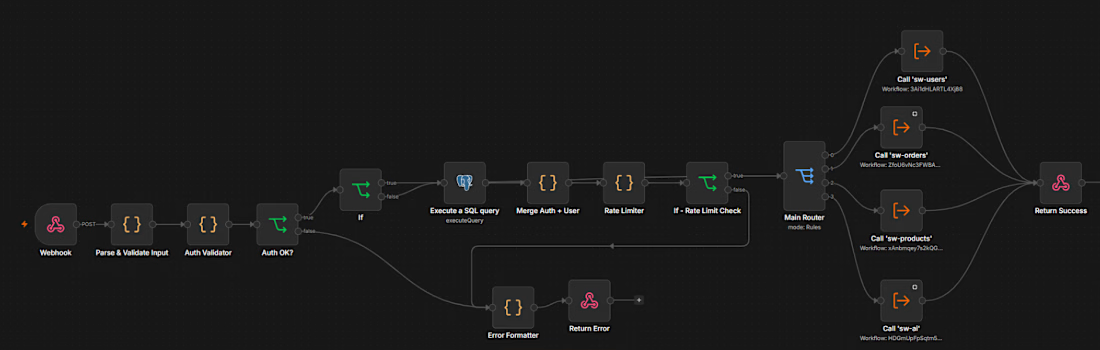
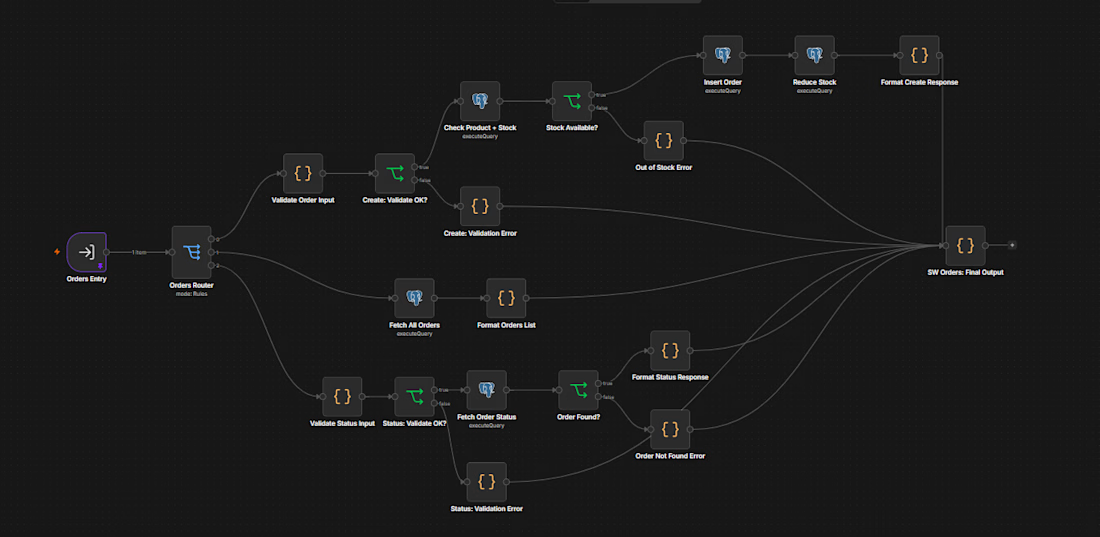

Nice to see a single webhook taking care of validation and rate limits before handing off to the user and order flows.

Rebuilding the moment an inbound inquiry turns into a confirmed booking for MEND Appliance Care, a local repair shop in Spalding, Lincolnshire.
The Problem Solved: Replaced 2.5 hours of daily owner phone-tag, vague fault descriptions, wrong van parts, and customer no-shows with an instant AI-powered diagnostic intake, fixed upfront pricing, deposit collection, and auto-generated dispatch scheduling.
Key Features Built in Lovable:
• Multi-Modal Intake: Customers describe the issue using text, photos, model numbers, or video.
• Instant AI Diagnosis & Transparent Pricing: Autodetects fault & exact part (e.g., Bosch Serie 6 drum shock absorbers) with clear labor/part cost breakdowns.
• Flexible Resolution Paths: Home Repair, Workshop Drop-Off, DIY Part Purchase, or local stockist routing (Toolstation/Screwfix).
• Owner Safety Net & Dispatch Dashboard: Real-time job calendar, "Ask Maya" human-in-the-loop review queue, and 1-click customer comms.
Built entirely with @Lovable for the #lovablechallenge.
Shop owner dashboard : Email: maya@mend-demo.co.uk
Password: MendDemo2026

The "Ask Maya" human-in-the-loop queue is one of those details that separates a clever demo from something you can actually ship to a real business. Most AI intake flows skip this — they either automate everything and break on edge cases, or hand off to a human and defeat the...