The network for creativity
Join 1.25M professional creatives like you
Connect with clients, get discovered, and run your business 100% commission-free
Creatives on Contra have earned over $150M and we are just getting started
Back to feedPost


AI can generate a website. But it can't always communicate a business's value.
Recently, I worked with a client who already had an AI-generated website. It looked decent at first glance, but it wasn't conveying the quality of their service or guiding visitors toward the right action.
Instead of starting from scratch, we focused on what really matters:
• Clear information hierarchy
• Conversion-focused user experience
• Premium visual consistency
• Responsive design across devices
• Scalable Webflow structure
• Performance and SEO best practices
AI is becoming an incredible tool, and I use it in my own workflow every day.
But great websites are still built by understanding people, business goals, and user behavior. Not just generating layouts.
That's where thoughtful design and development make the difference.


NEW PAID PROJECT
M Bilal AsgherQuillWorx
The network for creativity
Join 1.25M professional creatives like you
Connect with clients, get discovered, and run your business 100% commission-free
Creatives on Contra have earned over $150M and we are just getting started





Related posts

Recently explored a simple UI/UX concept for AI image generation.
The idea is to make prompts, references, lighting, and outputs easier to manage in one visual workflow.
Still refining it, but really enjoyed this one. ✨


does lighting sit as its own layer next to the prompt or inside the references panel?

AI didn't take my job. It became my business partner.
Every designer I know is asking the same question right now: what's left for us when AI can make something pretty in 10 seconds?
Here's my honest answer, from branding and from product.
The way I work has completely changed. Moodboards, variations, mockups, even clickable prototypes: what used to take days now takes hours.
But here's what nobody says out loud: people are making a lot of pretty things. And pretty doesn't build a brand.
Pretty doesn't tell a stranger why they should trust you.
Pretty doesn't make your offer clear in 5 seconds.
Pretty doesn't fix the screen where users give up.
That part is still on me. It's actually most of my job now.
So I stopped seeing AI as a competitor. It does the drafts, I do the thinking, and my clients get both, faster.
Designers, how has AI changed the way you work this year?

Wonderful presentation and I like your thought you shared

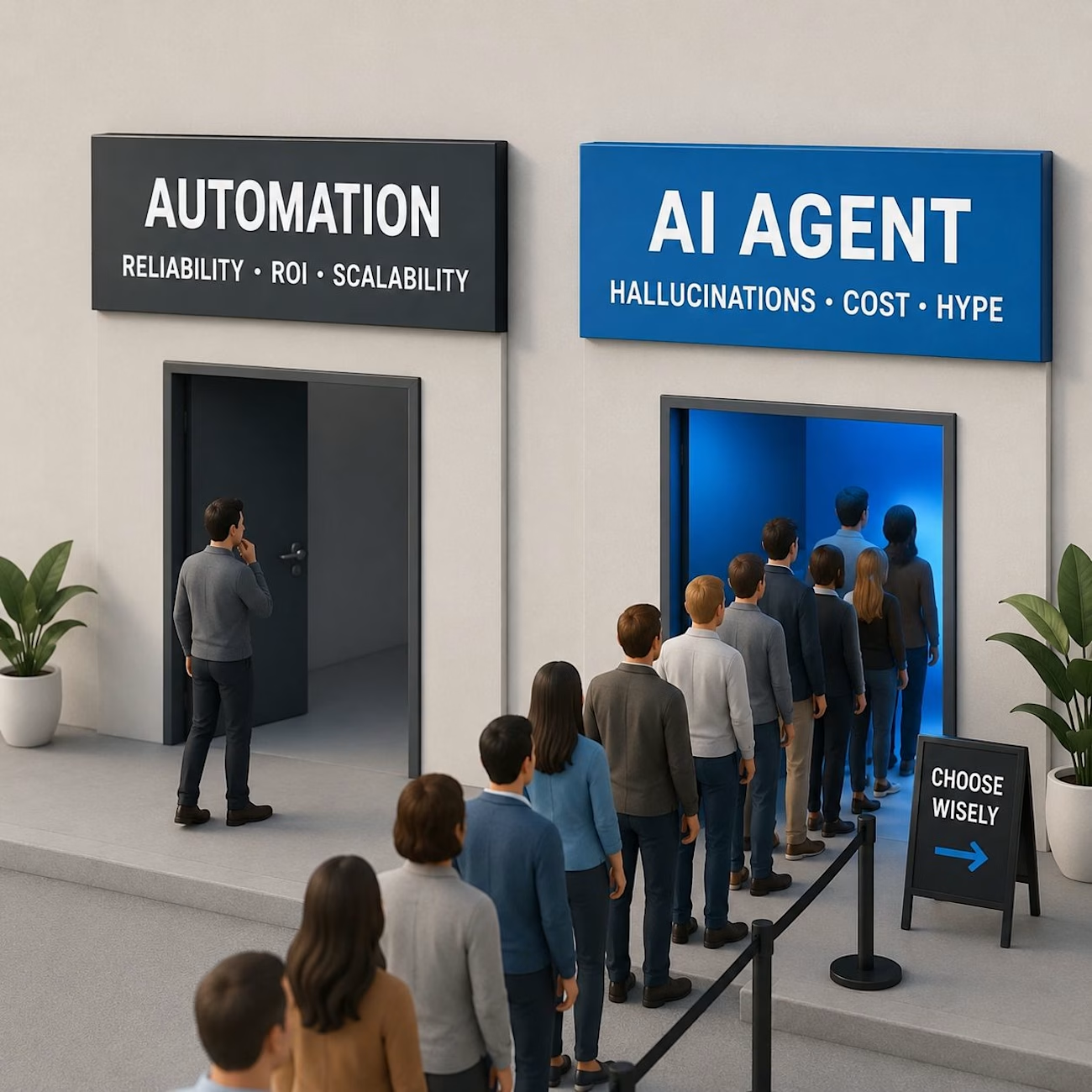
I don't think every business needs an AI agent.
That's probably not the popular opinion these days, but it's the one I've come to after building automation workflows.
A lot of the conversations I have start with the same request:
"We want an AI agent."
So I ask a different question.
"What's slowing your team down today?"
The answers are rarely about AI.
It's usually someone copying information between tools.
Someone sending the same emails every week.
Someone updating spreadsheets by hand.
Or someone chasing people for updates.
Those are workflow problems.
Sometimes a simple automation fixes them.
Sometimes AI is the right next step.
The trick isn't choosing the newest technology.
It's choosing the one that actually solves the problem.
That's why I spend more time understanding the process than deciding which AI model to use.
The technology is important.
The workflow is what people actually live with every day.
What's your view on this?
Do you start with AI, or do you start by fixing the process?