The network for creativity
Join 1.25M professional creatives like you
Connect with clients, get discovered, and run your business 100% commission-free
Creatives on Contra have earned over $150M and we are just getting started
Back to feedPost

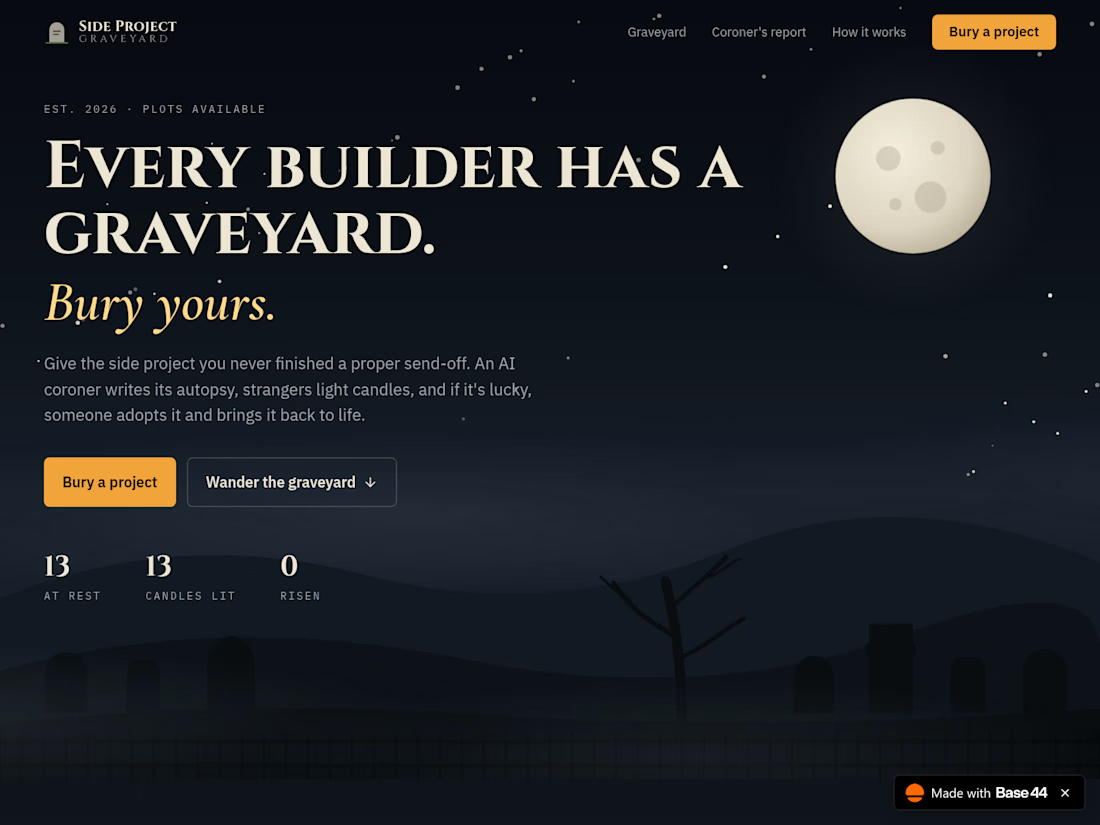
Every builder has a graveyard. This month mine got a new grave.
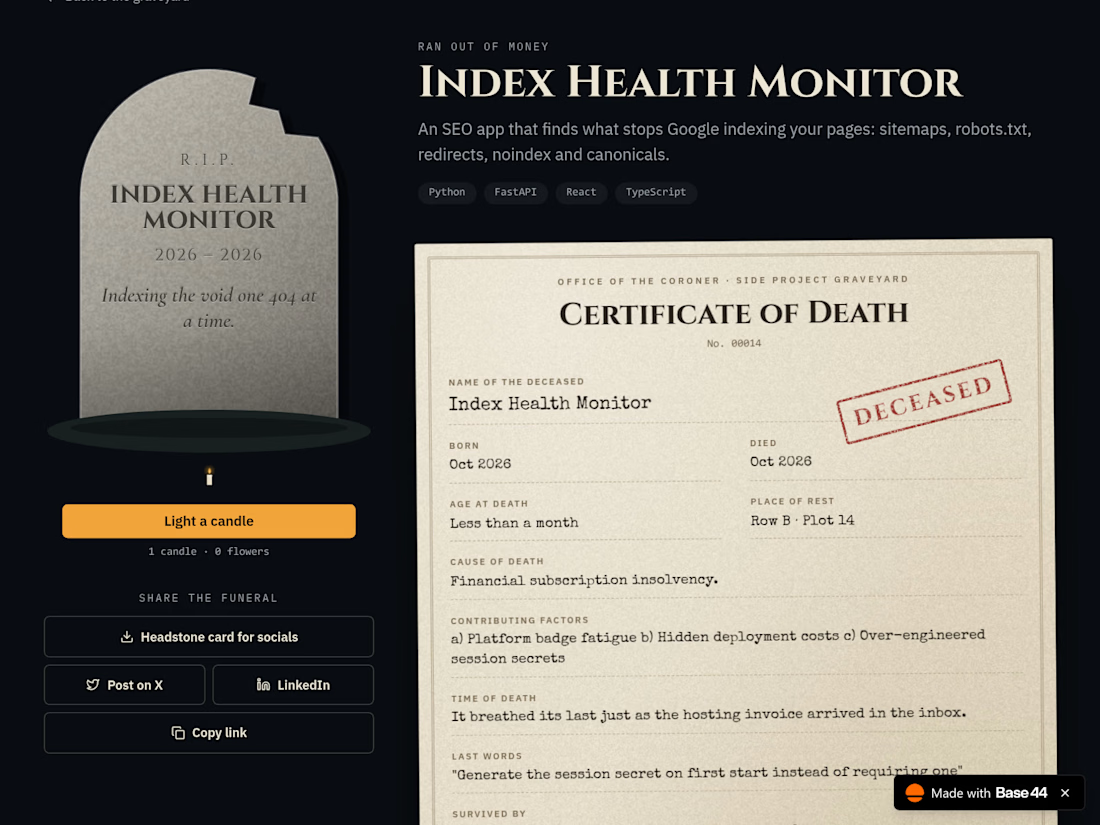
Index Health Monitor was an SEO tool with 59 passing tests. Then I found out publishing it needed a paid plan, and it quietly died on my laptop. Most side projects go that way: they don't fail, they fade.
Side Project Graveyard gives them a proper send-off.
What it does
• Bury a project in two minutes, no account. Its last commit message becomes its last words.
• An AI coroner writes the autopsy: cause of death, contributing factors, time of death, and an epitaph carved into the headstone.
• The death certificate types itself out and gets stamped DECEASED.
• Visitors light candles, leave flowers and sign the guestbook, live for everyone.
• Anyone can offer to adopt a project. The AI writes a handover kit for both builders, the original builder accepts from a private crypt, and the grave is stamped RESURRECTED.
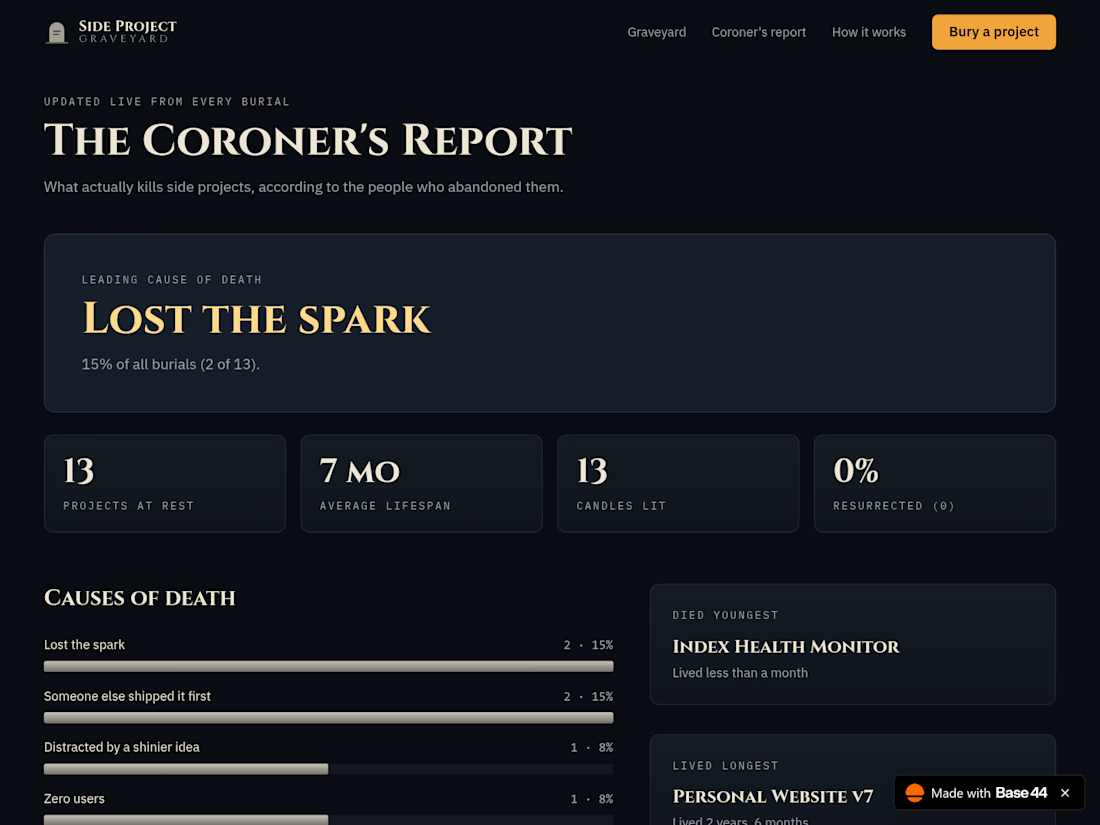
• The Coroner's Report turns every burial into data on what really kills side projects.
The automation: one click runs a whole funeral
Screening with a word filter and AI moderation
The AI autopsy, returned as structured data (InvokeLLM with a JSON schema)
Plot number, headstone, first candle and a private keeper key
A realtime broadcast: the new headstone rises on every open screen
The coroner's stats recalculate
Adoption: AI handover kit, keeper notified by email, resurrection on accept
It runs on Base44's free plan, so every AI call is metered, with hand-written fallbacks when the budget runs out.
Built with Base44:
7 entities with row-level security, 6 backend functions, realtime subscriptions, InvokeLLM and SendEmail. I picked the idea and directed the build; Claude wrote the code in Claude Code and shipped it with the Base44 CLI.

The network for creativity
Join 1.25M professional creatives like you
Connect with clients, get discovered, and run your business 100% commission-free
Creatives on Contra have earned over $150M and we are just getting started
Related posts

Vibe coding looks easy… until your app breaks. 😅
“Just tell AI what you want and it will build it.”
Sounds great.
Until you spend credits asking it to fix the same bug 10 different ways.
Then another feature breaks.
You fix that one.
Something else stops working.
Then you're staring at the same error for hours thinking:
“Why is this still happening?”
That's the part people don't show you about vibe coding.
AI can write code incredibly fast, but fast code doesn't automatically mean good code.
You still need to understand:
→ How the application is structured
→ Where the bug is actually coming from
→ How different features affect each other
→ When an AI-generated solution is making things worse
→ How to debug instead of blindly regenerating code
And sometimes the biggest time killer isn't building a feature.
It's getting stuck on one tiny bug that refuses to die.
That's why I don't see vibe coding as:
“Tell AI what to build.”
I see it as:
Human problem-solving + AI development.
The AI can help you move faster.
But you still need someone who knows where to go when things stop working.
That's where the real skill comes in.
What has been your biggest headache with vibe coding? 👇
— Optimum Studio


the same bug fixed 10 different ways is painfully accurate lol

Most inbound bottlenecks aren't caused by low lead volume—they happen during triage.
When inquiries roll into a Google Sheet or CRM, operations teams often waste 10–15 minutes per submission reading through messy paragraphs, deciphering budget mismatch, and manually deciding who gets an immediate call vs. a standard rate sheet.
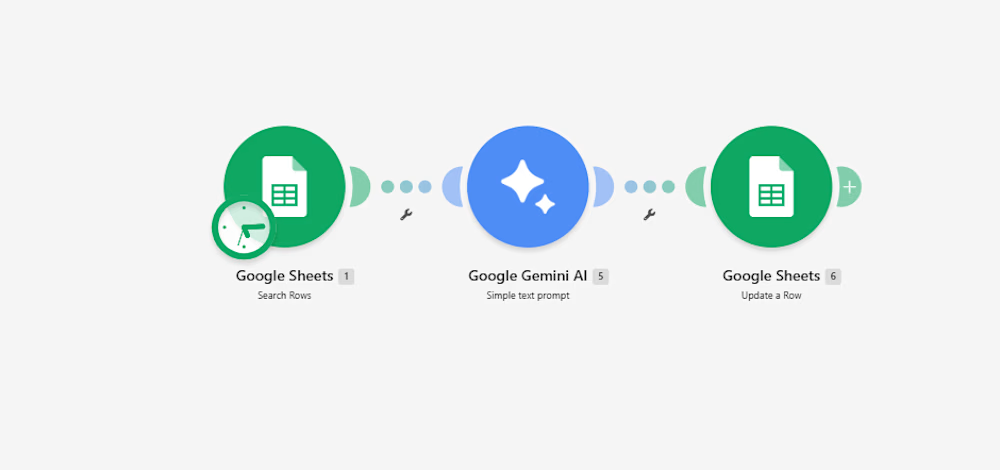
Instead of adding a bulky CRM add-on, I documented a lightweight 3-step automation pipeline built inside Make:
Intake & Extraction: An active listener triggers immediately upon a new submission, extracting core variables: client scope, target deliverables, timeline, and stated budget.
Context-Aware Evaluation (Gemini 2.5 Flash): The payload passes through an AI evaluation node with strict guardrails:
Evaluates budget against minimum agency criteria.
Assigns a triage score: Hot (immediate priority), Warm (nurture), or Cold (disqualified/template reply).
Generates a strict 15-word operational summary—no long paragraphs.
Determines an automated next step (e.g., routing to an account lead or flagging for asynchronous follow-up).
Data Return & Clean Pipeline: Appends the structured classification directly back to the master operational tracker, keeping the sheet filterable and clean.
The outcome: The sales and operations team can filter the entire board by priority status in two clicks, cutting first-touch response time to minutes without manually reading every single submission.
I’ve documented the full scenario map, execution logic, and data schemas below.
Curious how other agency operators and automation leads here handle their lead enrichment layer—are you doing AI scoring at the form level, or later in the CRM pipeline?:


For the budget gate, I'd keep an unstated budget separate from one explicitly below your minimum. Does the Make route ask for clarification when the amount or currency is missing, so a potentially suitable lead doesn't fall into Cold by default?


AdvantageGEO: a Framer site for an agency that gets brands cited by AI search.
The hero opens with a bold claim, SEO is dying.
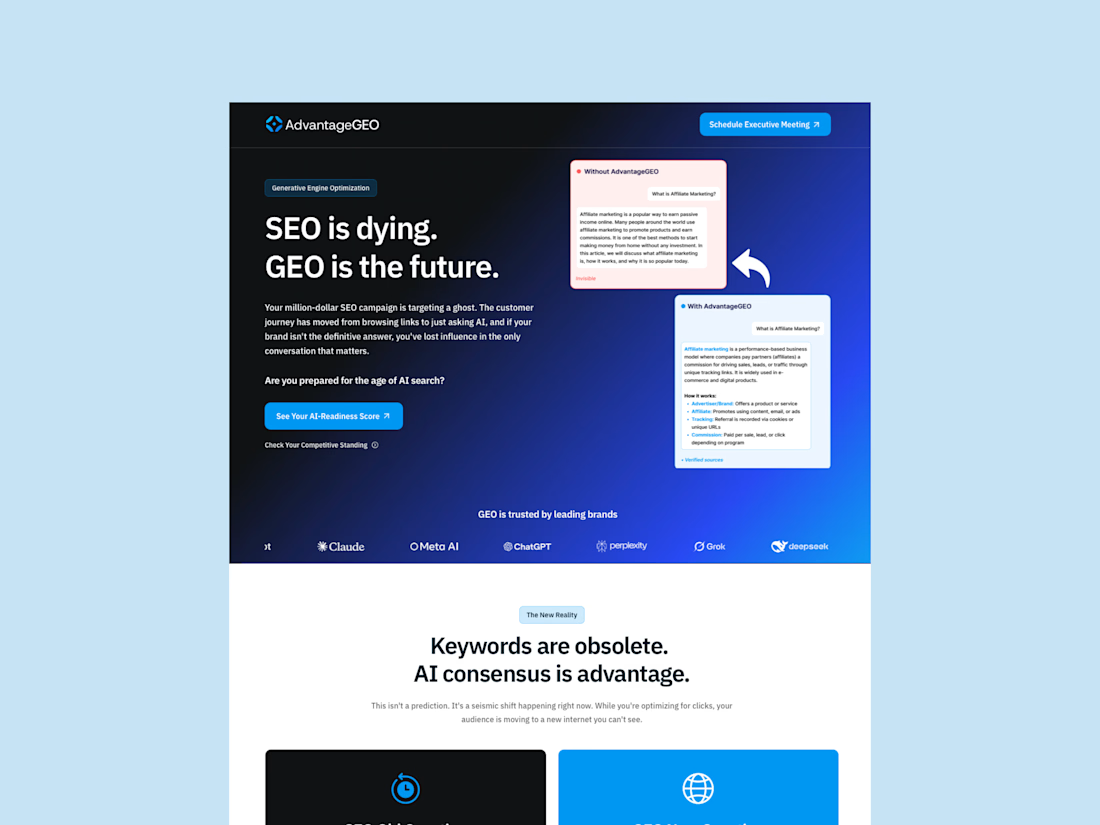

The dark blue hero with the "SEO is dying" headline is a bold opener. The side by side chat cards make the GEO idea easy to get at a glance.