The network for creativity
Join 1.25M professional creatives like you
Connect with clients, get discovered, and run your business 100% commission-free
Creatives on Contra have earned over $150M and we are just getting started
Back to feedPost

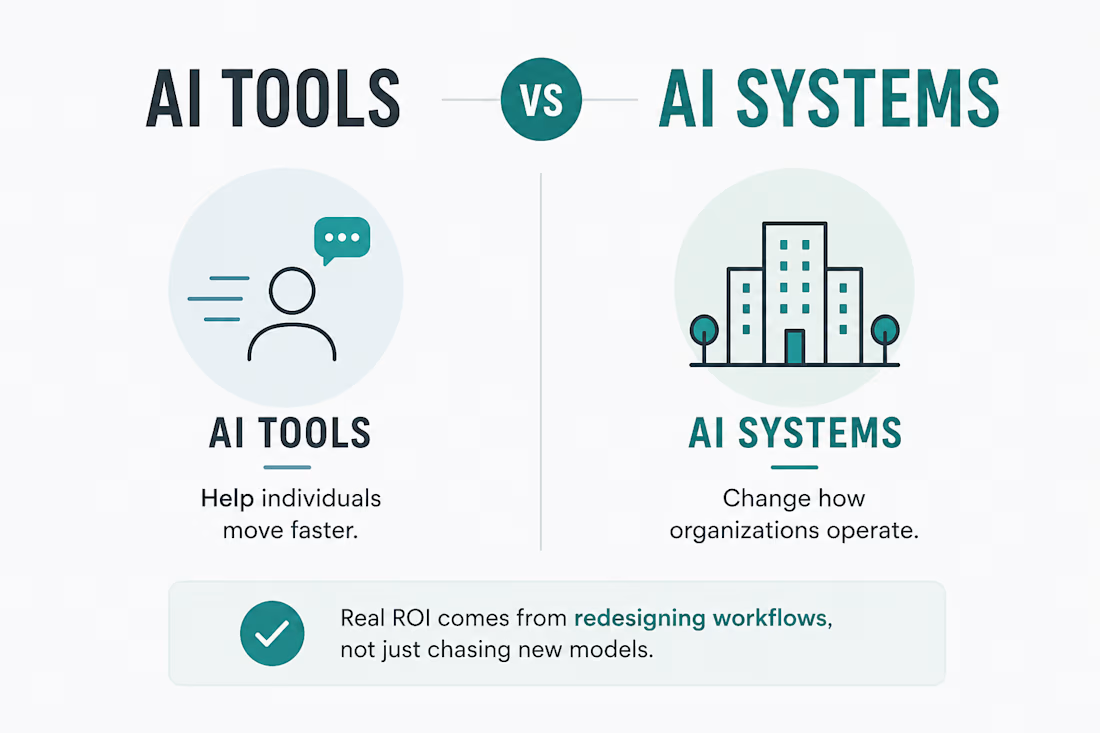
There’s a huge difference between using AI tools and building AI systems.
Most companies still treat them like the same thing.
AI tools help individuals move faster.
AI systems change how organizations operate.
That’s where the real complexity begins.
Because once AI becomes part of production workflows, the conversation changes very quickly.
It’s no longer:
“Which model should we use?”
Now it becomes:
→ How do approvals work?
→ Who handles escalations?
→ What happens when the AI fails?
→ How do permissions work?
→ How do we monitor reliability?
→ What breaks if the workflow goes down?
This is usually the moment companies realize:
AI is not replacing operational complexity.
It’s exposing it.
That’s why production AI ends up requiring:
→ workflow integration
→ governance
→ observability
→ infrastructure planning
→ operational reliability
The teams getting real ROI from AI are usually not the ones chasing every new model release.
They’re the ones redesigning workflows to remove friction across the business.
Feels like workflow design is quietly becoming more valuable than pure model experimentation.
P.S. If you’ve built AI workflows beyond demo stage, curious what became the biggest bottleneck for you.
The network for creativity
Join 1.25M professional creatives like you
Connect with clients, get discovered, and run your business 100% commission-free
Creatives on Contra have earned over $150M and we are just getting started





Related posts

𝐀𝐈 𝐀𝐮𝐭𝐨𝐦𝐚𝐭𝐢𝐨𝐧 & 𝐁𝐮𝐬𝐢𝐧𝐞𝐬𝐬 𝐎𝐩𝐞𝐫𝐚𝐭𝐢𝐨𝐧𝐬 𝐃𝐚𝐬𝐡𝐛𝐨𝐚𝐫𝐝
Atomie™ is a modern AI-powered automation dashboard designed to help businesses simplify complex workflows, reduce repetitive manual work, and make better operational decisions.
The platform brings AI automation, workflow management, performance analytics, and business insights into one clean and intuitive interface. Instead of managing disconnected tools and repetitive processes, teams can use a centralized dashboard to monitor operations, automate tasks, and understand what is happening across their business.
What I Built
AI-powered business automation dashboard
Workflow and task automation interfaces
Real-time performance and operational insights
Clean, responsive dashboard experience
Intuitive navigation for complex business processes
AI-focused UX designed around simplicity and usability
Scalable interface structure for future automation features
The Goal
The main goal was to make advanced AI automation feel simple and accessible. The interface was designed to reduce complexity while giving businesses a clear overview of their workflows, performance, and automation activity.
Atomie™ demonstrates how AI, automation, and modern product design can come together to create a smarter operating experience for growing businesses.
Focus: AI Automation · Business Operations · SaaS Dashboard · Workflow Automation · Product UI/UX · AI Systems


Nice work

We've been having a lot of fun testing AI recently in a brand and web projects.
I'm a big believer in everything we produce is human first and AI assisted to help spin up ideas of enhance our digital presence. Behind the scenes there isn't anything we can't achieve in digital now.
With Claude 5.5, An initial brief and just a few prompts later on a logo animation and I can visualise what I want for my animators and not just have to talk them through a few slides.
Most will say do we even need to improve what claude spits out, but I notice the little things and the little things are why we are always busy.
But this unlock has huge potential for us and our clients.


Good work

AI didn't take my job. It became my business partner.
Every designer I know is asking the same question right now: what's left for us when AI can make something pretty in 10 seconds?
Here's my honest answer, from branding and from product.
The way I work has completely changed. Moodboards, variations, mockups, even clickable prototypes: what used to take days now takes hours.
But here's what nobody says out loud: people are making a lot of pretty things. And pretty doesn't build a brand.
Pretty doesn't tell a stranger why they should trust you.
Pretty doesn't make your offer clear in 5 seconds.
Pretty doesn't fix the screen where users give up.
That part is still on me. It's actually most of my job now.
So I stopped seeing AI as a competitor. It does the drafts, I do the thinking, and my clients get both, faster.
Designers, how has AI changed the way you work this year?

Wonderful presentation and I like your thought you shared