The network for creativity
Join 1.25M professional creatives like you
Connect with clients, get discovered, and run your business 100% commission-free
Creatives on Contra have earned over $150M and we are just getting started
Back to feedPost

3 Bottlenecks Ruining Your SLA Metrics (and How to Fix Them)
In enterprise operations, high resolution times and missed SLAs usually come down to 3 root causes:
Tribal Knowledge: Teams relying on unwritten habits instead of documented SOPs.
Manual Escalations: Tickets sitting in unassigned queues waiting for manual review.
Band-Aid Fixes: Resolving individual tickets without performing Root Cause Analysis (RCA).
By applying Lean Six Sigma DMAIC frameworks and ServiceNow automation, we achieved these results:
• 50% reduction in Mean Time to Resolution (MTTR)
• 77% automated handling via workflow BOTs
• First Contact Resolution (FCR) increased from 30% to 50%+
Are you looking to optimize operational workflows, build an ISO 9001 QMS, or improve SLA compliance? Check out my available Services or send me a direct message!
The network for creativity
Join 1.25M professional creatives like you
Connect with clients, get discovered, and run your business 100% commission-free
Creatives on Contra have earned over $150M and we are just getting started




Related posts

I built Apex Connect—an autonomous AI operations hub for a busy solo roofing contractor in New York.
As a solopreneur, the owner is constantly on-site climbing ladders. This operational bottleneck causes him to miss inbound customer leads, wrestle with text-back-and-forth calendar scheduling, and face a high client no-show rate for property quotes.
This app fixes his business in two massive ways:
Fixes the Front Door: A Customer Portal that automatically triages roof damage. If a user selects "Emergency Storm Damage," the app intelligently unlocks priority, same-day booking slots automatically.
Fixes the Follow-Through: An Owner Dashboard featuring an automated "Follow-Through Queue." It runs background SMS No-Show Guards, tracks quote email follow-ups, and manages a clean lead pipeline completely hands-free.
The application successfully saved the hypothetical small business client 11.4 manual administrative hours in its first week alone.:

Amazing idea Maha! Love how you solved the solo contractor problem. Super clean UI! Best of luck with the challenge 🚀 - from a fellow builder (BizTool Finder)


Building a 4-role real-time SaaS taught me one uncomfortable lesson: the hard part was never the code.
I've been building RestaurantOS — one platform connecting Owner, Kitchen, Waiter, and Cashier in a single live workflow (Table → Order → Kitchen → Serve → Billing → Reports).
The tech stack was the easy part. The real challenge: keeping 4 different roles in sync in real time without any of them stepping on each other's data — a waiter updating a table while the kitchen marks an item ready while the cashier is mid-billing.
That forced decisions most tutorials never cover:
⚡ How much state should live client-side vs. source-of-truth server-side
⚡ What "real-time" actually needs to mean per role (a kitchen screen needs sub-second updates, a report dashboard doesn't)
⚡ Designing failure states — what happens when the waiter's app loses connection mid-order
Currently redesigning the UI/UX layer too (motion, better visual hierarchy) while keeping this real-time core intact.
If you've built multi-role or real-time systems — curious what broke first for you. And if you're a founder who needs something like this built, my DMs are open.


the role based flow is easy to follow. what part was hardest to keep real time?


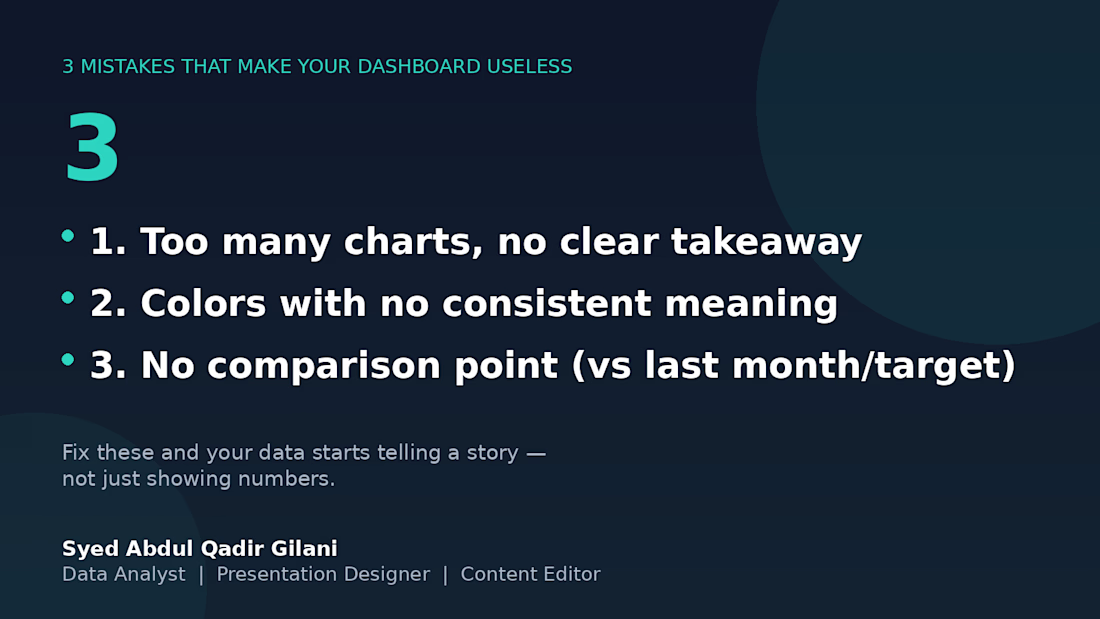
3 mistakes that will eventually make this board useless. 📉
I've reviewed several client dashboards over the years, and the same 3 problems show up over and over:
1️⃣ Too many charts, no clear takeaway — if I can't tell what to do after looking at it, it's decoration, not a dashboard.
2️⃣ Colors with no consistent meaning — red means "unacceptable" on one chart and "category 3" on the next. Pick a system and stick with it.
3️⃣ No comparison point — a number alone means nothing. "Revenue: $12,480" tells you nothing. "Revenue: $12,480 (+18% vs last month)" tells you everything.
Fix these three, and your data stops being numbers on a page — it starts being something people actually use to decide.
What's the most common dashboard mistake you've seen? 👇